
Copper Sequestrant for a 20,000-Gallon Well Water Pool at Opening: Exact Dose
Well water is loaded with copper, iron, and manganese that turn your pool walls green or brown the moment chlorine hits them. A 20,000-gallon pool on well water needs 32 to 48 ounces of a phosphonate-based copper sequestrant at opening, before you add any chlorine. This guide walks through the exact dose, the timing, and what to do if staining has already started.

Copper Sequestrant for a 20,000-Gallon Well Water Pool at Opening: Exact Dose
A 20,000-gallon pool filled with well water needs 32 to 48 ounces (1 to 1.5 quarts) of a phosphonate-based copper sequestrant added before any chlorine enters the water. If your well tests above 0.3 ppm copper, use the full 48-ounce dose. Add it right after filling, run your pump continuously for 24 hours, then introduce chlorine slowly. That sequence is what stands between you and a pool full of green or brown staining.
If you’ve ever filled a pool with well water, dosed a puck or two of trichlor the next morning, and walked out an hour later to find your plaster looking like a swamp, you know exactly why sequestrant timing matters so much. The chlorine isn’t turning the water green. It’s oxidizing copper, iron, and manganese that were dissolved invisibly in your fill water, forcing them out of solution and onto every surface they can reach. This article covers the exact dose for a 20,000-gallon pool, how to time each step, what to watch for, and how to keep metals under control all season long when you’re topping off with well water on a regular basis.
Why Well Water and Pools Are Such a Difficult Combination
Municipal water supplies are treated to keep heavy metals at very low levels. Well water is not. Depending on your aquifer, your well water can carry anywhere from trace amounts up to 2.0 ppm or more of dissolved copper, iron, or manganese, all of which are completely invisible in the bucket but ready to precipitate the moment they encounter an oxidizer. Chlorine is an aggressive oxidizer, which is precisely why it sanitizes. That same chemistry turns dissolved metal ions into metal oxides that plate out as stains.
Copper in pool water above 0.1 ppm is enough to cause tinting on light plaster surfaces. Iron above 0.3 ppm shows up as rust-brown streaks, particularly around return jets where oxidized water flows fastest. Manganese produces dark purple or black staining that is frequently misdiagnosed as algae. A simple metal test kit or a strip capable of reading copper and iron will tell you what you’re dealing with before you fill.
Choosing the Right Sequestrant for Copper
Not all sequestrants are built the same. There are two main chemistry types on the market, and they handle copper very differently.
- Phosphonate-based sequestrants: These are the gold standard for copper and iron. They bind tightly to metal ions and hold them in suspension even as pH and chlorine fluctuate through normal operating ranges. They are stable in chlorinated water up to about 3 to 5 ppm free chlorine and degrade slowly enough to give you meaningful protection for two to four weeks per dose.
- EDTA-based (chelating) agents: These work well for immediate stain treatment and can lift metal deposits back into solution, but they degrade faster in chlorinated water and are less suitable as a preventive maintenance product over a full season.
- Citric acid and ascorbic acid products: These are stain removers, not preventive sequestrants. They are extremely useful for treating existing staining, but they provide very little ongoing protection and can temporarily drop pH.
For a well-water situation where you’re filling and regularly topping off, a phosphonate-based product is the right tool. AquaDoc makes a phosphonate sequestrant that pool owners specifically use for well-water openings because the formula is designed to stay effective across the pH swings that happen in the first 48 to 72 hours after filling.
Calculating the Exact Opening Dose
Most quality phosphonate sequestrants recommend 1 quart (32 ounces) per 20,000 gallons as a starting dose for pools with moderate metal levels. For well water, treat that as a floor, not a target.
Here is how to size your dose based on your copper reading:
- Copper below 0.1 ppm: 32 ounces for 20,000 gallons. This is the minimum effective opening dose even if metals are low, because sequestrant capacity gets used up quickly as it binds to any metals present.
- Copper 0.1 to 0.3 ppm: 40 ounces for 20,000 gallons. At this range you have a real metal load, and the standard dose will be exhausted before you can get your chlorine stable.
- Copper above 0.3 ppm: 48 ounces (1.5 quarts) for 20,000 gallons. High copper from well water requires a larger initial dose to ensure enough sequestrant remains in solution after the metals are bound. If your copper is above 1.0 ppm, consider two separate 24-ounce additions 12 hours apart rather than one large slug so the product can distribute fully.
Say your well water tests at 0.5 ppm copper and you fill a 20,000-gallon pool. That 0.5 ppm represents roughly 83 grams of dissolved copper in your pool. At that level, a standard 32-ounce dose will be largely consumed before you even add your first dose of chlorine, leaving you with no protection buffer when you shock. Use 48 ounces, run the pump for 24 hours before adding any oxidizer, and test copper again at the 24-hour mark to confirm it’s still in solution.
Step-by-Step Opening Protocol for a Well Water Pool
- Step 1: Test your fill water first. Before you add a drop of water, test copper, iron, and manganese with a metal test kit. Write down the numbers. You need them to size your sequestrant dose.
- Step 2: Fill the pool without adding any chemicals. Let the water reach its normal operating level before you treat anything. Adding sequestrant partway through filling while hoses are still running just dilutes the product unevenly.
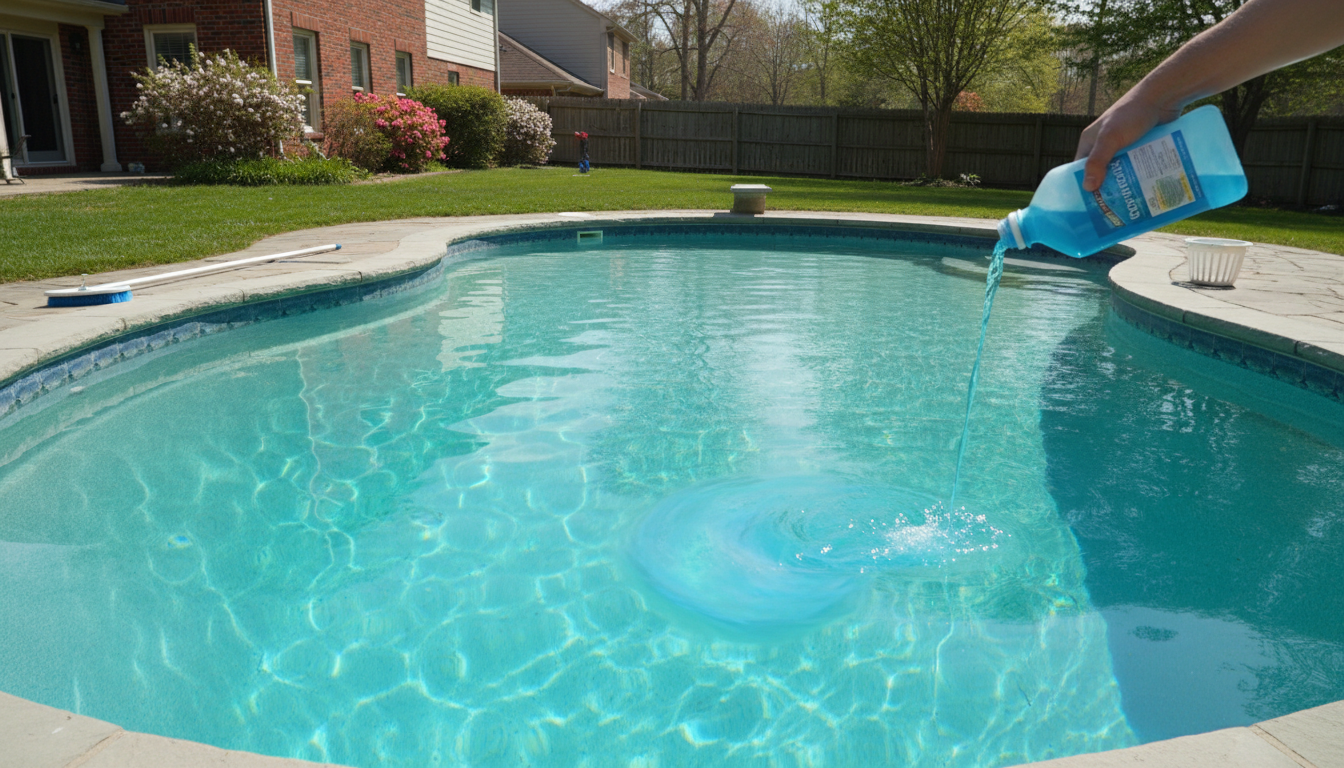
- Step 3: Add sequestrant immediately after filling. Pour it directly into the skimmer or broadcast it around the perimeter with the pump running. Use 32 to 48 ounces based on your copper reading above.
- Step 4: Run the pump continuously for 24 hours. Do not add any chlorine, shock, or oxidizing algaecide during this period. The sequestrant needs time to distribute fully and bind to dissolved metals before an oxidizer forces those metals out of solution.
- Step 5: Balance pH to 7.2 to 7.4. After 24 hours, adjust pH before adding chlorine. Sequestrants work most effectively in a slightly lower pH range, and low pH also makes initial chlorine less likely to cause a rapid oxidation event at the surface.
- Step 6: Raise chlorine slowly. Do not shock on day one. Add liquid chlorine in small doses (half a gallon per 10,000 gallons) every 6 to 8 hours over the first day, checking for color change before each addition. If the water stays clear, raise chlorine normally to your target range of 1 to 3 ppm.
- Step 7: Retest metals at 48 hours. Confirm copper is still in solution and not precipitating. If the water shows any tinting, add another 16 ounces of sequestrant and hold chlorine below 2 ppm for another 24 hours.
Maintenance Dosing Through the Season
Opening dose is not a one-time event when your pool relies on well water for top-offs. Every time you add well water to compensate for evaporation or splash-out, you’re introducing another copper load. Plan to redose with 8 to 16 ounces of sequestrant per 10,000 gallons every two to four weeks, or immediately after any significant top-off of more than a few hundred gallons of well water.
UV light and high chlorine both degrade phosphonate sequestrants over time. In a sunny backyard pool running at 3 ppm free chlorine, expect your sequestrant to last about three weeks before its metal-holding capacity is significantly reduced. If you use an automatic fill valve fed by your well, test for copper in the pool water monthly and add a maintenance dose whenever the reading climbs above 0.1 ppm.
One common mistake is waiting until tinting appears before reapplying sequestrant. By the time you see color in the water, copper has already begun to plate out on surfaces. Keeping a consistent maintenance schedule costs far less than treating staining after the fact. Pool owners whose plaster eventually does require replastering often trace the damage back to seasons of inconsistent metal management (if you’re ever at that point, the breakdown of replastering a 15×30 inground pool with a skimmer and two returns gives a realistic sense of what that investment looks like).
What to Do If Staining Has Already Started
If you added chlorine before sequestrant and you’re now looking at green or brown walls, sequestrant alone will not fix it. The metals are no longer dissolved. They’ve oxidized and bonded to your plaster or liner surface. Here’s the correction sequence:
- Lower chlorine to zero or near zero before treating stains, since an active oxidizer will fight your stain remover.
- Apply an ascorbic acid treatment at roughly 1 pound per 10,000 gallons, broadcast evenly across the surface. Copper stains typically lift within 30 to 60 minutes, turning the water slightly blue-green as metals re-dissolve.
- Add sequestrant immediately at the opening dose (48 ounces for 20,000 gallons) to hold those re-dissolved metals in suspension.
- Raise chlorine very slowly over 48 to 72 hours, testing for re-staining at each step.
This process works well for copper and iron. Manganese staining sometimes requires a different targeted treatment. If you’re unsure which metal caused the staining, a stain identification test (vitamin C rubbed on the surface clears copper stains almost immediately) will point you in the right direction.
Frequently Asked Questions
How much copper sequestrant do I add to a 20,000-gallon pool at opening?
Start with 32 to 48 ounces (1 to 1.5 quarts) of a phosphonate-based sequestrant for a 20,000-gallon pool filled with well water. Add it immediately after filling and before any chlorine touches the water. If your well water copper reading is above 0.3 ppm, use the full 48-ounce dose to ensure you have enough binding capacity remaining when you first introduce chlorine.
What happens if I add chlorine before sequestrant in a well water pool?
Chlorine oxidizes dissolved metals almost instantly, converting them from invisible dissolved ions into visible precipitates that plate onto your walls and floor. The result is green, brown, or black staining that is very difficult to remove without an ascorbic acid treatment or, in severe cases, replastering. Always add sequestrant first, run the pump for at least 24 hours, and then introduce chlorine gradually.
How often do I need to reapply sequestrant in a well water pool?
Sequestrants are consumed over time by binding to metals and by degrading in UV light and chlorine. Plan to reapply at a maintenance dose of 8 to 16 ounces per 10,000 gallons every two to four weeks throughout the season, and immediately after any significant well water top-off. If you use an autofill valve on a well supply, monthly copper testing in the pool will tell you when it’s time to redose.
Can I use a sequestrant if green staining has already appeared on my pool walls?
A sequestrant alone will not remove staining that has already bonded to your plaster or liner. It can prevent additional staining, but the existing discoloration usually requires an ascorbic acid treatment first to lift the metal deposits back into solution, followed immediately by a full sequestrant dose to keep them suspended while you slowly rebuild chlorine levels.
What copper level in well water requires sequestrant before filling a pool?
Any copper reading above 0.1 ppm in your fill water warrants sequestrant treatment before adding chlorine. Well water commonly runs between 0.3 and 1.5 ppm copper, and even 0.2 ppm can produce visible green tinting on light-colored plaster once chlorine is introduced. If you’ve never tested your well water for metals, do it before you fill. It’s a $10 test that can save you from a staining problem that costs hundreds of dollars to fix. If your pool is a newer fiberglass build, the stakes are similar since metals affect gel coat too, as covered in the overview of fiberglass pool resurfacing costs for a 12×24 with a tanning ledge.
For a 20,000-gallon well water pool, the right opening dose of copper sequestrant is 32 to 48 ounces of a phosphonate-based product added before any chlorine, with 48 ounces being the right choice whenever your well tests above 0.3 ppm copper. Get that step right on day one and you’ll spend the rest of the season managing chemistry instead of fighting stains.