How Much Shock Does a 20,000-Gallon Pool Need to Open After a Green Winter?
A 20,000-gallon pool that turned green under a mesh cover over winter needs 6 to 8 lbs of cal hypo shock at opening, sometimes more if the algae is severe. This post walks through how to calculate the right dose, the correct sequence to apply it, and what to expect over the next 48 to 72 hours.

How Much Shock Does a 20,000-Gallon Pool Need to Open After a Green Winter?
A 20,000-gallon pool that turned green under a mesh cover over winter needs 6 to 8 lbs of calcium hypochlorite (68% available chlorine) to open, and that number climbs to 10 to 12 lbs if the water is dark green or already showing black-green patches near the walls. Those figures assume a standard residential inground pool with no stabilizer in the water yet, pH adjusted to 7.2 to 7.4, and a functioning filter ready to run continuously. The sections below walk through how to confirm your dose, the right order to add chemicals, and what to watch for over the first 48 to 72 hours.
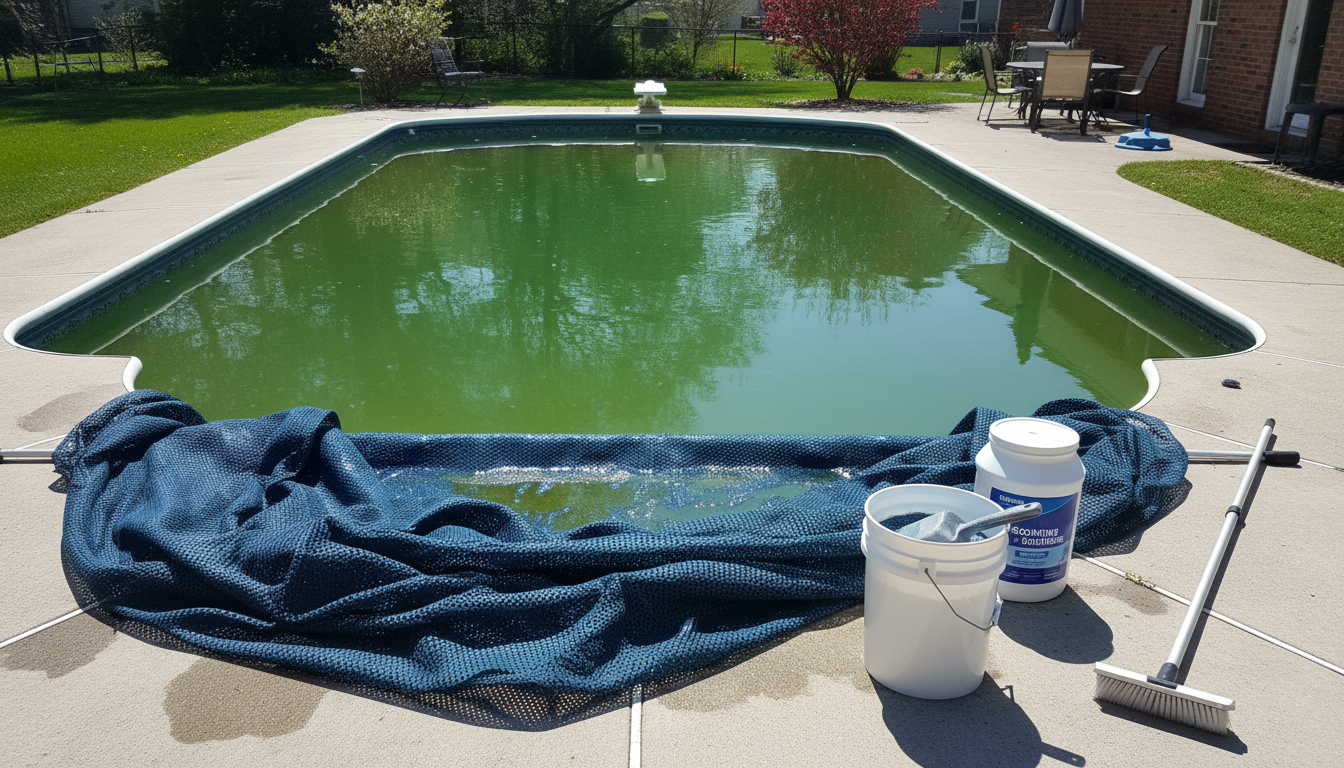
If you’ve ever pulled back a mesh cover in April and been greeted by water the color of pea soup, you know the sinking feeling that comes with it. Mesh covers are popular because they’re light and they handle standing water automatically, but they let sunlight and debris through all winter long. Sunlight drives algae growth even in 45-degree water, and all that leaf debris that rinsed through the mesh fed the algae the whole time. The good news is that a green pool after a mesh-cover winter is a completely solvable problem. You just need the right amount of the right chemical, applied in the right order.
Why Pool Volume and Algae Severity Both Drive the Dose
Standard shock dosing guidelines suggest 1 lb of cal hypo per 10,000 gallons for a maintenance shock on a clean pool. Opening a green pool is not a maintenance situation. You are killing an active algae bloom, which consumes chlorine faster than it can build up. The technical goal is called breakpoint chlorination: pushing free chlorine high enough (typically 10 to 30 ppm) to oxidize the combined chlorine, dead organic matter, and live algae all at once. For a 20,000-gallon pool, that means you need to add chlorine in a volume that temporarily raises the water to those levels despite constant consumption by the algae.
- Light green water (can still see the bottom): 6 lbs of 68% cal hypo applied in one dose. Free chlorine target is roughly 10 to 15 ppm.
- Medium green water (bottom is blurry or barely visible): 8 lbs split into two doses 12 hours apart. Free chlorine target is 15 to 20 ppm.
- Dark green or black-green water (bottom is completely invisible): 10 to 12 lbs over 24 to 48 hours in three to four doses. Free chlorine target is 25 to 30 ppm and you hold there until the water turns gray-blue.
The reason you split heavy doses is practical: dumping 12 lbs of cal hypo at once can spike pH and calcium hardness enough to cause cloudiness or scaling, especially in hard water. Smaller doses every 12 hours let the filter clear dead algae between applications so the chlorine in later doses actually reaches live cells instead of burning through debris.
Step-by-Step Opening Sequence for a Green 20,000-Gallon Pool
- Step 1: Get the pump running and the filter clean. A green pool opening is pointless if the filter is so dirty it cannot process dead algae. Backwash a sand filter, clean a cartridge, or charge a DE filter with fresh media before you add any chemical. Plan to run the pump continuously for at least 72 hours.
- Step 2: Test and adjust pH and alkalinity. Bring pH to 7.2 to 7.4 and total alkalinity to 80 to 120 ppm. Shock at a pH of 7.8 or above loses roughly 60% of its effectiveness, so this step is not optional. Add muriatic acid to lower pH if needed, wait 30 minutes with the pump running, then retest.
- Step 3: Hold off on CYA for now. Do not add stabilizer before killing the algae. CYA binds chlorine and reduces its killing power. You want naked, unbound chlorine working at full strength. Add CYA only after the water clears, targeting 30 to 50 ppm for a standard outdoor pool.
- Step 4: Pre-dissolve the cal hypo. Fill a 5-gallon bucket with pool water, add the cal hypo slowly to the bucket (never the reverse), stir, and pour the slurry around the perimeter of the pool with the pump running. Cal hypo added directly to pool water without pre-dissolving can bleach or etch a vinyl liner or fiberglass surface.
- Step 5: Add a phosphate remover or algaecide after the first shock dose (optional but useful). Algae feeds on phosphates that accumulate in pools that sit under mesh covers all winter. Removing the food source speeds recovery and reduces the chance of re-bloom.
- Step 6: Test every 12 hours and re-dose if chlorine drops to zero. If free chlorine reads zero 12 hours after shocking, the algae is still consuming everything you added. Add another 3 to 4 lbs and keep the pump running. Continue until chlorine holds above 1 ppm for a full 12-hour period.
- Step 7: Brush the walls and floor thoroughly. Algae clings to surfaces even after chlorine kills it. Brushing breaks it loose so the filter can capture it. Do this 24 hours after the first shock and again 48 hours in.
Worked Example: A Light-Green 20,000-Gallon Pool With pH at 7.6
Say your pool holds 20,000 gallons, the water is light green (you can still see the main drain), and your test kit reads pH 7.6, alkalinity 110 ppm, free chlorine 0 ppm, and CYA 20 ppm. Here is exactly what you do. First, add 20 oz of muriatic acid (31.45% concentration) around the perimeter, run the pump for 30 minutes, and retest. pH should now read 7.3. Then pre-dissolve 6 lbs of 68% cal hypo in a bucket and add it at dusk (UV light destroys unprotected chlorine fast, so evening application gives it the whole night to work). Run the pump overnight. By morning, free chlorine should read 5 to 10 ppm and the water should be turning gray-blue. If it is still green and chlorine reads below 2 ppm, add another 3 lbs and run another 12-hour cycle. If it holds above 3 ppm and continues to clear, you are through the hard part. After the water is visually clear, add CYA to reach 40 ppm, let chlorine drift back to 2 to 4 ppm, and the pool is ready to swim.
AquaDoc’s cal hypo shock is formulated at 68% available chlorine, which is the concentration these doses are based on. Products sold at a lower percentage (some retail brands run 47% to 56%) require proportionally more product to hit the same ppm target, so always check the label before measuring.
Common Mistakes That Stall a Green Pool Recovery
- Shocking at high pH: Every point of pH above 7.4 cuts chlorine effectiveness significantly. At pH 8.0, less than 10% of the chlorine you add is in the hypochlorous acid form that actually kills algae. Adjust pH first, every time.
- Running the filter only 8 to 10 hours a day: Dead algae particles are very fine and they need continuous filtration to be removed. A 20,000-gallon pool should run its filter 24 hours a day until the water is clear.
- Adding CYA too early: Stabilizer at 50 ppm can require free chlorine levels of 20 ppm or higher to match the killing power of 5 ppm unstabilized chlorine. Early CYA addition is one of the most common reasons a green pool stalls. For more on how shock can underperform when chemistry is off, the breakdown in understanding pool volume and its effect on chemical dosing is worth revisiting before you calculate.
- Skipping the brush: Brushing is not just aesthetic. Algae under the biofilm layer on walls is shielded from chlorine until you physically break it loose. Skip brushing and you will be re-shocking within a week.
If you want to understand why shock underperforms in general, the full breakdown of common shock mistakes goes deeper on timing, water temperature, and product choice.
Comparing Shock Types for a Green Pool Opening
| Shock Type | Available Chlorine | Raises CYA? | Raises Calcium? | Best Use Case |
|---|---|---|---|---|
| Calcium hypochlorite (cal hypo) | 65 to 78% | No | Yes | Green pool opening, all pool types except vinyl if pre-dissolved |
| Dichlor | 56 to 62% | Yes | No | Maintenance shock, hot tubs, pools with low CYA |
| Trichlor | 90% | Yes (high) | No | Not recommended for opening shock, slow-dissolving |
| Liquid chlorine (sodium hypochlorite) | 10 to 12.5% | No | No | Saltwater pools, pools with elevated calcium, high-volume treatment |
Cal hypo is the standard choice for a green pool opening because its high available chlorine percentage means you need less product by weight to hit breakpoint, and it does not add CYA at a time when you want unrestricted killing power. The calcium bump is worth noting: 6 lbs of cal hypo adds roughly 20 to 25 ppm of calcium to a 20,000-gallon pool. That is not a problem for most pools, but if your calcium hardness is already above 400 ppm going into spring, consider using liquid chlorine instead and simply adding more of it. Once your pool is open and chemistry is balanced, keeping up with routine chemistry is straightforward, and the approach in managing pool chemistry during heavy summer use picks up right where the opening process ends.
Frequently Asked Questions
How much shock does a 20,000-gallon pool need to open after a green winter?
A 20,000-gallon pool with light-to-moderate green water needs 6 to 8 lbs of calcium hypochlorite (68% available chlorine) at opening. If the water is dark green or black-green, plan on 10 to 12 lbs applied in multiple doses over 24 to 48 hours until the water turns gray-blue and chlorine holds above 1 ppm.
Why does a mesh cover cause worse green water than a solid cover?
Mesh covers let sunlight, rain, and airborne debris pass through all winter. Sunlight drives algae growth even in cold water, and organic debris feeds the algae the entire time. A solid or loop-loc cover blocks virtually all light, so pools under solid covers typically open clear or only slightly hazy rather than green.
Should you balance pool chemistry before shocking a green pool?
Adjust pH to 7.2 to 7.4 and alkalinity to 80 to 120 ppm before shocking. Shock is far less effective above pH 7.6, so skipping this step wastes chemical and time. Hold off on raising CYA until after the algae is dead, because high CYA reduces the killing power of the chlorine you need right now.
How long after shocking a green pool can you swim?
Wait until free chlorine drops back to 1 to 3 ppm and the water is visually clear. That typically takes 48 to 72 hours after the final shock dose, depending on water temperature, sun exposure, and filtration run time. Test with a reliable kit before anyone gets in.
What if the pool is still green after shocking twice?
If chlorine is not holding and the water stays green after two full rounds of shock, the most common causes are CYA that climbed too high over previous seasons, pH that drifted above 7.6 before shocking, or a filter too dirty to remove dead algae. Test CYA, recheck pH, clean or backwash the filter, then shock again.
For a 20,000-gallon pool opening green after a mesh-cover winter, start with 6 lbs of cal hypo if the water is light green and scale up to 10 to 12 lbs for severe cases. Adjust pH first, run the filter continuously, skip CYA until the water clears, and re-dose every 12 hours until chlorine holds. That sequence turns most green pools around within 48 to 72 hours.