
Antifreeze for a Pool With a Cleaner Line and In-Floor Pop-Up Heads: Exact Amounts
A pool with a dedicated cleaner line and in-floor pop-up heads has more pipe volume to protect than a standard pool, and each circuit needs antifreeze dosed separately. This guide breaks down exactly how much non-toxic pool antifreeze to pour into each line so nothing cracks over winter. Real numbers, real pipe volumes, no guessing.

Antifreeze for a Pool With a Cleaner Line and In-Floor Pop-Up Heads: Exact Amounts
A pool with a dedicated cleaner line and in-floor pop-up heads needs 1 to 2 quarts of non-toxic pool antifreeze for the cleaner line and 1 quart per 10 feet of pipe per branch circuit for the in-floor system, so most pools of this type require 8 to 16 quarts total across all circuits. That is on top of the standard half-quart per skimmer line you would add regardless of what other equipment you have.
If you have stood on the equipment pad in October staring at four or five plumbing connections and wondered which ones actually need antifreeze and how much, you are not alone. Pools with in-floor pop-up systems are common in Sun Belt states where builders install them as the primary cleaning method, but they winterize very differently from a simple two-return pool. Because the pop-up heads and their branch lines are buried in the pool floor, any freeze damage there means tearing up plaster to fix it. Getting the antifreeze dose right is worth the extra ten minutes.
Why This Pool Configuration Needs More Antifreeze Than Most
A standard pool has a skimmer line, a main drain, and a few return jets. Add a dedicated cleaner line and an in-floor pop-up system and you have doubled or tripled the number of pipe circuits that must be protected. Each circuit is a separate path: when you blow out the lines with a shop vac or compressor, air travels one route at a time. Water left in any branch that the air stream did not fully reach will freeze if temperatures drop below 32 degrees Fahrenheit. Antifreeze is the insurance policy against that leftover water.
In-floor systems are especially vulnerable because the branch circuits fan out under the pool floor. The pop-up heads themselves contain small O-rings and plastic bodies rated for water pressure, not ice expansion. A single freeze event can crack a head body or split a buried PVC tee, and because the pipe is under the plaster, the repair bill climbs fast. This is the same reason that replastering a 15×30 inground pool costs far more than a surface fix: once you are cutting into the shell, everything gets expensive quickly.
How to Calculate Your Total Antifreeze Volume
The formula is straightforward: estimate the volume of water in each pipe circuit after blowing it out, then add enough antifreeze to fill what remains. A 2-inch diameter PVC pipe holds about 0.17 gallons per foot. A 1.5-inch pipe holds about 0.10 gallons per foot. After a thorough blow-out, assume 20 to 30 percent of that volume is still coating pipe walls and sitting in low spots.
Here is a worked example. Say your pool has a dedicated cleaner line running 30 feet of 1.5-inch pipe from the equipment pad to the cleaner port in the wall. That pipe holds about 3 gallons when full; after blowing, roughly 0.6 to 0.9 gallons of water remains. One quart of antifreeze mixed into that residual water is enough to drop the freeze point well below zero degrees Fahrenheit. Use 1.5 quarts if the run is longer than 35 feet or has multiple elbows where water pockets.
For the in-floor pop-up system, count the branch circuits individually. A typical mid-size pool has four to six zones, each running 15 to 25 feet of 1.5-inch pipe from the manifold to the pop-up heads. At one quart per circuit, a six-zone system needs 6 quarts just for the pop-up branches. Add another quart for the main feed line from the pump to the manifold if that segment is longer than 20 feet. Total for the in-floor system alone: 6 to 8 quarts.
Step-by-Step: Winterizing Each Circuit
- Step 1: Lower the water level to below the skimmer mouth and all return fittings, including the cleaner port and any floor pop-up returns.
- Step 2: Blow out the cleaner line from the equipment pad toward the cleaner port until air bubbles steadily at the port for at least 30 seconds.
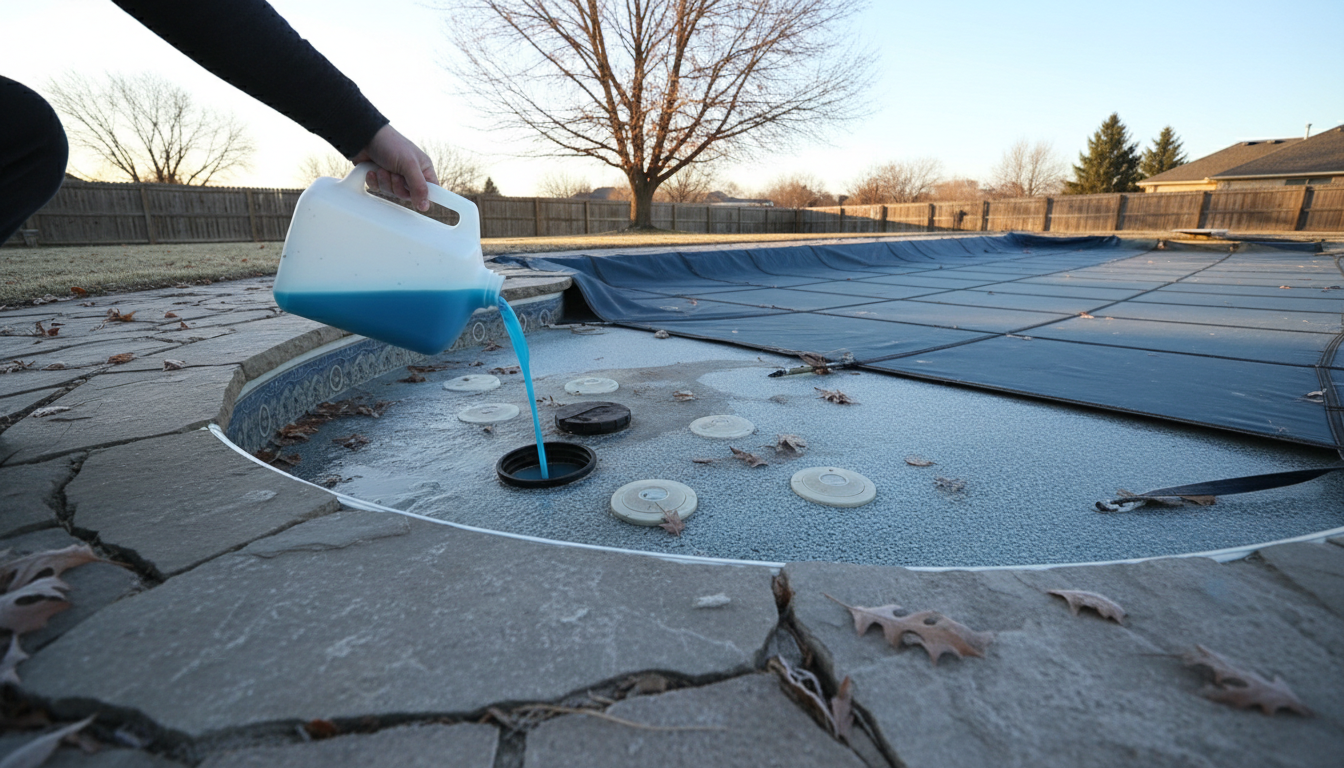
- Step 3: Pour antifreeze into the cleaner line through the skimmer or directly at the port fitting. Use 1 to 2 quarts depending on line length, then plug the cleaner port with a winterizing plug.
- Step 4: Blow out the in-floor feed line from the pump to the manifold. Plug the pump side.
- Step 5: Blow out each pop-up branch circuit individually through the manifold. Many in-floor systems have a winterizing port on the manifold for exactly this purpose. Listen at each pop-up head: you should hear air escaping before the head fully seats.
- Step 6: Pour antifreeze into each branch through the manifold winterizing port. One quart per branch is the standard starting dose. Cap the manifold port when done.
- Step 7: Blow out and plug skimmer lines and standard returns as you normally would, adding half a quart of antifreeze per skimmer.
Choosing the Right Antifreeze
Use only propylene glycol-based, non-toxic pool antifreeze. This type is rated for potable water contact, which matters because residual antifreeze will mix back into your pool water in spring. Look for a product rated to at least -50 degrees Fahrenheit. If you are in a climate where temperatures stay above 15 degrees Fahrenheit, a -30 degree Fahrenheit rating is usually sufficient, but buying the colder-rated version gives you a wider safety margin for the same price difference of a few dollars per jug. AquaDoc makes a propylene glycol pool antifreeze that pool owners use specifically because it carries a -50 degree Fahrenheit rating and is safe for all plumbing materials including the rubber O-rings inside pop-up heads.
Never use automotive antifreeze. Ethylene glycol is toxic to wildlife and humans, and even a small residual amount mixing into 20,000 gallons of pool water is not a situation you want to manage in spring. The price difference between automotive and pool-grade antifreeze is under two dollars per quart. It is not worth the trade-off.
Total Antifreeze Summary by Pool Configuration
| Circuit | Typical Pipe Run | Antifreeze Needed |
|---|---|---|
| Dedicated cleaner line (1.5 in.) | 20 to 40 feet | 1 to 2 quarts |
| In-floor main feed line (2 in.) | 15 to 25 feet | 1 quart |
| Each pop-up branch circuit (1.5 in.) | 15 to 25 feet | 1 quart per branch |
| Skimmer line (1.5 in.) | 10 to 20 feet | 0.5 quarts per skimmer |
| Standard return jets (1.5 in.) | 10 to 20 feet | 0.5 quarts per return |
Why These Differences Matter
The cleaner line and in-floor circuits hold significantly more pipe volume than a single return jet because they run longer distances to reach the pool floor or wall port. A standard return jet might run 8 to 12 feet; a cleaner line or in-floor branch often runs two to three times that length with more elbows where water pools. Using return-jet dosing for these longer circuits is the most common winterizing mistake pool owners make, and it is the one that causes cracked pop-up bodies in January.
Common Mistakes to Avoid
- Skipping the manifold blow-out: Many pool owners blow out from the pump and assume the branches clear automatically. They do not. Each branch needs its own air pass or water stays trapped at the far end near the pop-up head.
- Using too little antifreeze on a long cleaner line: A 40-foot cleaner line run with a single quart is underdosed. Measure the run before closing and use 1.5 to 2 quarts if you are over 30 feet.
- Forgetting the manifold housing itself: The manifold body holds water and can crack if left unprotected. After dosing all branches, pour a half-quart directly into the manifold housing before capping it.
- Pulling the pop-up heads before winterizing: Some owners remove heads thinking it helps drainage. Removing them before blowing out means the air escapes immediately at the head socket and never travels down the branch to clear the pipe.
Frequently Asked Questions
How much antifreeze does a pool with in-floor pop-up heads need?
Plan on 1 quart of non-toxic pool antifreeze per branch circuit for the in-floor system, plus 1 quart for the main feed line. A six-zone in-floor system typically needs 7 quarts for those circuits alone. Add your cleaner line dose (1 to 2 quarts) and skimmer doses on top of that for a combined total of 10 to 16 quarts for the full closing.
Do in-floor pop-up heads need separate antifreeze from the main return lines?
Yes. In-floor pop-up heads are fed by their own manifold and branch lines, which are entirely separate from your standard return jets. Each branch must be blown out and dosed individually. Lumping them in with return jet dosing almost always leaves water trapped in a branch that can freeze and crack the pop-up body or the buried pipe beneath it.
Can I use regular RV antifreeze in my pool cleaner line?
RV antifreeze is typically propylene glycol and is acceptable for pool plumbing as long as it is rated for potable water contact and carries a freeze protection rating of at least -30 degrees Fahrenheit for most climates or -50 degrees Fahrenheit in the coldest zones. Never use automotive antifreeze, which contains ethylene glycol and is toxic to humans and animals.
How much antifreeze goes in a dedicated pool cleaner line?
After blowing out the line, add 1 quart of pool antifreeze for a run up to 30 feet, and 1.5 to 2 quarts for a run of 30 to 50 feet. The cleaner port fitting and any low-point elbows trap residual water even after a good blow-out, so this dose is not optional in freeze climates.
What happens if you skip antifreeze in an in-floor pop-up system?
Water left in a pop-up branch line will freeze, expand, and either crack the PVC pipe or shatter the pop-up head body. Because the branch lines are buried in or under the pool floor, repairs require cutting through plaster and can cost several hundred dollars per break. The antifreeze needed to prevent this costs roughly two to three dollars per quart, making it one of the best value investments in pool winterizing.
A pool with a dedicated cleaner line and in-floor pop-up heads needs 10 to 16 quarts of propylene glycol pool antifreeze in total when you dose each circuit at the right rate. Treat every branch as its own job, and nothing cracks.