
Liquid Chlorine Dosing for a 20,000-Gallon Pool at CYA 70 and 95°F
When CYA is 70 ppm and your pool is baking at 95°F, standard chlorine doses barely move the needle. This guide gives you the exact liquid chlorine amounts, minimum FC targets, and timing strategy to get your 20,000-gallon pool back under control fast.

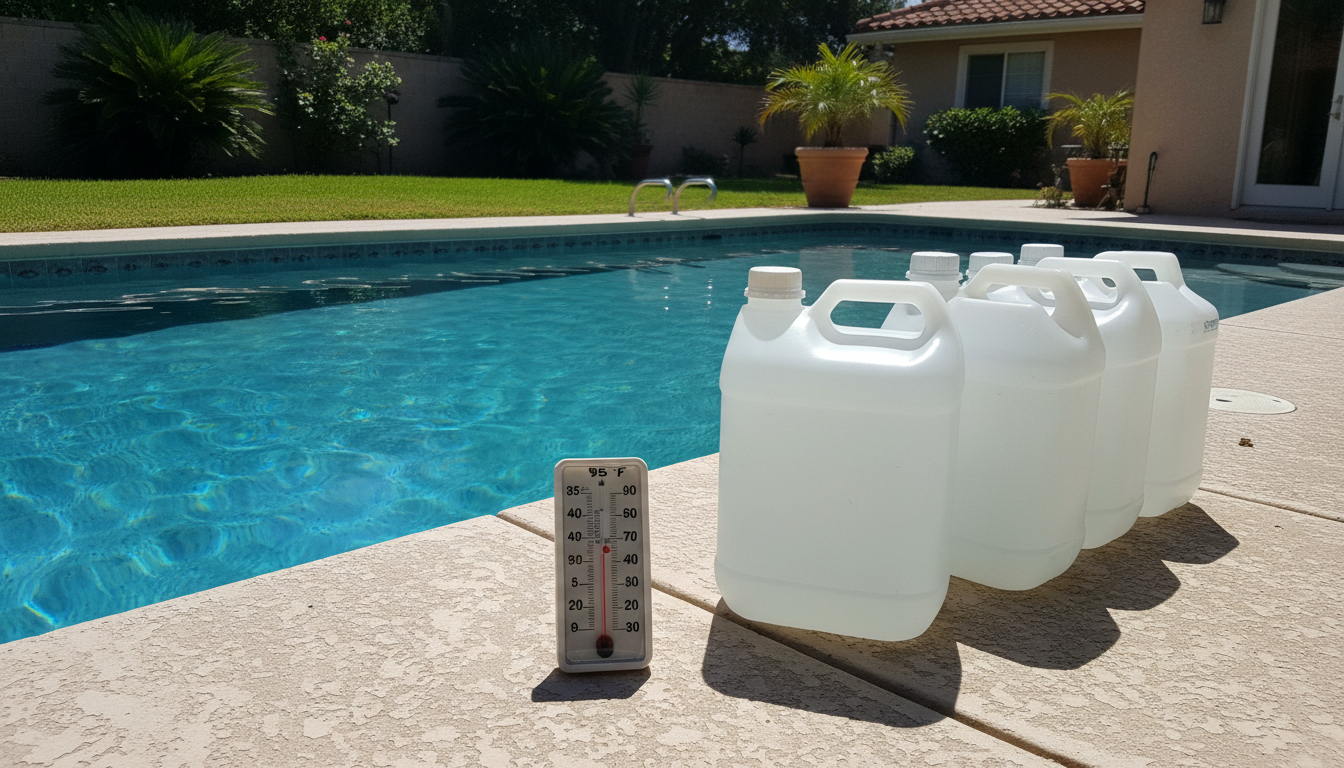
Liquid Chlorine Dosing for a 20,000-Gallon Pool at CYA 70 and 95°F
Raising free chlorine in a 20,000-gallon pool when CYA sits at 70 ppm and the thermometer reads 95°F takes more product than you probably expect. To lift FC by 5 ppm in a 20,000-gallon pool using 10% liquid chlorine, you need roughly 10 gallons added in the evening, with the pump running overnight. That is the short answer, but the reasoning behind it matters as much as the number, because if you skip any part of the logic you will dose, test, and wonder why the chlorine keeps disappearing.
If you have been fighting this battle for a few days, you already know the frustration. You add chlorine, it looks fine the next morning, and by afternoon your test strip shows near zero again. High CYA, intense heat, and heavy bather load are all working against you at the same time. This article walks through the minimum FC target you should be chasing, the exact dose calculation, the shock threshold you may need to hit first, and the timing that makes liquid chlorine last longer in extreme heat.
Why CYA 70 and 95°F Is a Particularly Tough Combination
Cyanuric acid (CYA) protects chlorine from UV breakdown, which is a good thing in reasonable amounts. The problem is that it also reduces the sanitizing power of whatever free chlorine is in the water. At CYA 70 ppm, only a fraction of your FC is in the active, killing form (hypochlorous acid) at any given moment. The widely cited guideline is to keep FC at roughly 7.5% of your CYA level as a minimum. At 70 ppm CYA, that floor is about 5.25 ppm, so target 5 to 6 ppm as your everyday minimum, not the 1 to 3 ppm you might hold when CYA is 30 ppm.
Layer 95°F heat on top of that and chlorine demand accelerates sharply. At that temperature, UV intensity is at its peak, bather evaporation carries organics into the water faster, and chlorine off-gassing increases. Many pool owners at this temperature see 2 to 4 ppm of FC disappear per day even with a mid-range CYA protecting it. That is why a dose that felt adequate in May stops working by July.
Check for Chlorine Demand Before You Dose Normally
Before calculating a routine top-up dose, test whether you have an underlying chlorine demand. Add a small amount of chlorine, wait 30 minutes without bathers, and retest. If FC drops more than 1 ppm in that window, you have combined chlorines or organic contamination consuming product faster than you can add it. That condition is called chlorine demand, and a standard maintenance dose will not fix it. You need breakpoint chlorination first.
Breakpoint in a pool with CYA present is commonly calculated at 30% of your CYA level. At 70 ppm CYA, breakpoint shock target is roughly 21 ppm FC. To hit 21 ppm in a 20,000-gallon pool starting from near zero, you need approximately 42 gallons of 10% liquid chlorine (each gallon raises FC by about 0.5 ppm in 20,000 gallons at that concentration). Cal hypo at 65% is more concentrated: 1 pound raises FC roughly 0.75 ppm per 10,000 gallons, so about 56 pounds total to reach 21 ppm in 20,000 gallons. Use whichever you have, but do not add more CYA-containing products like dichlor or trichlor at this stage.
The Routine Dose Calculation for a 20,000-Gallon Pool
Once you have confirmed there is no underlying demand (or you have already hit breakpoint and FC is holding), the routine math is cleaner. Here is how to work through it:
- Step 1: Know your current FC. Test with a reliable reagent kit, not a color-fade strip, for accuracy at high temperatures. Say your current FC is 2 ppm.
- Step 2: Set your target. At CYA 70 ppm and 95°F, target 6 ppm FC as your daily starting point (high end of the 7.5% rule, with extra buffer for heat loss).
- Step 3: Calculate the rise needed. You need to raise FC by 4 ppm (from 2 to 6).
- Step 4: Convert to product. One gallon of 10% liquid chlorine raises FC by roughly 0.5 ppm in a 20,000-gallon pool. To raise 4 ppm, you need 8 gallons of 10% liquid chlorine.
- Step 5: Add in the evening. Dose after sunset. UV cannot destroy chlorine at night, so more of what you add survives until morning and distributes evenly.
That worked example assumes 10% sodium hypochlorite, the standard pool-grade liquid chlorine sold in jugs. If your product is 12.5%, multiply the gallon count by 0.8 (you need about 6.4 gallons for the same 4 ppm rise). Always check the label concentration before calculating.
Timing and Pump Run Strategy in Extreme Heat
Timing is not a minor detail here. In 95°F weather with high UV, chlorine added at noon can lose 50% or more of its potency within a few hours before it even circulates fully. Add liquid chlorine after 8 p.m. whenever possible. Run the pump continuously through the night so the product distributes evenly, then test at 7 a.m. before the sun is high. If FC is already below 5 ppm by morning, your daily demand is running 1 to 2 ppm higher than your dose, so increase the nightly addition by 2 gallons until morning readings stabilize above 5 ppm.
Keeping up with summer chemistry at this pace can feel relentless, especially in a heat wave. The Summer Pool Chemistry: How to Keep Up When Everyone’s Swimming guide on this site covers the broader maintenance rhythm, including how to adjust dosing schedules when swim traffic spikes.
What to Do About Your CYA Level
CYA at 70 ppm is manageable, but it is at the upper end of the recommended 30 to 70 ppm range. Do not add any more stabilizer this season. More importantly, stop using trichlor tablets as your primary chlorine source. Each tablet adds CYA along with the chlorine, and if your CYA climbs to 90 or 100 ppm, the minimum effective FC target rises to 7 to 8 ppm and your chlorine becomes even less efficient. Liquid chlorine and cal hypo add no CYA, which makes them the right choice for routine dosing when stabilizer is already at the ceiling.
If CYA has drifted above 80 ppm and you want to bring it back down, the only practical fix is a partial drain and refill. Draining 20% of a 20,000-gallon pool (4,000 gallons) and replacing with fresh water will reduce CYA by roughly 20%, dropping 70 ppm to around 56 ppm. That is a meaningful improvement. For a detailed look at how volume and pool dimensions affect your chemical math, Cloudy Pool Water: What’s Causing It and How to Fix It Fast covers water balance issues that often develop alongside high CYA.
Cloudiness After Shocking: What to Expect
If you hit breakpoint and shocked the pool to 21 ppm, expect the water to look milky or hazy for 12 to 24 hours. That is normal: oxidized organics and dead algae particles are suspended in the water. Keep the pump running, do not add a clarifier until FC drops below 10 ppm (clarifiers can react with high chlorine), and retest every 12 hours. AquaDoc liquid chlorine is a product pool owners use in this situation specifically because the 10% concentration makes dosing arithmetic clean and consistent, and the formula includes no stabilizer to push CYA higher.
Once FC holds above 5 ppm for two consecutive mornings without an additional dose, you have beaten the demand and established a stable baseline. From that point, a nightly maintenance dose of 3 to 4 gallons of 10% liquid chlorine should keep a 20,000-gallon pool in range through peak heat.
Frequently Asked Questions
What free chlorine level should I target when CYA is 70 ppm?
With CYA at 70 ppm, target a free chlorine level of at least 5 to 6 ppm for routine sanitation. The commonly used ratio is roughly 7.5% of CYA, which puts your minimum effective FC at about 5.25 ppm. In 95°F heat, stay closer to 6 ppm to have a buffer against daytime burn-off.
How much liquid chlorine does a 20,000-gallon pool need to raise FC by 5 ppm?
Using 10% liquid chlorine, one gallon raises FC by approximately 0.5 ppm in a 20,000-gallon pool. To raise FC by 5 ppm, add 10 gallons. If your product is 12.5%, you need about 8 gallons for the same result. Always confirm the concentration on the label before calculating.
Does 95°F heat really burn off chlorine that fast?
Yes. At 95°F, the combination of UV intensity and heat accelerates chlorine off-gassing and demand significantly. Even with CYA at 70 ppm providing UV protection, many pools in extreme heat lose 2 to 4 ppm of FC per day. That is roughly double the typical burn rate at 75°F, which is why daily dosing becomes essential.
Should I shock my 20,000-gallon pool at CYA 70 ppm before resuming normal dosing?
Yes, if FC has been at or near zero for more than a few hours, chlorine demand from combined chlorines and organic load is likely present. Shock to approximately 21 ppm FC (30% of your 70 ppm CYA) using liquid chlorine or cal hypo, run the pump overnight, and resume routine dosing only after FC holds above 5 ppm on its own.
Can I use trichlor tablets to raise free chlorine when CYA is already at 70 ppm?
Using trichlor at CYA 70 ppm is not recommended. Each tablet contributes 2 to 3 ppm of additional CYA per 10,000 gallons over time, and pushing CYA above 80 to 90 ppm reduces chlorine effectiveness dramatically. Stick with liquid chlorine or cal hypo, neither of which adds stabilizer.
The bottom line: in a 20,000-gallon pool at CYA 70 and 95°F, dose 8 to 10 gallons of 10% liquid chlorine each evening and hold FC between 5 and 6 ppm. If FC will not stay up, shock to 21 ppm first, then resume nightly maintenance from a clean baseline.