
Antifreeze for a Pool With a Heater, Booster Pump, and Six Return Jets: Exact Amounts
A pool with a heater, booster pump, and six return jets needs roughly 2 to 3 gallons of non-toxic pool antifreeze in total, applied line by line. This guide walks through each component, explains how much antifreeze goes where, and covers the most common mistakes that leave pipes vulnerable to freeze damage.

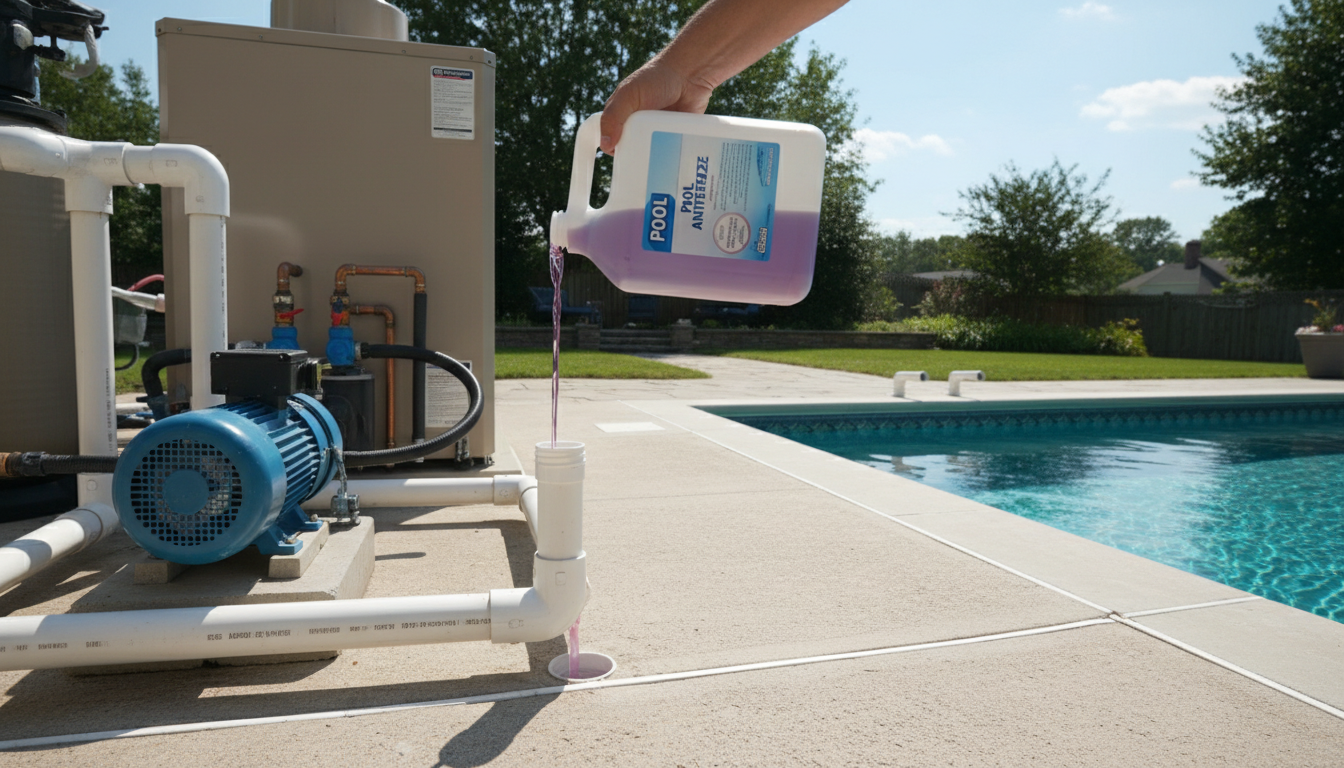
Antifreeze for a Pool With a Heater, Booster Pump, and Six Return Jets: Exact Amounts
A pool system with a heater, a booster pump, and six return jets needs approximately 2 to 3 gallons of non-toxic pool antifreeze in total to winterize correctly, broken down across five distinct component groups: the heater inlet and outlet lines, the booster pump body and cleaner line, the six return lines, the main pump and filter loop, and the skimmer lines. That range exists because run lengths vary from one installation to the next, but the per-component amounts below give you the working numbers to calculate your exact total before you buy.
If you have stood in front of your equipment pad in October staring at a tangle of pipes wondering whether one jug is enough or three is overkill, you are not alone. A standard pool with a simple pump and filter needs far less than a system loaded with a heater, a booster pump running a pressure-side cleaner, and half a dozen returns spread around the shell. Getting the amounts wrong in either direction is a problem: too little and you crack a heat exchanger or a booster pump housing; too much and you are dumping diluted antifreeze into the pool at opening for no extra protection. This guide walks you through each line, with real quart-by-quart numbers, so you can close with confidence.
Why This System Needs More Antifreeze Than a Basic Pool
A basic pool with a single pump, a filter, and four returns might need 1 to 1.5 gallons of antifreeze to close safely. Add a heater with its heat exchanger and bypass ports, a booster pump with its own internal cavity, a dedicated cleaner line, and two extra returns, and you are looking at roughly twice as much pipe volume that needs protection. Each added component is a potential freeze point, and heaters in particular are expensive to repair. A cracked heat exchanger can cost $500 to $1,500 to replace, which makes an extra quart of antifreeze a very easy decision.
Step 1: Blow Out the Lines First
Antifreeze works best as a secondary defense, not a substitute for blowing out. Use a wet/dry shop vac or a compressor set to 30 to 40 PSI to force standing water out of every line before you pour anything. Work from the skimmers and main drain outward through the returns. For the heater, follow your heater manufacturer’s drain procedure, which usually involves opening a drain plug at the bottom of the heater body. For the booster pump, remove the drain plug and let it empty. Once each line is as dry as you can get it, you are ready to add antifreeze to protect whatever water remains.
Step 2: Heater Inlet and Outlet Lines
The pool heater is the most expensive component in this system, and its heat exchanger holds water in bends and chambers that compressed air cannot always clear completely. After draining and blowing, pour 1 quart of pool-grade propylene glycol antifreeze into the heater inlet port and 1 quart into the outlet port. That is 0.5 gallons just for the heater. If your heater has a bypass loop plumbed in, that bypass line needs its own quart. Total for the heater section: 0.5 to 0.75 gallons.
Step 3: Booster Pump and Cleaner Line
A booster pump (the kind that powers a pressure-side automatic cleaner) has an impeller housing and a small internal reservoir that retains water after the drain plug is removed. After draining, pour half a quart into the pump body through the drain plug opening and re-plug loosely, allowing antifreeze to coat the internal cavity. The cleaner line itself, running from the booster pump out to the cleaner port in the wall, typically holds about a quart depending on its length. Add 1 quart to the cleaner line after blowing it out. Total for the booster pump section: 0.5 to 0.75 gallons.
Step 4: Six Return Lines
Each return line runs from your equipment pad to a return fitting in the pool wall, and that run can be anywhere from 10 to 50 feet depending on where the jet is positioned. The standard approach is 1 quart of antifreeze per return line. With six returns, that is 1.5 gallons. Here is the worked example: say your pool has four returns clustered at one end and two at the far end. The two far-end returns have a longer run, perhaps 40 feet each. After blowing, funnel 1.5 quarts down each of those long lines and 1 quart each into the shorter four. Your six-return total comes to roughly 1.5 to 2 gallons, depending on run length.
If your six returns share a manifold or header pipe that runs more than 10 feet before splitting into individual lines, add one extra quart to that shared trunk. The manifold is a low-lying section that traps water and is easy to overlook.
Step 5: Main Pump, Filter, and Skimmer Lines
The main circulation pump, filter, and skimmer lines are part of every pool closing, with or without a heater and booster pump. Add 1 quart per skimmer line after blowing out and dropping in a Gizzmo or skimmer plug. For the main pump and filter loop, drain the pump, remove the drain plugs from the filter, and add half a quart to the pump pot before closing it. Total for this section: 0.5 to 1 gallon, depending on how many skimmers you have.
Total Antifreeze: Putting the Numbers Together
| Component | Antifreeze Needed | Notes |
|---|---|---|
| Heater inlet and outlet | 0.5 to 0.75 gallons | Add extra quart for bypass loop if present |
| Booster pump and cleaner line | 0.5 to 0.75 gallons | Half quart in pump body, 1 quart in cleaner line |
| Six return lines | 1.5 to 2 gallons | 1 to 1.5 quarts per line based on run length |
| Skimmer lines (2 typical) | 0.5 gallons | 1 quart per skimmer after blowing |
| Main pump and filter | 0.25 to 0.5 gallons | Half quart in pump pot, rest in filter loop |
Why These Numbers Matter for Your Purchase
Adding the columns above gives you a total of 3.25 to 4.5 gallons for the full system. Buy four 1-gallon jugs and you will have enough for most installations, with a small buffer in case a long run needs an extra pour. If your cleaner line is unusually long (over 60 feet) or you have three skimmers instead of two, bump your purchase to five gallons. AquaDoc pool antifreeze is formulated as a propylene glycol blend rated to minus 40 degrees Fahrenheit, which is what pool professionals use in freeze-prone climates where temperatures drop hard and fast.
Common Mistakes That Leave Pipes Vulnerable
- Skipping the heater drain plug: Many pool owners blow out lines but forget to open the heater’s physical drain port. The heat exchanger retains a cup or more of water even with a strong air blast, and that water will freeze solid in a hard winter.
- Treating the booster pump like the main pump: The booster pump drains differently from your primary circulation pump. It has a separate drain plug location and needs antifreeze added through that opening specifically, not just poured down the cleaner port.
- Underestimating long return runs: A return line running 50 feet to the far corner of the pool holds significantly more water than a 15-foot line. If you budget 1 quart for all returns equally, the long ones will not be fully protected.
- Using the wrong antifreeze: Never use automotive ethylene glycol antifreeze in a pool system. It is toxic and will contaminate your water. Pool antifreeze is propylene glycol, which is non-toxic and safe for plumbing that connects to a pool shell.
- Not plugging returns before adding antifreeze: If you pour antifreeze into a return line without plugging the jet fitting, it flows straight into the pool. Use threaded winter plugs in every return before you pour.
If you are also trying to figure out the total water volume your system holds (which helps when planning spring chemical doses after opening), the guide on how many gallons a 16×32 above-ground pool holds walks through the volume formulas you need by pool shape and depth.
Frequently Asked Questions
How much antifreeze does a pool with a heater need?
A pool heater typically requires about 1 quart of non-toxic pool antifreeze poured into each port (inlet and outlet) after blowing out and draining. If your heater has a bypass loop, add one more quart for that section. Budget 0.5 to 0.75 gallons for the heater alone, because a cracked heat exchanger costs far more to fix than the antifreeze costs to add.
Do you need antifreeze in a pool booster pump?
Yes. A booster pump has its own internal cavity and impeller housing that retains water after the drain plug is removed. Pour at least half a quart of pool-grade antifreeze into the pump body through the drain plug opening and add 1 quart into the connected cleaner line. Skipping this step is one of the most common causes of a cracked booster pump housing after the first hard freeze.
How much antifreeze do you need for six pool return jets?
Plan on 1 quart of non-toxic pool antifreeze per return line, so six returns require roughly 1.5 gallons total. If your returns share a manifold pipe that runs more than 10 feet before splitting into individual branches, add an extra quart to that trunk. Long runs (over 40 feet) may need 1.5 quarts each to ensure the antifreeze reaches the full length of the pipe.
What type of antifreeze do you use in a pool?
Always use non-toxic propylene glycol pool antifreeze, rated for protection to at least minus 40 degrees Fahrenheit. Never use automotive ethylene glycol antifreeze in a pool system because it is toxic to people, animals, and pool surfaces. Propylene glycol is what pool supply brands formulate specifically for this application.
Can you skip antifreeze if you blow out the pool lines?
Blowing out lines removes most water, but not all of it. Water trapped in low spots, inside valve bodies, or inside a heater heat exchanger can still freeze and crack. Using antifreeze after blowing is cheap insurance, and for a complex system with a heater and booster pump, it is not optional in climates where temperatures consistently drop below 32 degrees Fahrenheit.
For a pool loaded with a heater, a booster pump, and six return jets, budget 3.25 to 4.5 gallons of propylene glycol pool antifreeze and work through each component group one at a time so nothing gets skipped.