
CYA Lost to Backwashing a Sand Filter All Season in a 20,000-Gallon Saltwater Pool
Every backwash cycle flushes pool water out of your sand filter, and that water carries cyanuric acid with it. A 20,000-gallon saltwater pool running a standard sand filter can lose 15 to 30 ppm of CYA over a full swim season from backwashing alone. This post shows you exactly how to calculate that loss and what to do about it.

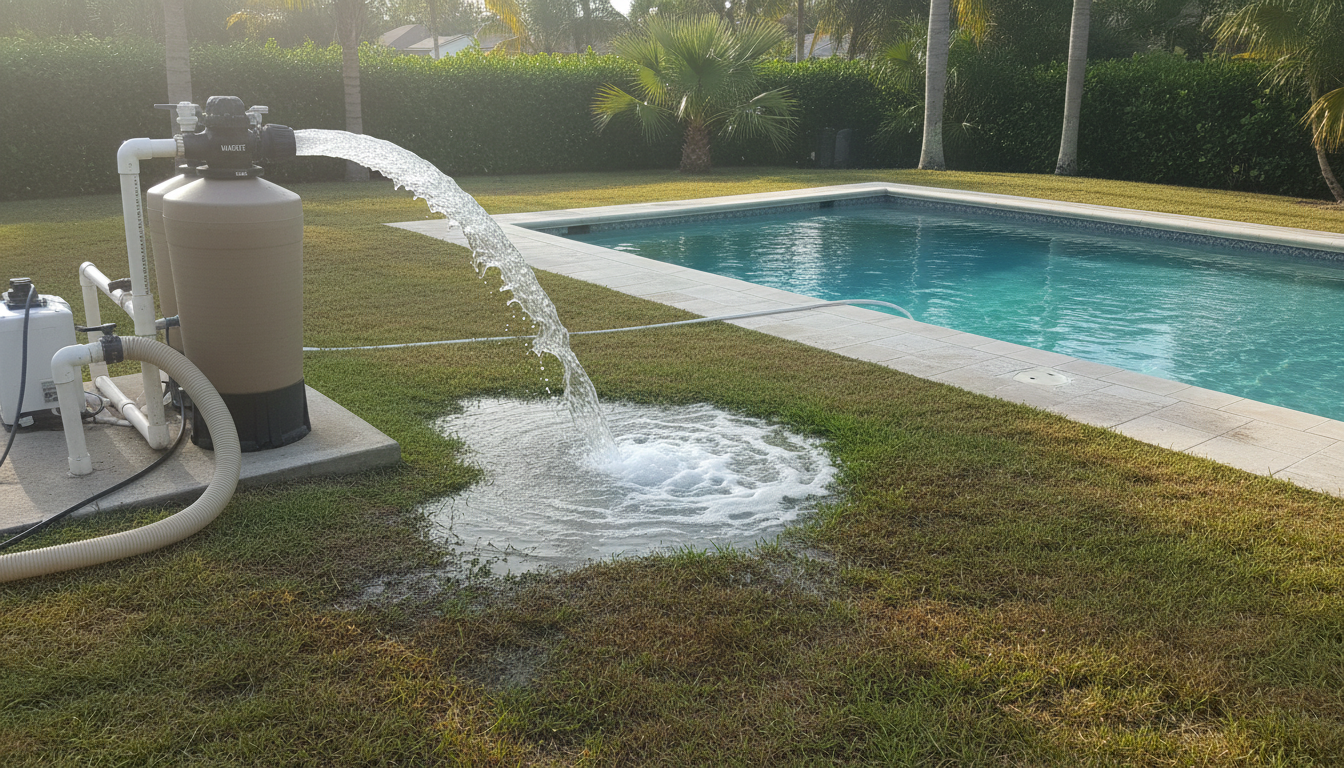
CYA Lost to Backwashing a Sand Filter All Season in a 20,000-Gallon Saltwater Pool
A 20,000-gallon saltwater pool running a standard residential sand filter loses approximately 15 to 30 ppm of cyanuric acid (CYA) over a full swim season from backwashing alone. That range reflects roughly 10 to 20 backwash cycles, each flushing 200 to 300 gallons of pool water to waste. If your CYA started the season at 70 ppm and you have not added any stabilizer since, hitting 45 ppm by Labor Day is not unusual, and that is low enough to hurt chlorine efficiency in a saltwater pool.
If you have ever tested your water in late August and wondered why your stabilizer reading keeps dropping despite never draining the pool, backwashing is usually the culprit. Each cycle removes a small but real slice of your pool water, and every gallon that exits carries dissolved CYA with it. This post walks through how to calculate your actual seasonal loss, shows a full worked example for a 20,000-gallon pool, and tells you how to stay ahead of it without over-treating.
Why Backwashing Removes CYA in the First Place
Cyanuric acid does not bind to sand, get consumed by UV, or break down in the water the way chlorine does. It stays dissolved in solution. When you flip the valve to backwash, water flows backward through the filter media and exits through the waste port, taking every dissolved chemical with it at the same concentration as the pool itself. If your pool sits at 70 ppm CYA, the water leaving your filter during backwash is also carrying 70 ppm CYA. There is no way to filter it out before it goes down the drain.
This matters more for saltwater pools than for pools using trichlor tablets. Trichlor slowly adds CYA with every tablet that dissolves, so there is a passive replenishment mechanism at work. A salt cell produces pure chlorine with no CYA component, so whatever you lose to backwashing, rain overflow, or splash-out is a net reduction with nothing automatically replacing it.
How to Calculate Your Seasonal CYA Loss
The math is simpler than it looks. You need three numbers: how many gallons your filter wastes per backwash cycle, how many times you backwash per season, and your pool volume.
- Find your gallons per cycle. Time your backwash and multiply by your filter’s flow rate. Most residential sand filters running at 50 to 75 GPM for 2 to 3 minutes waste 100 to 225 gallons per cycle. A conservative real-world figure, accounting for the rinse cycle and slight over-runs, is 250 gallons per backwash.
- Count your seasonal backwashes. You should backwash when the pressure gauge reads 8 to 10 PSI above its clean baseline. For a typical 20,000-gallon pool, that works out to roughly 12 to 18 cycles across a 20-week season.
- Calculate total water lost to waste. Multiply cycles by gallons per cycle.
- Find the fraction of pool volume removed. Divide total waste gallons by 20,000.
- Apply that fraction to your starting CYA. Multiply starting CYA by the fraction removed to get your ppm loss.
Worked Example: A Real 20,000-Gallon Season
Say your pool holds 20,000 gallons. You backwash 15 times over the season, each cycle using 250 gallons. That is 3,750 gallons of pool water sent to waste. Divide 3,750 by 20,000 and you get 0.1875, meaning you removed about 18.75 percent of your pool volume over the season. If you started at 70 ppm CYA, multiply 70 by 0.1875 and you get a loss of roughly 13 ppm from backwashing alone.
Now add realistic variables. If you backwash more aggressively (20 cycles at 300 gallons each), that is 6,000 gallons removed, or 30 percent of your pool volume. At a starting CYA of 70 ppm, that is a 21 ppm loss. Combine that with minor splash-out, a heavy rain that overflows the skimmer, and any partial drain for chemistry correction, and landing at 40 to 50 ppm by season’s end is easy to do. For a saltwater pool, the target range is 60 to 80 ppm, so a 20 to 30 ppm loss is not trivial.
What 15 to 30 ppm Lost Actually Means for Chlorine Protection
Free chlorine in a saltwater pool is generated continuously by the salt cell, but it still degrades rapidly under direct UV radiation without adequate CYA to shield it. At 60 ppm CYA, an outdoor pool in full sun can lose most of its free chlorine within a few hours without the salt cell running. Drop CYA to 40 ppm and that window shrinks further, forcing the cell to work harder and potentially shortening its lifespan. The practical result is a pool that looks fine in the morning and turns hazy by afternoon even with the system running correctly.
Saltwater systems are also less forgiving than tablet-fed pools when CYA drifts low because there is no built-in correction. If you are noticing the cell running more frequently than usual or your chlorine readings are inconsistently low, checking CYA before assuming the cell is failing is a smart first step. Reviewing your fall pool maintenance checklist before closing is also a good time to catch CYA drift that accumulated quietly all summer.
How to Offset Seasonal CYA Loss From Backwashing
The fix is simple: test CYA monthly and add granular stabilizer when it drops below 60 ppm. Granular cyanuric acid dissolves slowly, so add it to the skimmer basket with the pump running rather than broadcasting it across the surface. Use this formula to find how much to add:
- Target rise in ppm: Decide how many ppm you need to gain (say, from 55 ppm to 70 ppm is a 15 ppm rise).
- Pounds needed: For a 20,000-gallon pool, 1 pound of granular stabilizer raises CYA by roughly 6 ppm. To gain 15 ppm, you need about 2.5 pounds.
- Addition method: Add it slowly through the skimmer over 20 to 30 minutes with the pump running. Avoid adding more than 10 ppm worth at one time to prevent clouding.
Spreading additions across the season is better than one large dose. Two or three small top-ups of 1 to 1.5 pounds each, spaced 4 to 6 weeks apart, keep CYA stable without risk of overshooting. AquaDoc makes a granular stabilizer designed for exactly this kind of routine maintenance top-up, and it dissolves cleanly without leaving residue in the skimmer basket.
One common mistake is waiting until closing to realize CYA is at 40 ppm and then adding a large slug of stabilizer. Granular CYA can take 2 to 7 days to fully register on a test kit, so a late-season correction may not reflect accurately before you close the pool, leaving you guessing heading into spring.
Backwash Frequency Matters More Than You Think
Over-backwashing is one of the most common sand filter errors pool owners make. Some people backwash on a fixed weekly schedule whether the pressure is elevated or not. If your clean baseline is 12 PSI and you are backwashing at 14 PSI instead of waiting for 20 to 22 PSI, you are sending water (and CYA) to waste unnecessarily and not giving the filter bed enough time to build the debris cake that actually improves filtration. For more on reading your pressure gauge correctly, the guide on sand filter backwash mistakes covers the most common errors in detail.
If you notice the pool losing water volume faster than evaporation explains, it is worth confirming the waste is coming from backwashing and not a plumbing issue. A pool that loses more than a quarter inch per day without any backwashing may have a leak worth investigating.
Seasonal CYA Loss Comparison by Backwash Frequency
| Backwash Cycles per Season | Gallons Wasted (at 250 gal/cycle) | % of Pool Volume Removed | Estimated CYA Loss (starting at 70 ppm) |
|---|---|---|---|
| 8 cycles (light use) | 2,000 gallons | 10% | 7 ppm |
| 12 cycles (average use) | 3,000 gallons | 15% | 10.5 ppm |
| 18 cycles (heavy use / algae events) | 4,500 gallons | 22.5% | 15.75 ppm |
| 24 cycles (over-backwashing) | 6,000 gallons | 30% | 21 ppm |
Why these differences matter: At 8 cycles, the loss is minor enough that one small top-up at mid-season handles it. At 24 cycles, you are looking at a 21 ppm drop from backwashing alone, and if anything else reduces your water level (a heavy rain overflow, for example), you could realistically lose 25 to 30 ppm and fall below the 60 ppm floor for saltwater pools before you notice. The table makes clear that managing backwash frequency is as much a chemistry decision as it is a filtration one.
Frequently Asked Questions
How much CYA does a 20,000-gallon pool lose from backwashing all season?
A 20,000-gallon saltwater pool typically loses between 15 and 30 ppm of cyanuric acid over a full swim season from sand filter backwashing alone. The exact number depends on how often you backwash, how long each cycle runs, and your starting CYA level. Topping up with granular stabilizer two or three times per season is usually enough to stay in the 60 to 80 ppm target range for saltwater pools.
How much water does a sand filter backwash cycle use?
A typical residential sand filter backwash cycle uses 200 to 300 gallons of pool water over a 2 to 3 minute run. Larger filters or longer cycles can push that toward 400 gallons per backwash. Multiply your gallons-per-cycle figure by the number of backwashes you do in a season to get your total seasonal water loss.
What is the correct CYA level for a 20,000-gallon saltwater pool?
For a saltwater pool, the target cyanuric acid range is 60 to 80 ppm. Levels below 60 ppm leave the chlorine your salt cell generates vulnerable to rapid UV degradation, while levels above 90 ppm begin to suppress the effectiveness of free chlorine. Test CYA monthly and after any significant water loss event to stay in that window.
How often should you backwash a sand filter during swim season?
Backwash a sand filter when the pressure gauge reads 8 to 10 PSI above its clean baseline, which typically means every 1 to 4 weeks depending on bather load and debris. Over-backwashing wastes water and chemicals unnecessarily, while under-backwashing reduces flow and filter efficiency. Most residential pools land at roughly 10 to 20 backwash cycles per season.
Does a saltwater pool lose more CYA than a traditional chlorine pool from backwashing?
No, the rate of CYA loss from backwashing is the same regardless of sanitizer type because backwashing simply dilutes the pool water. A saltwater pool does not replenish CYA through its salt cell the way trichlor tablets passively add stabilizer, so the loss feels more pronounced because nothing is automatically replacing what goes down the drain.
The bottom line: a 20,000-gallon saltwater pool loses roughly 15 to 30 ppm of CYA over a full swim season from sand filter backwashing, and staying ahead of that with monthly testing and two or three small stabilizer top-ups per season is all it takes to protect your chlorine and your salt cell all summer long.