
How Much Water to Drain From an Above-Ground Pool With a Vinyl Liner Before Adding a Winter Cover
Draining the wrong amount of water before putting on a winter cover can damage your vinyl liner or sink your cover. This guide gives you exact drain-down numbers for above-ground pools, explains why the target level matters, and walks through the steps to get it right.

How Much Water to Drain From an Above-Ground Pool With a Vinyl Liner Before Adding a Winter Cover
You pull out the winter cover, start reading the instructions, and suddenly realize nobody told you how much water to actually remove before the cover goes on. Drain too little and your skimmer cracks. Drain too much and you risk wrecking the liner itself. It is one of those closing tasks that sounds simple until you are standing there with a pump and no clear answer.
For an above-ground pool with a vinyl liner, the target drain-down is 4 to 6 inches below the bottom of the skimmer opening. That is the number most liner manufacturers and pool pros agree on, and it protects both the skimmer line from freeze damage and the liner from losing the water tension that keeps it seated against the walls. This article walks through why that range exists, how to calculate the actual gallons you are removing, what to do with the return jet, and the mistakes that cost people a liner replacement every winter.
Why the Water Level Matters More Than You Think
A vinyl liner in an above-ground pool is not glued down. It sits in place because water pushes it against the floor and walls from the inside. When you remove too much of that water, the liner loses tension. In cold weather, vinyl becomes stiff and brittle, and a liner that is not held taut by water weight can shrink, develop deep creases, or pull out of the bead track along the top rail. Those creases rarely relax back out when you refill in spring, and a pulled liner often needs full replacement.
On the other side of the problem, leaving the water too high means your skimmer throat stays submerged. Water inside the skimmer body and the plumbing line leading to it will freeze, expand, and crack the skimmer housing or the pipe fittings. Skimmer replacement on an above-ground pool runs $80 to $250 in parts alone, and if the freeze damage extends into the wall of the pool, the repair gets considerably more complicated.
The Right Drain-Down Target: 4 to 6 Inches Below the Skimmer
The 4-to-6-inch rule gives you a margin that keeps the skimmer body above the waterline while still leaving enough water in the pool to hold the liner firmly. After draining, the final water surface should also sit just below the return jet wall fitting so you can plug it cleanly. On most standard above-ground pools, the return fitting and the skimmer opening are within a few inches of each other vertically, so hitting 4 to 6 inches below the skimmer usually takes care of the return at the same time.
If your return fitting sits lower on the wall than your skimmer, drain until the water is below the return first, then confirm you are still within that 4-to-6-inch window below the skimmer. If the return is so low that clearing it would require dropping 8 or more inches below the skimmer, use a freeze plug in the return fitting and do not drain that extra distance. Keeping the liner properly tensioned is more important than fully clearing the return by water level alone.
How Many Gallons You Are Actually Removing
Knowing the gallon count helps you pick the right pump and estimate how long the job takes. For a round above-ground pool, every inch of water depth equals roughly 0.034 times the diameter squared in gallons per inch. That sounds complicated, but the math is fast with real numbers.
Say your pool is a 24-foot round. Multiply 24 by 24 to get 576, then multiply by 0.034 to get about 19.6 gallons per inch of depth. Draining 5 inches means removing roughly 98 gallons per foot of diameter squared, or about 390 gallons from that 24-footer. At the low end (4 inches) you are pulling out about 312 gallons; at the high end (6 inches) it is around 470 gallons. A standard submersible pump rated at 30 to 50 GPM handles that in under 20 minutes.
For an oval pool, multiply the length by the width, then multiply by 0.034 to get gallons per inch, and scale from there. A 15×30 oval comes out to about 15.3 gallons per inch, so a 5-inch drain-down removes roughly 77 gallons. Much smaller job, faster pump-out time.
Step-by-Step: Draining Before the Cover Goes On
- Finish your chemical closing first. Shock the pool, adjust pH to 7.2 to 7.6, and add winterizing algaecide before you touch the water level. Chemicals need to circulate while the pump is still running. If you are unsure about the full chemical prep sequence, the guide on fall pool maintenance before you close covers those steps in order.
- Turn off the pump and filter. Once chemicals have circulated for at least 8 hours, shut down the system. Do not drain with the pump running from the skimmer line or you risk running it dry.
- Use a submersible pump or siphon to lower the water level. Drop a utility pump into the deep end if you have one, or use a garden hose siphon. Aim for the midpoint of your target range: about 5 inches below the skimmer throat.
- Measure with a tape measure, not by eye. Hold the tape against the inside pool wall and measure from the bottom of the skimmer opening down to the water surface. Stop pumping when you hit 4 to 6 inches.
- Plug the skimmer and return fittings. Use expansion plugs sized for your fittings (most above-ground pools use 1.5-inch fittings). AquaDoc makes closing plugs sized for standard above-ground return and skimmer fittings, which pool owners find handy for getting a watertight seal before the cover goes on.
- Add pool antifreeze to the skimmer line if you are in a freeze climate. Pour antifreeze rated for pool plumbing (not automotive antifreeze) into the skimmer body, then cap it. Even with the water level lowered, any residual water trapped in the line needs protection below 32°F.
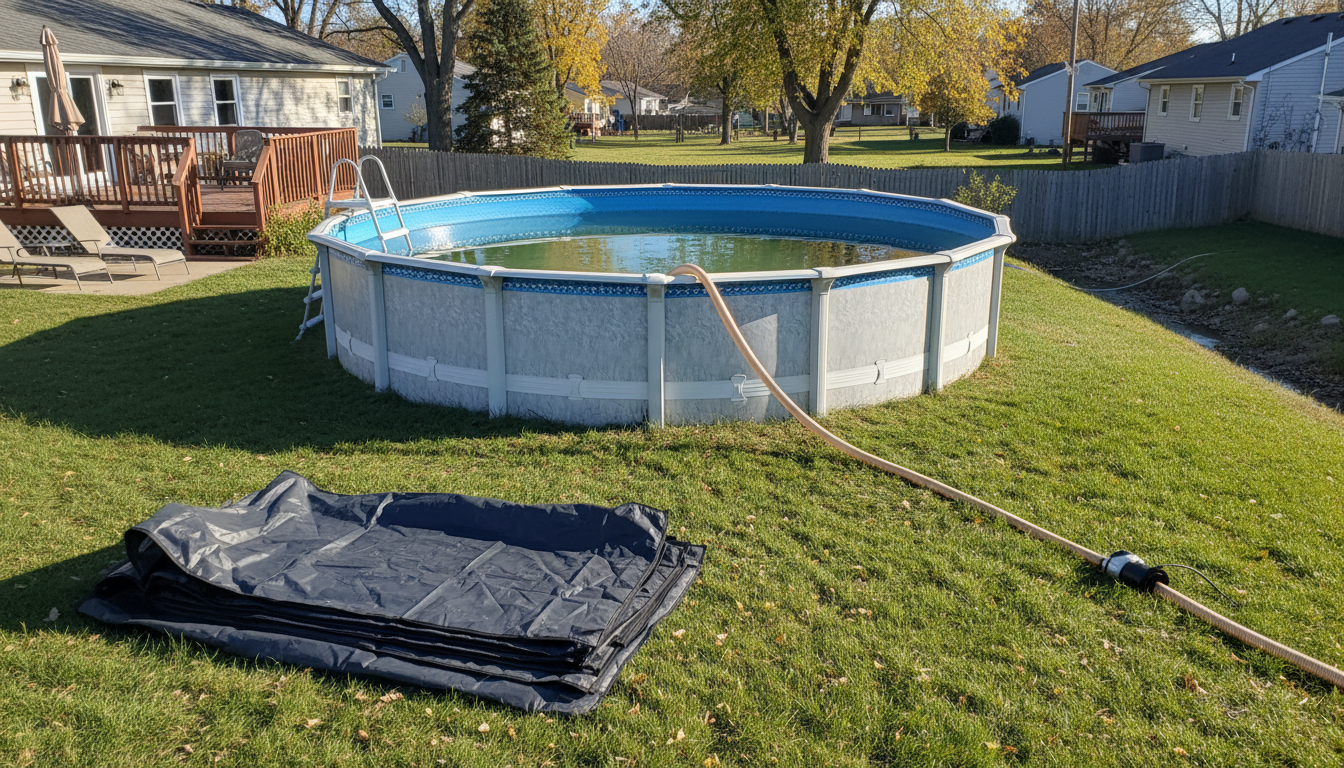
- Install the winter cover. With the water at the correct level, the cover should sit a few inches above the water surface in the center, allowing for rain and snow accumulation without the cover touching the water and sinking in.
Common Mistakes That Damage Liners and Covers
- Draining more than 6 inches: Some owners think lower is safer from a freeze standpoint. It is not. Excess drain-down removes the liner’s support and dramatically increases the risk of shrinkage and crease damage over a cold winter.
- Not measuring at all: Eyeballing the water level against the skimmer is unreliable. The skimmer body extends several inches below the visible opening. Measure from the bottom edge of the throat, not the top.
- Draining after the cover is already on: You cannot accurately measure the water level once the cover is in place. Drain first, confirm the measurement, then cover.
- Skipping freeze plugs: Even with the water level below the skimmer, moisture remains in the skimmer body and line. Without a plug and antifreeze, that moisture freezes and cracks the housing. This is one of the most common and preventable above-ground pool repairs.
- Forgetting the return jet: If the return fitting is still above the final water line and you have not plugged it, cold air can travel back through the line and freeze residual water in the pump or filter. Always plug every fitting that is exposed.
What About Pool Covers That Rest on the Water?
Standard above-ground winter covers (the blue or black tarp-style covers with water bags or clips) are designed to float on or just above the water surface. If you drain too far, the cover sags into the pool and collects debris directly against the liner. If you leave the water too high, rain and snowmelt pile up on the cover with nowhere to go and can pull the cover into the pool entirely. The 4-to-6-inch drain-down range keeps the cover slightly elevated above the water, which is exactly where it performs best through the winter months.
Mesh winter covers require a slightly different approach since they let water pass through, but the drain-down target remains the same for protecting the skimmer and liner. The difference is that you should expect the pool to gain water over winter through the mesh, so starting at 5 inches below the skimmer gives you a bit more buffer before spring overflow becomes a problem.
If your above-ground pool ever needs a liner replacement and you are curious about what structural work looks like on an inground pool at the same closing-season time of year, the breakdown of replastering a 15×30 inground pool with a skimmer and two returns shows how differently plumbing and wall fixtures get handled on a permanent structure.
Frequently Asked Questions
How much water should you drain from an above-ground pool before putting on a winter cover?
For most above-ground pools with a vinyl liner, drain the water down to about 4 to 6 inches below the skimmer opening. That is typically 3 to 6 inches below the top of the pool wall, depending on your skimmer placement. Dropping more than 6 inches risks letting the liner shrink and lose shape over winter.
Can you drain an above-ground vinyl liner pool completely for winter?
No. Never fully drain a vinyl liner above-ground pool for winter. Without water weight holding it in place, the liner can shrink, wrinkle, crack, or pull away from the wall bead track. Even a few thousand gallons left in the pool keeps enough tension to protect the liner through a cold season.
What happens if you drain too much water from a vinyl liner pool before winter?
If you drop the water level too far, the liner loses the water tension that holds it snug against the walls and floor. Cold temperatures then cause the liner material to contract and stiffen, which can create permanent creases or cause the liner to unseat from the top rail bead. Replacement costs for an above-ground vinyl liner typically run $500 to $1,500 or more depending on pool size and liner pattern.
How much water do you drain from a 24-foot round above-ground pool for winter?
On a 24-foot round above-ground pool, draining down 4 to 6 inches removes roughly 310 to 470 gallons. The pool holds about 13,500 gallons at a 4-foot average depth, so you are removing around 2 to 3.5 percent of the total volume, which is enough to protect the skimmer line from freezing without over-stressing the liner.
Should the water level be above or below the return jet when closing an above-ground pool?
The water level should end up below the return jet opening after your drain-down. This lets you plug the return fitting and treat the line without water siphoning back in. For most above-ground pools, that means the final water surface sits roughly 4 to 6 inches below the skimmer throat and just at or below the return wall fitting.
The bottom line is simple: drain to 4 to 6 inches below the skimmer, measure it with a tape, plug every fitting, and your liner and skimmer will both come through winter in solid shape.