
How Much Weight Can a Pool Safety Cover Hold Before It Fails?
A pool safety cover must hold at least 485 pounds by ASTM F1346 standard, but real-world loads from wet leaves, ice sheets, and accumulated snow can test that limit fast. This article breaks down what the rating actually means, what causes covers to fail, and how to stay safe all season.

How Much Weight Can a Pool Safety Cover Hold Before It Fails?
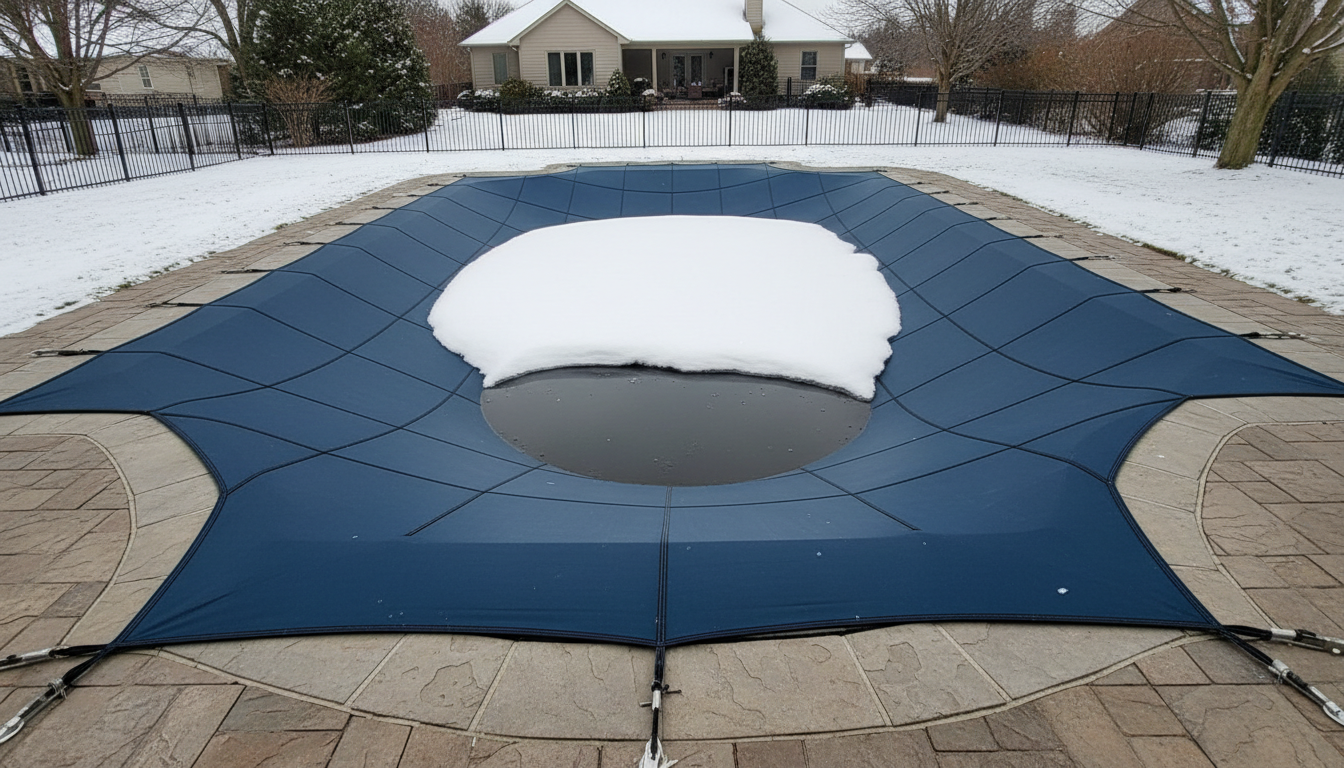
You pull back the curtain one morning after a rough February storm and there it is: your pool safety cover sagging under a sheet of ice and a foot of wet snow, anchors straining, water pooling in the center. The obvious question hits you: how much weight is this thing actually rated to hold, and am I about to find out the hard way?
A pool safety cover certified to ASTM F1346 must support a minimum static load of 485 pounds (220 kg) applied at a single point, but that number is a floor, not a ceiling, and many quality covers are rated significantly higher. This article walks through what that rating really means, how real winter loads stack up against it, what causes covers to fail, and what you can do to stay inside safe limits all season.
What the ASTM F1346 Standard Actually Requires
ASTM F1346 is the safety standard that separates a true safety cover from a plain winter tarp. To earn that certification, a cover must pass three tests: it has to support 485 pounds at any single point without collapse, it has to allow a trapped person to get out of the pool unaided (no cover should trap someone underneath), and it has to prevent a 60-pound weight from passing through any gap. That 485-pound point load is the benchmark most people cite, but the whole-cover distributed load rating is usually much higher. Many residential mesh safety covers are rated to 2,000 to 4,000 pounds total across their surface area, and commercial pool covers sometimes exceed 4,000 pounds. When you shop for a cover, look for both the ASTM F1346 label and the manufacturer’s distributed load rating printed on the spec sheet. They are different numbers that tell you different things.
How Heavy Do Real Winter Loads Actually Get?
This is where the math gets sobering. Snow weight varies dramatically by moisture content. Fresh powder weighs roughly 5 pounds per square foot at a 6-inch depth. Wet, dense snow after a freeze-thaw cycle can hit 20 pounds per square foot at the same depth. Ice is even heavier at around 57 pounds per cubic foot.
Say you have a standard 16×32 pool. The cover surface is roughly 512 square feet once you account for deck overlap. Six inches of wet spring snow at 15 pounds per square foot puts roughly 7,680 pounds across that cover. Even distributed evenly, that is well above the point-load minimum and will test even a well-rated cover if the weight concentrates in the center due to sag. A cover anchored tightly with no sag distributes load more evenly toward the edges and anchors. A cover with slack lets weight pile at the lowest point, multiplying the stress on the fabric and hardware at that spot.
Standing water adds up fast too. One inch of water across a 512-square-foot cover weighs about 267 pounds. At 3 inches of standing water, you are pushing 800 pounds concentrated at the low spot. That is why a submersible pump parked at the center of your cover is not optional in wet climates.
The Two Things That Actually Fail First
When a safety cover fails, the fabric rarely rips first. The weak points are almost always the anchors and the strap hardware connecting the cover to them.
- Anchor pullout: Brass or stainless deck anchors are set into drilled holes and secured with an expanding mechanism. If the concrete around the anchor is old, cracked, or was poured shallow, the anchor can pull free under a heavy load. Covers are typically anchored every 3 to 5 feet around the perimeter. When one anchor fails, its load transfers instantly to the neighbors, which can trigger a chain failure.
- Strap and buckle failure: The straps and spring-loaded buckles that connect the cover to each anchor are often the lowest-rated components in the system. Buckles rated to 300 to 400 pounds of tension are common on mid-range covers. If the cover sags and concentrates load on a corner strap, that buckle can fail before the fabric does.
- Seam and grommet tearing: Fabric failure almost always starts at a seam or grommet eyelet rather than in the middle of a panel. Manufacturers reinforce these points, but UV degradation and age reduce that strength significantly over time. Most manufacturers rate cover lifespan at 10 to 15 years, but UV exposure, chemical contact, and mechanical stress from heavy loads can cut that short.
Mesh vs. Solid Covers: Does Cover Type Change the Load Limit?
| Cover Type | Typical Load Rating | Water Drainage | Ice Risk | Average Lifespan |
|---|---|---|---|---|
| Mesh safety cover | 2,000 to 4,000 lbs distributed | Drains through fabric | Lower (water passes through) | 10 to 15 years |
| Solid safety cover | 2,000 to 3,500 lbs distributed | Requires pump | Higher (water pools and freezes) | 8 to 12 years |
| Standard winter tarp | Not rated (no ASTM cert) | Requires pump or drains off edge | High | 1 to 5 years |
Why These Differences Matter for Your Winter Strategy
Mesh covers let rainwater and meltwater pass through into the pool rather than pooling on top, which means you will rarely face the 800-plus-pound standing water scenario described above. The tradeoff is that fine debris and some algae-feeding nutrients get into the pool water all winter, so your spring opening chemistry will need more attention. Solid covers block debris completely but trap every drop of precipitation on their surface, making a submersible pump mandatory in any climate that gets rain or significant snowfall. If you are wrestling with what your spring water chemistry will look like after a mesh cover season, the guide on fall pool maintenance before you close covers the chemical prep steps that will make your opening much easier.
AquaDoc makes a winter closing kit that includes a sequestering agent specifically for pools using mesh covers, where minerals and staining agents slowly accumulate through the winter. It is a practical addition if you have a mesh cover and hard source water.
Common Mistakes That Push Covers Past Their Limits
Even a well-made cover can fail early if you make these errors. Pool owners see them every season.
- Skipping anchor inspection: Anchors should be checked each fall before the cover goes on. A loose or corroded anchor you ignore in October becomes a pulled anchor in January under a heavy snow load.
- Using the wrong spring tension: Cover springs come in multiple tension ratings. Using a spring that is too stiff pulls the cover tight, which looks good but creates high strap tension even before any load is applied. Manufacturers specify the correct spring for the cover model; use it.
- Letting debris accumulate: Wet leaves weigh roughly 25 to 50 pounds per cubic foot when compacted. A thick mat of leaves across a large cover can add hundreds of pounds before you even factor in rain soaking into that mat. Clear leaves from the cover surface every few weeks through fall.
- Ignoring the cover’s age: A 14-year-old cover may technically be intact but has lost significant tensile strength at seams and grommets from UV exposure. The load rating printed on the spec sheet assumes a cover in good condition, not one that has been cooking in the sun for a decade.
Keeping the Load Inside Safe Limits All Season
Managing the load on your cover is an active job through winter, not a set-it-and-forget-it situation. Remove standing water once it reaches 2 to 3 inches deep. Clear snow after any storm that drops more than 4 to 6 inches, especially if temperatures are hovering near freezing and the snow is wet. Use a soft roof rake or push broom to move snow toward the edges rather than lifting it, which avoids point-loading the center. Inspect straps and anchors after any major storm. A cover that passed inspection in October may have a loosened anchor by February after freeze-thaw cycling in the deck concrete. And keeping your deck drains clear matters too: water that cannot run off the deck migrates under the cover edge and adds to the pooling problem. While you are thinking about pool safety this season, it is worth reviewing how to maintain pool drain covers for safety, since drain covers are another overlooked safety component that need seasonal attention.
Frequently Asked Questions
How much weight can a pool safety cover hold?
By ASTM F1346 standard, a certified pool safety cover must support a minimum static load of 485 pounds applied at a single point. High-end residential and commercial-grade covers are rated to 2,000 to 4,000 pounds or more across the full surface. Always check the manufacturer’s distributed load rating on the spec sheet, not just the ASTM label, because the two numbers measure different things.
What happens when a pool safety cover fails?
The most common failure modes are anchor pullout from the deck, buckle failure at the strap hardware, or fabric tearing at a seam or grommet eyelet. These failures rarely happen slowly: when one anchor or buckle goes, its load transfers to adjacent attachment points and the failure cascades quickly. Whatever is on the cover at that moment drops straight into the water.
How much does snow weigh on a pool cover?
Fresh powder snow weighs roughly 5 pounds per square foot at a 6-inch depth, but wet compacted snow can reach 20 pounds per square foot at the same depth. On a 16×32 pool with 6 inches of wet snow, the total load can exceed 6,000 pounds. If the cover sags and concentrates that weight at the center, the stress on the fabric and anchors at that point multiplies significantly.
Should I remove standing water or snow from my safety cover?
Yes, remove standing water once it reaches 2 to 3 inches deep and clear heavy snow after any significant storm. A submersible pump placed at the low point of the cover handles meltwater automatically through a wet winter. Letting water pool in the center dramatically increases the concentrated load and accelerates wear on the fabric and anchors at that spot.
What size pool safety cover do I need for a 16×32 pool?
For a 16×32 inground pool you need a cover that is at least 20×36 feet so there is enough material to reach and anchor into the deck on all sides, typically 2 to 4 feet of overlap per side. Always confirm your pool’s exact shape and anchor spacing before ordering, since irregular steps or benches can require a custom-cut cover to maintain proper anchor placement and load distribution.