
Pool Heater Running Cost All Season: By Fuel Type and Pool Size
Running a pool heater all season is one of the biggest ongoing costs a pool owner faces, and the number swings wildly depending on fuel type and pool size. This post breaks down real seasonal cost estimates for gas, propane, electric heat pump, and solar heaters across pools ranging from 10,000 to 30,000 gallons. Use the worked examples and comparison table to figure out what your heater is actually costing you.

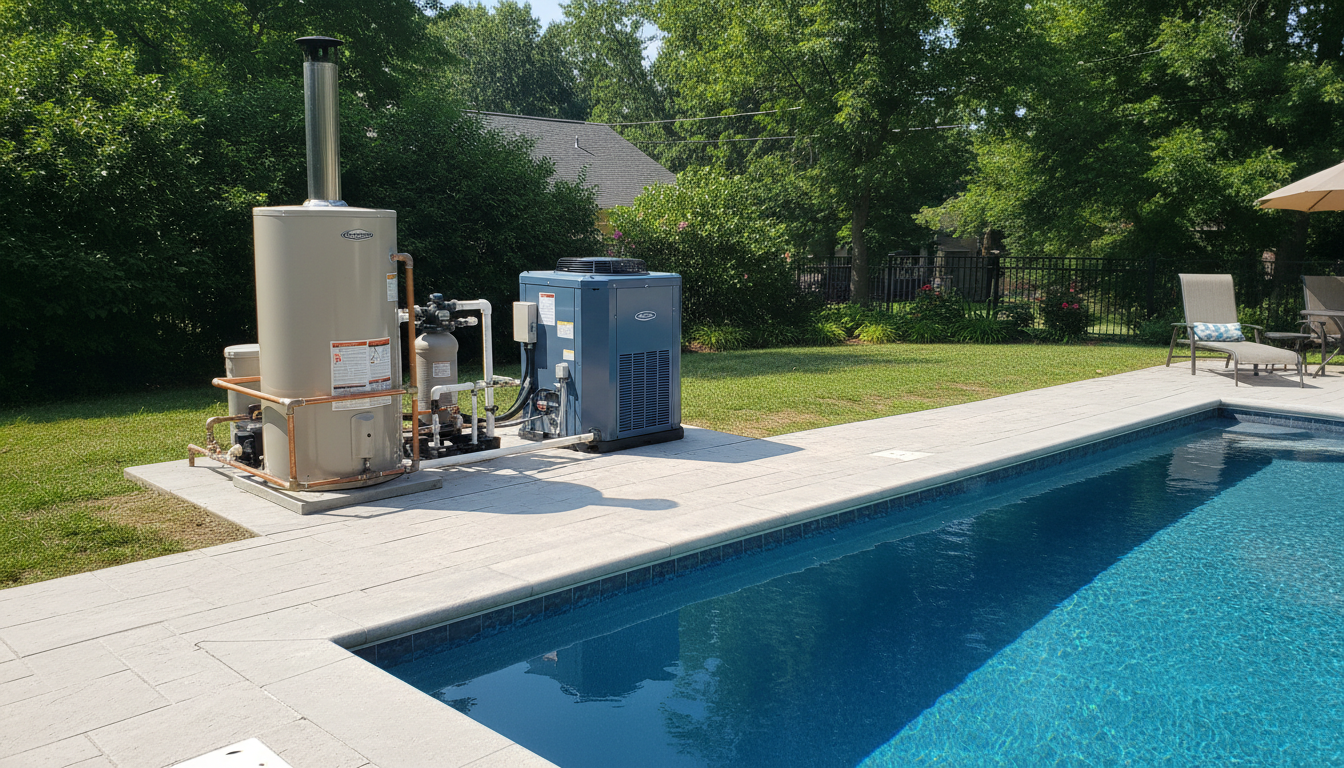
Pool Heater Running Cost All Season: By Fuel Type and Pool Size
If you have ever opened your gas bill in August and done a double-take, you are not alone. Pool heaters are one of the most significant ongoing costs in backyard pool ownership, and most people have only a vague sense of what they are actually spending over a full season.
The honest seasonal cost to run a pool heater ranges from near zero for solar to roughly $3,000 or more for a large pool on propane, with natural gas and heat pumps landing in between. This article walks through real per-season cost estimates for all four major fuel types, sized across pools from 10,000 to 30,000 gallons, with worked examples and a comparison table so you can see where your setup falls.
What Drives Pool Heating Costs
Four variables determine what you spend to heat a pool each season: fuel cost, heater efficiency, pool volume, and how much heat you are fighting to maintain. That last one is easy to underestimate. Every degree of temperature difference between your pool water and the outside air means more BTUs the heater has to replace. A pool in Phoenix fighting a 10-degree temperature rise in a warm month costs a fraction of what the same pool in Minnesota needs to reach the same target in May.
Covering your pool overnight makes an enormous difference. An uncovered 20,000-gallon pool can lose 3 to 5 degrees overnight on a cool evening, forcing your heater to run hard every morning. A solar cover can cut that heat loss by 50 to 70 percent, which translates directly to dollars saved regardless of fuel type.
Fuel Type Cost Comparison at a Glance
| Fuel Type | Typical Efficiency | Fuel Cost Reference | Seasonal Cost (15,000-gal pool) | Seasonal Cost (25,000-gal pool) |
|---|---|---|---|---|
| Natural Gas | 80-85% thermal | $1.20-$1.80 per therm | $300-$900 | $600-$1,500 |
| Propane | 80-85% thermal | $3.00-$5.00 per gallon | $1,200-$2,000 | $2,000-$3,500 |
| Electric Heat Pump | COP 4-6 (400-600%) | $0.12-$0.18 per kWh | $350-$700 | $600-$1,200 |
| Solar | Near 100% of collected heat | Free (sunlight) | $0-$50/year operating | $0-$80/year operating |
Why These Differences Matter for Your Decision
The fuel cost column explains the most important divide in pool heating: propane is expensive to run because the fuel itself is expensive, while a heat pump uses electricity very efficiently by moving heat rather than generating it. If you have natural gas service at the house, a gas heater offers the best combination of fast heating (a 400,000 BTU gas heater can raise a 20,000-gallon pool about 1 degree per hour) and reasonable operating cost. Heat pumps cost less to run per season but heat slowly at 3 to 5 degrees per hour, and they lose efficiency below about 50 degrees Fahrenheit, making them poorly suited for cold spring and fall use in northern states.
Natural Gas Heater: Seasonal Cost by Pool Size
Natural gas heaters are rated in BTU per hour. A 400,000 BTU heater burning natural gas at 80 percent efficiency delivers 320,000 BTU of usable heat per hour and consumes about 4 therms per hour. At $1.50 per therm, that is $6 per hour of operation at full output.
Say your pool holds 15,000 gallons. You swim from Memorial Day to Labor Day, 15 weeks. You run the heater 4 hours per day, 5 days per week to maintain 82 degrees. That is 300 hours of operation per season. At $6 per hour, your natural gas cost comes to roughly $1,800 for the season if you run it hard every day. With a solar cover cutting overnight losses in half, you might cut that to 150 hours and $900. Many moderate-climate owners with good cover discipline land in the $400 to $600 range for a 15,000-gallon pool.
- Small pool (10,000 gallons): $250 to $600 per season on natural gas with a 5-month swim season and reasonable cover use.
- Mid-size pool (15,000 to 20,000 gallons): $400 to $1,000 per season, depending on climate and cover discipline.
- Large pool (25,000 to 30,000 gallons): $800 to $1,500 per season is typical; uncovered pools in cool climates can reach $2,000.
Propane Heater: Seasonal Cost by Pool Size
Propane heaters use the same hardware as natural gas heaters but burn a denser fuel. One therm of natural gas equals about 1.1 gallons of propane in energy content. A 400,000 BTU propane heater burns roughly 4.4 gallons per hour at full output. At $4.00 per gallon, that is $17.60 per hour to run, nearly three times the natural gas cost.
Using the same 15,000-gallon example above with 150 hours of seasonal operation, propane costs come to around $2,640 per season. That is why most owners on propane use their heater selectively rather than continuously. A common strategy: bring the pool up 5 degrees before a weekend party, then let it drift back during the week. That might mean 30 to 50 hours of actual heater time per season, landing total propane costs at $500 to $900 even at $4.00 per gallon. For a 25,000-gallon pool run more continuously, budget $2,500 to $3,500 per season.
Electric Heat Pump: Seasonal Cost by Pool Size
A heat pump does not generate heat from electricity. It extracts heat from the surrounding air and moves it into the water, so a 5 kW heat pump can deliver 17,000 to 25,000 BTU of heat per hour depending on ambient temperature. That ratio is called the coefficient of performance (COP). Most pool heat pumps run a COP between 4 and 6, meaning every dollar of electricity buys 4 to 6 dollars worth of heat output.
A 110,000 BTU heat pump typically draws about 5 to 6 kW. At $0.15 per kWh, that is $0.75 to $0.90 per hour to run. Over a 20,000-gallon pool season with 300 hours of heat pump operation, you are looking at roughly $225 to $270 in electricity cost at the low end. Real-world seasonal costs are higher because pools in cooler climates run the heater longer. Expect $400 to $700 per season for a 15,000 to 20,000-gallon pool in a typical climate with cover use, and $700 to $1,200 for a 25,000-gallon pool or a cool-climate location.
One common mistake with heat pumps is sizing them too small and running them constantly. A 100,000 BTU heat pump on a 30,000-gallon pool in a 65-degree climate will struggle to keep up, run near 100 percent duty cycle, and still cost more than a properly sized 140,000 BTU unit running 60 to 70 percent of the time.
Solar Heater: Upfront vs. Operating Cost
Solar pool heating has essentially zero operating cost once installed. A properly sized solar system in a sunny climate can keep a pool 8 to 12 degrees warmer than an unheated pool at no ongoing expense. The catch is upfront cost: a professionally installed rooftop solar system for a 15,000 to 20,000-gallon pool typically runs $3,000 to $5,000, and larger or more complex installations can reach $7,000. Maintenance is minimal, mostly periodic flushing and replacing valves every 5 to 7 years at $200 to $400 per service.
Compare that to $600 per season in natural gas savings. You recover the investment in 5 to 8 years, with the panels lasting 15 to 25 years. In Florida or Arizona where the swim season runs 8 to 10 months, payback can come in under 5 years. In a northern state with a 4-month season, solar alone may not keep water warm enough in cool months, so many owners pair it with a heat pump backup. If you are planning a major pool renovation, the timing can line up well: as explored in our article on 12×24 inground pool replaster cost with a salt system, bundling upgrades during a replaster project often cuts labor costs for ancillary equipment installation.
Tips That Cut Heating Costs Regardless of Fuel Type
- Use a solar cover: A good solar blanket reduces nighttime heat loss by 50 to 70 percent. This is the single highest-return investment for any heater type.
- Lower your target temperature: Dropping from 84 degrees to 80 degrees reduces heat demand by roughly 10 to 15 percent, which adds up over a full season.
- Use a timer: Running your heater only during off-peak electricity hours (heat pump) or only during active use days (gas or propane) can cut seasonal run hours by 30 percent or more.
- Keep the heater maintained: A gas heater with a dirty heat exchanger or a heat pump with a clogged air coil loses efficiency fast. Annual service runs $80 to $150 and pays for itself quickly.
- Check water chemistry: Corrosive water damages heat exchanger metals and shortens heater life. Keeping calcium hardness between 200 and 400 ppm and pH between 7.4 and 7.6 protects the equipment. AquaDoc makes a calcium hardness increaser specifically formulated for pools with heating systems where scale buildup is a concern.
If you are also weighing a surface renovation that affects long-term equipment placement, the breakdown of fiberglass pool resurfacing cost for a 12×24 with tanning ledge and steps covers how equipment pads and pad access are typically handled in that scope of work.
Frequently Asked Questions
How much does it cost to heat a pool with a gas heater all season?
A natural gas heater running on a 15,000 to 20,000-gallon pool typically costs $400 to $1,000 per season across a 5 to 6 month swim season in a moderate climate. Cold climates or pools without covers can push natural gas costs above $1,500 per season. Using a solar cover and running the heater only when swimming can cut that figure by 40 to 50 percent.
Is a heat pump cheaper to run than a gas pool heater?
Yes, in most climates a heat pump costs 30 to 50 percent less per season than a natural gas heater and 60 to 70 percent less than propane. For a 20,000-gallon pool, expect $400 to $700 per season in electricity for a heat pump versus $600 to $1,200 for natural gas. The trade-off is slower heating and reduced efficiency below 50 degrees Fahrenheit, which limits heat pump usefulness in northern states during early spring and late fall.
How much does it cost to run a propane pool heater all season?
Propane is the most expensive fuel option, typically costing $1,200 to $2,800 per season for a 15,000 to 20,000-gallon pool run on a normal schedule. At $4.00 per gallon and 4.4 gallons per hour for a 400,000 BTU heater, you spend about $17.60 per operating hour. Most propane pool owners limit use to warm-up sessions before weekends and special occasions rather than continuous heating to keep costs manageable.
What size pool heater do I need for a 20,000-gallon pool?
A 20,000-gallon inground pool generally needs a gas or propane heater in the 300,000 to 400,000 BTU range for reasonably fast heating (1 to 2 degrees per hour). For a heat pump, a 110,000 to 140,000 BTU unit is typical, delivering 3 to 5 degrees per hour at a COP of 5. Sizing too small means the heater runs near its limit continuously, increasing wear and energy cost without hitting your temperature target.
Does a solar pool heater actually save money compared to gas over the long run?
Yes, over a 10 to 15 year period solar heating is significantly cheaper than any fossil fuel option. With near-zero operating costs after a $3,000 to $7,000 upfront installation, payback versus natural gas typically comes in 5 to 8 years, and versus propane in as few as 3 years. The limitation is that solar alone cannot reliably heat a pool in cold or cloudy climates, so many owners in those regions use solar as a primary heat source and keep a heat pump for shoulder-season backup.
Bottom Line
For most pool owners, a natural gas heater or electric heat pump will cost $400 to $1,200 per season depending on pool size and climate, while propane can easily triple that figure. If you have sun exposure and a longer view, solar heating pays for itself and runs essentially free for 20 years.