
Daily Cost to Run a Pool Robot Cleaner: Real Numbers by Model
Running a pool robot cleaner every day adds to your electric bill, but the actual cost depends on the wattage of your unit and your local electricity rate. This article breaks down daily, monthly, and seasonal running costs with real numbers so you know exactly what you're paying.

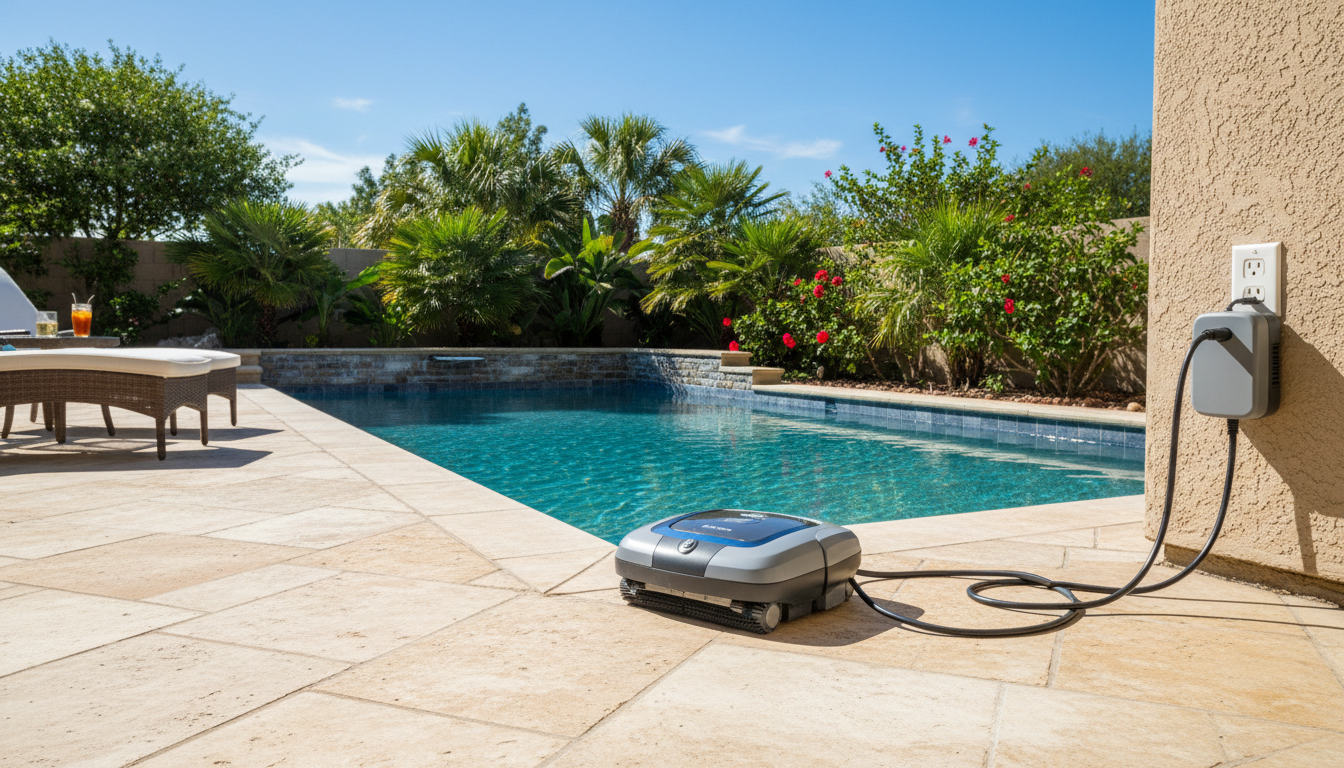
Daily Cost to Run a Pool Robot Cleaner: Real Numbers by Model
You plug in your robotic pool cleaner, drop it in the water, and walk away feeling pretty good about yourself. But somewhere around month two you start wondering whether that little machine is quietly inflating your electric bill every single day. It’s a fair question, and the answer is more specific than you might expect.
Running a pool robot cleaner daily costs most homeowners between $0.04 and $0.18 per session, or roughly $1.20 to $5.40 per month, depending on the unit’s wattage and your local electricity rate. That’s the short answer. Below, this article walks through how to calculate your exact daily cost, how robots compare to other cleaner types, what drives costs up or down, and how to stretch the value of every cleaning cycle.
What Determines How Much Electricity a Pool Robot Uses?
Two numbers control your running cost: the wattage of your robot and your utility’s rate per kilowatt-hour (kWh). The formula is simple: multiply watts by hours of use, divide by 1,000 to get kWh, then multiply by your rate. Everything else is just filling in the blanks.
- Motor Wattage: Entry-level robots typically draw 100 to 130 watts. Mid-range units land around 150 to 180 watts. High-end models with large filter canisters, scrubbing brushes, and wall-climbing ability can pull 200 to 250 watts.
- Cycle Length: Most cleaning programs run 1.5 to 3 hours. Some models let you select a 90-minute quick clean or a full 3-hour deep clean. Longer cycles use proportionally more electricity.
- Electricity Rate: The U.S. national average sits around $0.16 per kWh as of 2024, but rates range from roughly $0.10 in parts of the South to $0.28 or more in Hawaii and California. Your actual rate is printed on your utility bill.
- Transformer Standby Draw: Most robotic cleaners draw a small standby current (2 to 5 watts) when the power supply is plugged in but the robot is not running. Over 30 days, that adds less than $0.25 at average rates, so it’s minor but worth noting.
Step-by-Step: Calculate Your Own Daily Running Cost
- Step 1: Find your robot’s wattage. Check the label on the power supply or the spec sheet in the manual. If the manual lists amps and volts instead of watts, multiply them (for example, 1.5A x 120V = 180 watts).
- Step 2: Determine your cycle length. Check your model’s default program or the setting you use most often. If you are unsure, 2 hours is a safe average for most mid-range units.
- Step 3: Calculate kWh per session. Multiply watts by hours, then divide by 1,000. A 180-watt robot running for 2 hours uses 0.36 kWh per session.
- Step 4: Multiply by your electricity rate. At $0.16 per kWh, that session costs $0.058, which rounds to about $0.06.
- Step 5: Scale to monthly and seasonal totals. Seven days a week at $0.06 per run is $0.42 per week, $1.80 per month, and about $10.80 over a 6-month swimming season.
Worked Example: Three Common Scenarios
Say you own a mid-range robotic cleaner rated at 180 watts and you run it once a day for a 2-hour cycle. Your utility charges $0.16 per kWh. Your daily cost is (180 x 2) / 1,000 x 0.16 = $0.058 per day. Over a 180-day swimming season, that’s roughly $10.44 total. That is less than the cost of a single bag of pool shock.
| Robot Wattage | Cycle Length | kWh Per Session | Cost at $0.16/kWh | Monthly Cost (Daily Use) |
|---|---|---|---|---|
| 110W (entry-level) | 1.5 hrs | 0.165 kWh | $0.026 | $0.79 |
| 180W (mid-range) | 2 hrs | 0.360 kWh | $0.058 | $1.74 |
| 240W (high-end) | 2.5 hrs | 0.600 kWh | $0.096 | $2.88 |
If you live in a high-rate state like California at $0.28 per kWh, multiply those monthly costs by roughly 1.75. A high-end robot running daily would still cost you only about $5 per month, which puts the electricity cost in perspective next to the labor and chemical savings the machine delivers.
How Does a Robot Compare to Other Cleaner Types?
This is where the robot really shines from a cost perspective. Pressure-side cleaners require your booster pump, which typically draws 1,000 to 1,500 watts for 2 to 3 hours per day. At $0.16 per kWh, that is $0.32 to $0.72 per day, or five to ten times more than a robot. Suction-side cleaners don’t need a booster pump but they do increase the load on your main circulation pump, which usually draws 1,000 to 2,000 watts depending on the motor. A robot’s dedicated low-voltage transformer sidesteps your main pump entirely, keeping its electricity draw self-contained and small.
Beyond electricity, robots tend to reduce chemical consumption too. Because the robot actively vacuums debris into its own filter canister rather than sending it through your pool’s filtration system, your sand or cartridge filter gets less clogged between cleanings. That means fewer backwashes, fewer filter cleanings, and slightly less chemical demand from organic matter in the water. AquaDoc’s clarifier concentrate, for example, works noticeably better in pools where debris is pulled out by a robot before it dissolves and clouds the water, because there is simply less organic load for the clarifier to work against.
What Drives the Cost Higher Than Expected?
A few habits can push your robot’s running cost above the estimates above, and they are worth knowing upfront.
- Running It Too Long: Some owners leave the robot in the pool all day or set it to loop continuously. Once the cleaning cycle ends, most robots idle with the pump still circulating slightly, burning watts for no cleaning benefit. Pull it out when the cycle ends.
- A Dirty Filter Canister: A clogged internal filter makes the motor work harder and can increase effective wattage draw by 10 to 15 percent. Rinse the canister after every session.
- High-Rate Time-of-Use Plans: If your utility charges peak rates between 4 and 9 p.m., scheduling your robot during that window inflates costs unnecessarily. Run it overnight or in the morning for the same result at off-peak rates.
- Older Units With Degraded Motors: A robot that is 6 to 8 years old may draw more current than its original rating as motor windings wear. If your electric bill creeps up unexpectedly, the robot is worth checking with a plug-in watt meter (under $20 at most hardware stores).
How Often Should You Actually Run It?
Why every day? Because a pool that gets daily light vacuuming stays cleaner with less chemical intervention than one that gets a heavy cleaning every three days. Organic debris (leaves, pollen, sunscreen residue) starts breaking down within 24 to 48 hours in warm water, consuming chlorine and raising demand. A daily 90-minute quick cycle on a smaller pool or a 2-hour cycle on a larger one keeps that organic load in check. For pools under 15,000 gallons, every other day is often enough. For a heavily used pool or one surrounded by trees, daily is worth the $0.06.
If you are weighing long-term pool infrastructure decisions (like whether to resurface before investing in new equipment), understanding ongoing operating costs is part of that picture. The full cost breakdown for replastering a 15×30 inground pool is a useful reference for seeing how equipment costs stack up against major renovation expenses.
Getting the Most Value Out of Every Run
Keep the robot’s filter canister clean, store the unit out of direct sun when not in use (UV degrades the plastic housing faster than the motor wears out), and check the brushes and tracks every 60 to 90 days for wear. Most mid-range robots are rated for 5 to 8 years of residential daily use. The internal pump is usually the first component to show wear, and replacement pumps for common models run $40 to $120, making a repair far cheaper than replacing the whole unit. If you’re budgeting for a full pool season, factor the robot’s electricity into the same spreadsheet as your chemicals, filter media, and pump costs. For owners also tracking surface maintenance, knowing the replaster cost for a 12×24 pool with a salt system shows how a robotic cleaner can actually extend plaster life by reducing abrasive debris contact with the finish.
Frequently Asked Questions
How much does it cost to run a pool robot cleaner every day?
Most robotic pool cleaners cost between $0.04 and $0.18 per cleaning session based on wattages of 100 to 200 watts and the U.S. average electricity rate of $0.16 per kWh. A typical 2-hour cycle on a 180-watt unit works out to about $0.06 per run, or roughly $1.74 per month with daily use.
How much electricity does a robotic pool cleaner use per hour?
A standard robotic pool cleaner draws between 100 and 250 watts per hour depending on the model. Budget plug-in units sit closer to 100 to 130 watts, while feature-rich models with stronger motors and built-in water lifts can reach 200 to 250 watts. Most mid-range residential units land around 150 to 180 watts.
Is it cheaper to run a pool robot or a pressure-side cleaner every day?
A robotic cleaner is almost always cheaper to run daily because it operates on its own low-voltage transformer and does not require your booster pump. Running a booster pump for 2 to 3 hours uses 1,000 to 1,500 watts, compared to 180 to 360 watt-hours for a typical robot over the same period, making the robot five to ten times more efficient by electricity alone.
How many hours a day should I run my robotic pool cleaner?
Most robotic cleaners finish a thorough cleaning cycle in 1.5 to 3 hours, so running the unit once per day for one full cycle is enough for a standard residential pool. Running it longer than one cycle does not improve results and adds unnecessary wear to the motor and brushes.
Does running a pool robot every day shorten its lifespan?
Daily use will accumulate hours faster, but most quality robotic cleaners are rated for 5 to 8 years of regular residential use. To protect lifespan, rinse the filter canister after every run, store the unit in the shade or indoors between sessions, and never leave it submerged in the pool when it is not actively cleaning.
Running a pool robot cleaner every day costs most homeowners less than $2 per month at average electricity rates, making it one of the cheapest forms of automated pool maintenance available. Choose a unit sized for your pool, keep the filter canister clean, and run it during off-peak hours if your utility has time-of-use pricing.