
Winter Water Level in a Pool: Deep End vs. Shallow-Only Design
Leaving the right amount of water in your pool at closing depends heavily on whether you have a deep end or a flat-bottom shallow design. This post breaks down the correct water level for each pool type, explains the reasoning behind the numbers, and covers the common mistakes that cause damage over winter.

Winter Water Level in a Pool: Deep End vs. Shallow-Only Design
You know that moment when you’re standing at the equipment pad with the hose running and you realize you have no idea when to stop draining? Deep end, shallow end, vinyl liner, gunite: everyone online seems to give a different number, and the stakes feel real when ice damage can run into hundreds of dollars.
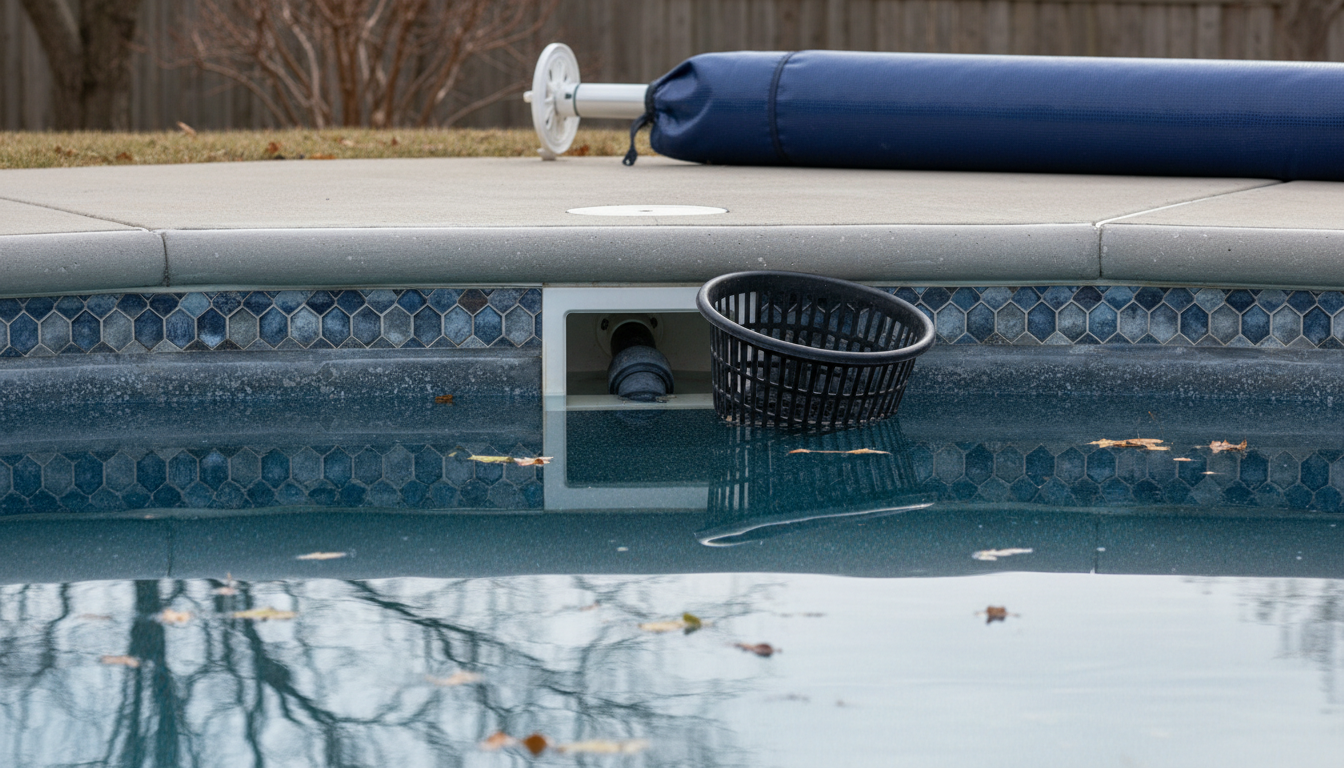
The short answer is this: for a pool with a deep end, drop the water level to 4 to 6 inches below the bottom of the skimmer opening. For a shallow-only pool (flat-bottom above-ground or inground), leave at least 12 to 18 inches of water across the entire floor. The rest of this article explains why those targets are different, walks through the math for a real pool, covers what happens when you get it wrong, and flags the situations where the standard rule needs adjusting.
Why Pool Shape Changes the Winter Water Level Target
The goal at closing is simple: protect your skimmers and return fittings from ice expansion while keeping enough water in the shell to counteract outside pressure. The conflict between those two goals plays out differently depending on whether your pool has a deep end.
In a pool with a deep section (typically 5 to 8 feet), there is a large reservoir of water sitting below the skimmer throat even after you lower the surface by 4 to 6 inches. That water mass presses outward against the walls and downward against the floor, which is exactly what you want. An inground shell, whether vinyl, fiberglass, or gunite, is engineered to hold back soil and groundwater from the outside. Remove too much water and the shell faces unbalanced pressure from the saturated ground surrounding it.
A shallow-only pool, whether a flat-bottom above-ground model or a uniform-depth inground design at 3 to 4 feet throughout, has almost no buffer. If you drain it to the skimmer level, you might remove half or more of the total water volume. On a vinyl liner pool, that can allow the liner to float off the floor or pull away from the bead channel. On a fiberglass shell, reduced internal water pressure is one of the leading causes of shell movement and wall bowing in winter.
The Right Water Level for a Pool With a Deep End
Target: 4 to 6 inches below the bottom of the skimmer opening. That is the near-universal standard for inground pools with a traditional shallow-to-deep slope, and the reasoning is mechanical. Water expands roughly 9 percent when it freezes. A skimmer body is a sealed plastic or ABS housing. If water sits inside the skimmer mouth and freezes, there is nowhere for that expansion to go except outward through the skimmer walls or faceplate. Dropping the level below the skimmer mouth eliminates that risk entirely.
For a worked example: say you have a 16×32 inground pool with a 3.5-foot shallow end sloping to an 8-foot deep end. The skimmer is mounted on the shallow-end wall with the bottom of the throat sitting at roughly 3 feet of depth. Dropping the surface 5 inches puts the waterline at about 2 feet 7 inches on the shallow side. The deep end still holds more than 7 feet of water. That depth provides more than enough weight and hydrostatic pressure to keep the shell stable through a hard freeze.
If you’re unsure whether you dropped the level far enough, a quick visual check works: stand at the skimmer and look into the opening. You should not be able to see water touching the bottom of the faceplate. If you can, drain another inch or two.
The Right Water Level for a Shallow-Only Pool
Target: leave at least 12 to 18 inches of water across the entire floor. On a standard 4-foot flat-bottom above-ground pool, that means leaving roughly one-third to nearly half the total volume in the pool. On a uniform-depth inground (common in some older kidney and freeform designs built at a consistent 4.5 feet), the same rule applies.
The reason you keep more water in a shallow pool is that you have very little depth to give up. If your only water is 48 inches deep and you drain to the skimmer (typically 4 to 6 inches below the coping), you have removed roughly 10 to 13 percent of your depth, which sounds small but leaves a liner with minimal downward weight holding it flat. In areas with high groundwater tables, even one wet winter can float a drained liner right off the floor.
For above-ground pools specifically, the water level does double duty: it also helps support the walls against winter wind loads. Pool Losing Water: Evaporation or a Leak? Here’s How to Know is worth reading before closing if you suspect your pool is already losing water, because starting winter with less water than you think you have is exactly how liners end up damaged before spring.
Comparing the Two Approaches Side by Side
| Pool Type | Recommended Winter Water Level | Primary Risk if Too Low | Primary Risk if Too High |
|---|---|---|---|
| Inground with deep end (vinyl or fiberglass) | 4 to 6 inches below skimmer opening | Liner float, shell movement from groundwater | Skimmer cracking from ice expansion |
| Inground with deep end (gunite/concrete) | 4 to 6 inches below skimmer opening | Hydrostatic pressure on floor, possible pop | Skimmer and return fitting cracking |
| Shallow-only inground (uniform depth) | 12 to 18 inches minimum across floor | Liner float or fiberglass shell movement | Skimmer damage, cover stress from ice sheet |
| Above-ground flat-bottom (vinyl) | 12 to 18 inches from the floor | Liner pulls from bead channel, wall deformation | Excessive weight on cover, wall stress |
Why These Differences Matter for Your Closing Checklist
If you have a deep-end pool, the skimmer is your main vulnerability and the 4-to-6-inch rule protects it directly. If you have a shallow-only design, your liner or shell stability is the main vulnerability and keeping water volume in the pool is your protection. Treating both pools the same and draining to the skimmer on a shallow flat-bottom pool is one of the most common winterization mistakes service techs see every spring.
Situations Where the Standard Rule Needs Adjusting
A few pool configurations push the target outside the standard range:
- High groundwater table: If your yard sits in a flood zone or your water table rises significantly in winter, leave more water in the pool, not less. For inground gunite pools in high-water-table areas, some service pros recommend keeping the level no more than 2 to 3 inches below the skimmer rather than the full 6 inches, to maintain maximum hydrostatic resistance.
- Pools with a main drain and no hydrostatic relief valve: If your gunite pool was built before the mid-1990s, it may lack a hydrostatic relief valve in the main drain. These pools are at higher risk of popping if drained too aggressively in wet winters. Keep water level closer to 3 to 4 inches below the skimmer, not 6.
- Pools with side-mounted return jets near the waterline: If you have return fittings within 6 inches of the standard closing level, plug them before dropping the water. AquaDoc winterization plugs are one option pool owners use for this: they thread into the return fitting from inside the pool and seal before you drain, which prevents water from sitting in the fitting through freeze cycles.
- Beach entry or tanning ledge pools: These designs often have plumbing that runs through the ledge itself. The ledge plumbing should be blown out and plugged before you lower the main water level, because ledge jets are typically at or above the closing waterline and will otherwise hold standing water through winter.
Step-by-Step: How to Drop to the Right Level
- Step 1: Identify your skimmer throat. Look at the inside wall of the skimmer and find the bottom edge of the opening where water flows in. That is your reference point, not the top of the skimmer or the coping.
- Step 2: Mark your target. Use a grease pencil or a piece of tape on the pool wall to mark 4 to 6 inches below that skimmer throat. This prevents you from eyeballing it from outside the pool and getting it wrong.
- Step 3: Use a submersible pump or your filter’s backwash port. A small 1,500 GPH submersible pump will drain a typical pool to the target level in 2 to 4 hours. Watch the level, do not walk away.
- Step 4: Plug the skimmer and return fittings. Once the level is at target, insert winterization plugs into the skimmer throat and all return fittings before blowing out lines. This sequence matters: plug, then blow, so you do not push water back through an open fitting.
- Step 5: Verify the level one more time after the pump lines are blown. Blowing out lines can displace a small amount of water back into the pool. Check that the surface is still below the skimmer throat before covering.
What Happens If You Get It Wrong
Too much water left above the skimmer mouth: ice forms inside the skimmer housing and can fracture the body, the faceplate, or both. Replacing a single inground skimmer runs $200 to $600 in parts and labor, more if the surrounding coping or tile is damaged in the process.
Too little water left in a shallow-only pool or a vinyl liner pool with a deep end: the liner can float up from the floor if the water table rises, and when it settles back down it rarely lays flat. Liner replacement costs $1,500 to $4,500 depending on pool size and access. Getting the closing water level right costs you nothing extra; getting it wrong can cost you a full liner.
Frequently Asked Questions
How low should you drain a pool with a deep end for winter?
Lower the water to 4 to 6 inches below the bottom of the skimmer opening. That protects the skimmer from ice damage while leaving plenty of water weight in the deep section to hold the shell against groundwater pressure from outside.
Can you drain a shallow-only pool completely for winter?
No. Even a shallow flat-bottom pool should retain at least 12 to 18 inches of water across the floor. Completely draining a vinyl liner or fiberglass shell risks the liner floating off the floor or the shell walls shifting outward under unbalanced groundwater pressure.
What happens if you leave too much water in a pool over winter?
Water sitting at or above the skimmer mouth will freeze and expand inside the skimmer housing, which can crack the body or the faceplate. That repair typically costs $200 to $600 per skimmer. For pools with covers, excess water also increases the load on the cover anchors and the cover itself.
What is the correct winter water level for a gunite pool with a deep end?
For a gunite pool, drop the water 4 to 6 inches below the lowest skimmer opening. Gunite is rigid and does not float, but the skimmer is still the weak point. In high-water-table areas, keep the level closer to 2 to 3 inches below the skimmer to maintain hydrostatic resistance through wet winters.
Does a pool with a beach entry or tanning ledge need a different water level at closing?
Yes. Tanning ledges and beach entries often have their own plumbing that runs above the standard closing waterline. Blow out and plug the ledge fittings before lowering the main pool level, then drop the main surface to the standard 4 to 6 inches below the skimmer throat as usual.
The right winter water level is not one-size-fits-all: pools with deep ends close at 4 to 6 inches below the skimmer, while shallow-only designs need at least 12 to 18 inches on the floor. Get that number right and your liner, shell, and skimmers will be in good shape come spring.