Liquid Chlorine Dose for a 15,000-Gallon Vinyl Liner Pool After Rain and Heavy Use
A week of rain plus heavy swimmer traffic is one of the fastest ways to crash your pool's chlorine. This post walks through exactly how much liquid chlorine a 15,000-gallon vinyl liner pool needs to recover, with real numbers and a step-by-step process.

Liquid Chlorine Dose for a 15,000-Gallon Vinyl Liner Pool After Rain and Heavy Use
You come back from a week of summer rain, half the neighborhood has been in the pool, and your test strip shows a chlorine reading somewhere between “barely there” and “what chlorine?” That combination of dilution, organic load, and sunlight is brutal on sanitizer levels, and a basic maintenance dose won’t get you back on track.
For a 15,000-gallon vinyl liner pool after a week of rain and heavy use, you need a full shock dose that brings free chlorine to 10 ppm. In practical terms, that means adding 3 to 4 quarts of 10% liquid chlorine (sodium hypochlorite), adjusted up or down based on where your chlorine actually tests right now. The rest of this article walks through how to calculate your exact dose, why liquid chlorine is the right choice for vinyl liners, and what to check before and after you add it.
Why Rain and Heavy Use Hit So Hard at the Same Time
Rain does several things to pool water at once. It dilutes free chlorine directly, washing in phosphates, nitrates, and organic debris that give chlorine even more to fight. A week of steady rain can cut a well-maintained chlorine level in half before a single swimmer gets in. Add heavy bather load on top of that and you get sweat, sunscreen, and body oils creating chloramines, which are ineffective at sanitizing but still consume the chlorine your test kit counts as “free.” The result is a pool that looks fine but is actively losing its ability to kill anything.
Vinyl liner pools have one additional concern here. Because the liner is a finished surface with a color and texture, you want to restore chlorine correctly rather than just dumping in whatever is handy. Granular chlorine products that don’t dissolve fully can settle on the liner and create bleached spots or accelerate degradation over time. That is why liquid chlorine is the standard recommendation for vinyl liners specifically.
Step 1: Test Before You Dose
Never add shock without testing first. Your dose changes based on where chlorine actually stands. Use a proper drop-test kit rather than a strip, and check free chlorine, pH, and cyanuric acid (CYA) before you pour anything in. You need three numbers:
- Free Chlorine: Your starting level tells you how far below 10 ppm you need to climb. A pool at 0 ppm needs more liquid chlorine than one sitting at 1.5 ppm.
- pH: Liquid chlorine is alkaline and will push pH up slightly. If pH is already above 7.6, consider a small acid adjustment before shocking so chlorine stays effective. Target 7.2 to 7.4 before you add any oxidizer.
- CYA: Stabilizer (cyanuric acid) at 30 to 50 ppm is the right range for an outdoor vinyl liner pool. If CYA is very low, chlorine will burn off in sunlight before it finishes the job. If CYA is above 70 ppm, your chlorine loses killing power even at 10 ppm, and you may need a bigger dose or a partial drain.
Step 2: Calculate Your Liquid Chlorine Dose
Standard pool shock targets 10 ppm of free chlorine. To raise a 15,000-gallon pool by 1 ppm of free chlorine using 10% sodium hypochlorite (the most common strength at pool supply stores), you need roughly 12.5 ounces, or just under a quart.
Here is the worked example: your pool tests at 0.5 ppm free chlorine. You need to raise it by 9.5 ppm to hit 10 ppm. Multiply 9.5 by 12.5 ounces and you get 119 ounces, which is 3.7 quarts. Round up to 4 quarts to be safe, especially after heavy organic load from a week of rain and swimmer traffic. If your pool tests at 1 ppm, you need to raise it 9 ppm, which works out to about 112 ounces or 3.5 quarts. Round to the nearest half quart based on what your test shows.
If you can only find 12.5% liquid chlorine (sometimes sold as “pool strength”), multiply those quart amounts by 0.8. Four quarts of 10% becomes about 3.2 quarts of 12.5%. If you are working with a pool of a different size and wondering how the math scales, the post on how many gallons an 18×36 inground pool holds and what it means for chemicals explains the underlying volume math that makes these per-ppm calculations work.
How to Add Liquid Chlorine Safely to a Vinyl Liner Pool
- Adjust pH first if it is above 7.6. Let the pump run 30 minutes after any acid addition before moving to chlorine.
- Run the pump at full speed so the chlorine circulates immediately rather than sitting in one zone.
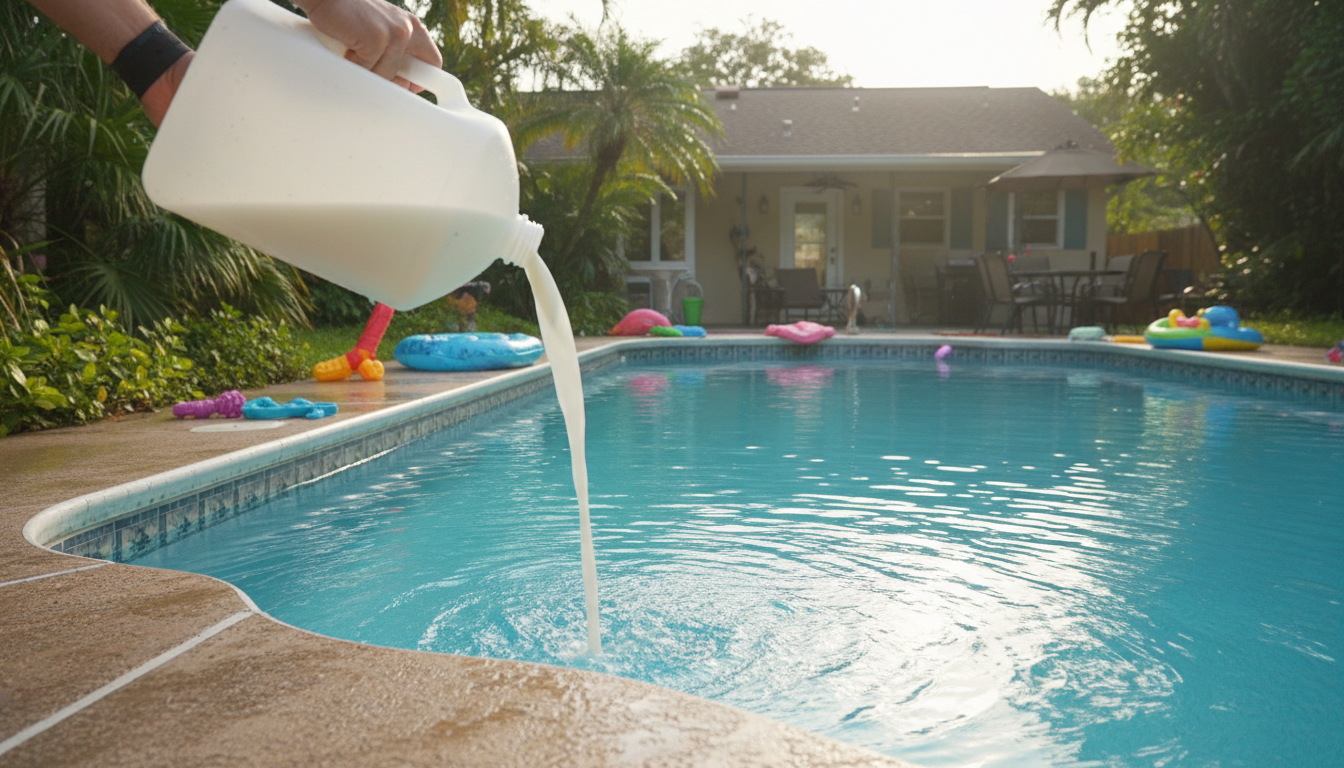
- Pour slowly around the perimeter of the pool while walking, keeping the stream in front of a return jet where possible. Never pour directly onto the liner floor or walls.
- Do not dilute before adding. Liquid chlorine poured straight from the jug into moving water disperses well on its own. Diluting it in a bucket first adds steps without benefit.
- Shock at dusk. UV from sunlight destroys unprotected chlorine quickly. Adding your dose in the evening gives it a full night of circulation before the sun hits it. This matters even more when CYA is low.
- Run the filter overnight for at least 8 hours after shocking.
What to Check the Next Morning
Test free chlorine the next morning before anyone swims. You are looking for a reading above 4 ppm to confirm the shock worked, or the water would not have held chlorine through the night if there was still heavy organic demand. If free chlorine is already back below 2 ppm by morning, your pool had a higher chlorine demand than the initial dose covered, and you need to repeat the shock. This can happen after particularly heavy algae growth or after water that sat close to zero for more than a day.
Do not let anyone swim until free chlorine is at or below 4 ppm. That is typically 8 to 24 hours after a shock dose, depending on sunlight intensity, CYA level, and how much the filter circulates. If you want to dig deeper into keeping chlorine steady through a whole season of heavy use, the post on summer pool chemistry when everyone’s swimming covers the full maintenance rhythm that prevents situations like this from happening week after week.
Common Mistakes After Rain and Heavy Use
- Underdosing: Adding one jug of liquid chlorine because it feels like “a lot” without testing first is the most common problem. A pool with zero chlorine and four days of organic load needs a real shock dose, not a maintenance top-up.
- Skipping pH adjustment: Chlorine added to water above pH 7.8 is significantly less effective. You can add the right amount and still see little improvement overnight if pH is too high.
- Shocking during the day: Even with stabilizer in the water, daytime shocking in direct sun wastes product. Evening application is worth the wait.
- Ignoring CYA: A vinyl liner pool with 0 ppm CYA loses most of a shock dose to sunlight within a few hours. If CYA is below 20 ppm, add stabilizer before or alongside the shock.
- Not running the filter long enough: Eight hours minimum after shocking. If the filter is dirty or the pump is undersized, circulation is poor and chlorine stays concentrated near the returns instead of reaching the whole pool.
If you get the shock done but still end up with hazy or green water a day or two later, the problem has likely moved past simple low chlorine into early algae territory. The guide on how to clear pool water after an algae bloom walks through what to do when a shock alone is not enough.
A Note on Liquid Chlorine Concentration
Liquid chlorine concentration matters more than people realize. Pool supply store jugs are typically 10% available chlorine. Grocery store bleach is usually 6% to 8.25%, and using it is not wrong, it just means you need more of it. To raise 15,000 gallons by 9.5 ppm using 6% bleach, you would need about 5.9 quarts instead of 3.7. AquaDoc’s liquid chlorine, which many vinyl liner pool owners use specifically because it is labeled with available chlorine percentage, makes this math consistent from jug to jug so you are not guessing when concentrations vary by brand.
| Chlorine Concentration | Quarts to Raise 15,000 Gal by 9.5 ppm | Notes |
|---|---|---|
| 6% (grocery bleach) | ~5.9 quarts | Works but requires larger volume |
| 8.25% (strong grocery bleach) | ~4.3 quarts | More practical but still not pool-grade |
| 10% (standard pool liquid chlorine) | ~3.7 quarts | Most common pool supply store strength |
| 12.5% (high-strength pool chlorine) | ~3.0 quarts | Most efficient per jug, check label carefully |
The practical takeaway from this table: always read the label and use the concentration percentage to adjust your quart amount. Assuming all liquid chlorine is the same strength is how people either undershock or overshoot their target.
Frequently Asked Questions
How much liquid chlorine do I add to a 15,000-gallon pool after heavy rain?
Add enough liquid chlorine to bring free chlorine to 10 ppm. For a 15,000-gallon pool starting near zero, that is typically 3 to 4 quarts of 10% sodium hypochlorite. Test your current chlorine level first and adjust the dose based on how far below 10 ppm you are starting.
Will rain alone drop chlorine enough to need shocking?
Yes, especially after several consecutive days of rain. Rain dilutes existing chlorine directly, washes in organic debris and nitrogen compounds that consume chlorine fast, and often destabilizes pH. A full week of rain combined with heavy swimmer traffic almost always calls for a full shock dose rather than a simple top-up.
Is liquid chlorine safe for vinyl liner pools?
Liquid chlorine (sodium hypochlorite) is one of the safest shock options for vinyl liners because it dissolves instantly and leaves no undissolved granules that can bleach or degrade the liner surface. Pour it slowly in front of a return jet with the pump running and never pour it directly onto the liner floor or walls.
How long after adding liquid chlorine can I swim in a 15,000-gallon vinyl liner pool?
Wait until free chlorine drops to 4 ppm or below before swimming, which typically takes 8 to 24 hours depending on sunlight, CYA level, and how well your pump circulates the water. Always test before letting anyone in, especially children.
What should my chlorine level be in a vinyl liner pool on a normal day?
Target 2 to 4 ppm of free chlorine for daily maintenance in a vinyl liner pool. Pair that with cyanuric acid (stabilizer) at 30 to 50 ppm so sunlight does not burn off your chlorine before it can do its job between shock treatments.
After a week of rain and heavy use, a 15,000-gallon vinyl liner pool needs 3 to 4 quarts of 10% liquid chlorine to reach a proper shock level of 10 ppm. Test first, adjust for your starting point, shock at dusk, and run the filter overnight.