Borax vs Boric Acid for a 20,000-Gallon Pool: Hitting 50 ppm From Zero
Reaching 50 ppm borates in a 20,000-gallon pool sounds complicated until you do the math once. This guide shows exactly how much borax or boric acid to add, how to dissolve it, and what to expect when the dose is right.

Borax vs Boric Acid for a 20,000-Gallon Pool: Hitting 50 ppm From Zero
You’ve read that borates make pool water feel silkier, hold pH steadier, and slow algae growth, and now you want to actually add them. The problem is that every source seems to quote a different number, and none of them do the math for a 20,000-gallon pool hitting 50 ppm from a dead start.
Here is the direct answer: a 20,000-gallon pool starting at zero borates needs roughly 25 pounds of borax or 13 pounds of boric acid to reach 50 ppm. Which product you choose changes the math and the pH impact, and this article walks through both options, step by step, with the numbers you actually need.
Why Borate Level Matters and What 50 ppm Does
Borates are not a sanitizer. They work alongside chlorine rather than replacing it. At 30 to 50 ppm, borates function as a pH buffer, a mild algae suppressant, and a water conditioner. Pool owners who maintain borates in this range consistently report lower chlorine demand, more stable pH between visits, and water that looks clearer and feels noticeably softer against skin. As Pool Shark H2O explains, borates essentially make every other chemical in your pool work more efficiently.
The 50 ppm target is the upper boundary recommended by most pool professionals and is generally recognized as the point where all three benefits are fully realized without any concern about skin or equipment irritation. Going above 50 ppm is unnecessary and wastes money. Going below 30 ppm means you lose most of the algae-suppression benefit. So 50 ppm is the right goal.
Borax vs Boric Acid: Two Ways to Get There
Both products deliver boron to your water, but they behave differently. Borax (sodium tetraborate) is inexpensive and widely available, but it raises pH significantly. Boric acid is a purer boron source that barely moves pH at all. Here is how they compare side by side.
| Product | Boron Concentration | pH Effect | Typical Cost | Pounds Needed (20,000 gal, 50 ppm) |
|---|---|---|---|---|
| 20 Mule Team Borax | ~11.3% boron by weight | Raises pH 0.5 to 1.0 units | $0.80 to $1.20 per lb | ~25 lbs |
| Boric Acid (99%) | ~17.5% boron by weight | Negligible effect | $2.50 to $4.00 per lb | ~13 lbs |
Why These Differences Matter for Your Dose
If your pH is sitting at 7.4 to 7.6 already, borax is going to push it up to 8.0 or higher once you add 25 pounds of it. That is not a disaster, but it means you need muriatic acid on hand before you start. A reasonable estimate is 1 to 1.5 quarts of 31.45% muriatic acid to bring pH back down after a full borax treatment on a 20,000-gallon pool, though the exact amount depends on your current alkalinity and pH. Plan the acid addition after the borax is fully circulated. Boric acid skips that correction step entirely, which is why it costs more and is worth it for many pool owners who have already balanced their water. As MyPoolCalc notes, boric acid is generally easier to work with when your baseline chemistry is already dialed in.
The Exact Math for a 20,000-Gallon Pool
The standard dosing formula for borax: you need approximately 20 ounces (1.25 pounds) of borax to raise borates by 10 ppm in 10,000 gallons. Scale that up to 20,000 gallons and 50 ppm:
- Target increase: 50 ppm (starting from zero)
- Pool volume: 20,000 gallons (two times a 10,000-gallon unit)
- Dose per 10 ppm per 10,000 gallons: 1.25 lbs borax
- Calculation: 1.25 lbs x 5 (for 50 ppm) x 2 (for 20,000 gal) = 12.5 lbs
Wait, that is different from the 25-pound figure mentioned above. Here is why. The 20 Mule Team Borax sold in grocery stores is not pure borax. It is sodium tetraborate decahydrate, which is roughly 47 to 50% anhydrous borax by weight. Doubling to account for that dilution gives you the real-world number: approximately 25 pounds of 20 Mule Team Borax to hit 50 ppm in a 20,000-gallon pool. If you are using a pool-grade borax product at higher purity, check the label and scale accordingly. A boric acid pool calculator can also confirm your numbers if you want to double-check before purchasing.
For boric acid (99% pure), the calculation is cleaner. You need roughly 1.3 pounds per 10,000 gallons per 10 ppm. So: 1.3 x 5 x 2 = 13 pounds of boric acid for 50 ppm in a 20,000-gallon pool from zero.
Step-by-Step: How to Add Borates Correctly
Adding borate product directly to the pool in one pile near a return is the fastest way to create a white cloud that settles on your liner or plaster and takes a week to fully dissolve. Do it right instead.
- Test your current pH first. You want it at 7.4 to 7.6 before you start if using borax, because it is going up. If using boric acid, this step is less critical but still worth checking.
- Pre-dissolve in buckets. Fill a five-gallon bucket two-thirds full of warm pool water. Add no more than five pounds of borax or boric acid at a time and stir thoroughly until dissolved. Do not skip this step.
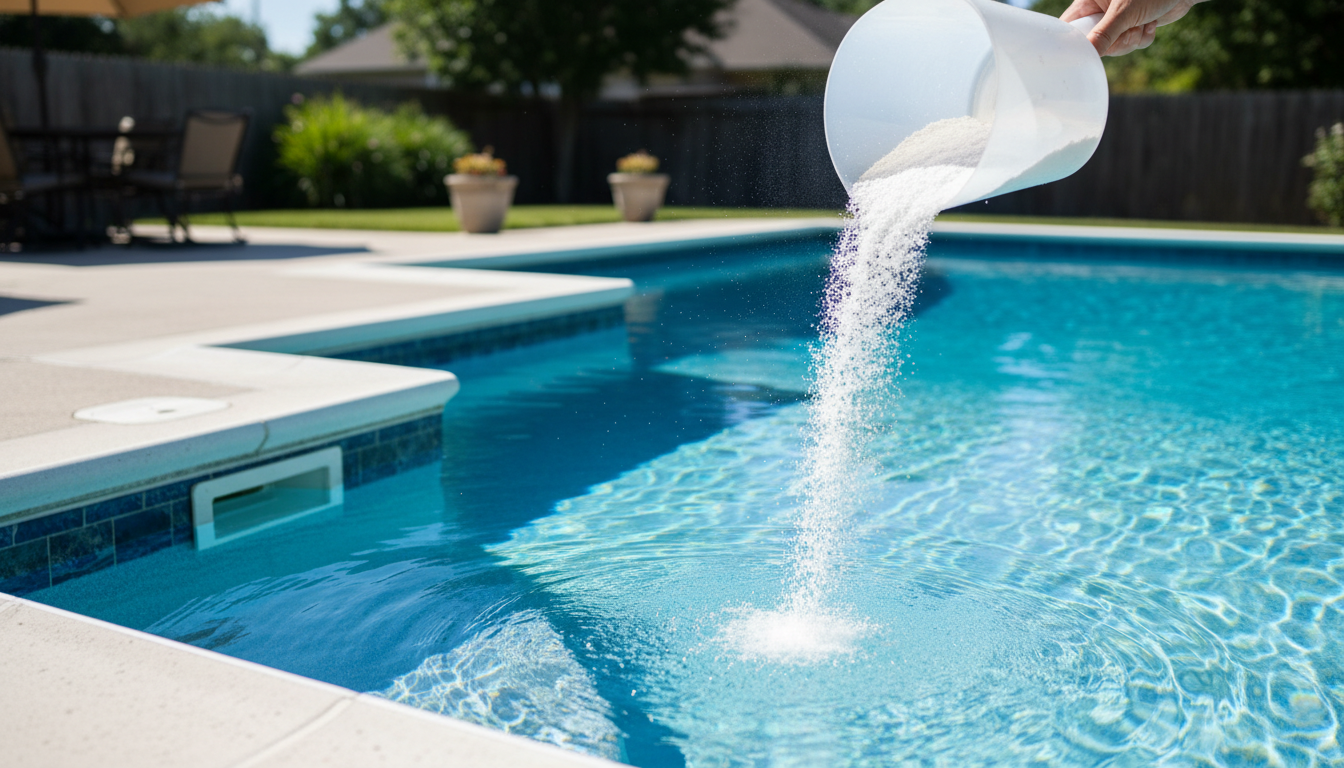
- Pour along the perimeter. Walk the edge of the pool slowly and pour each dissolved bucket in a thin stream. This distributes the dose before it can settle.
- Run the pump continuously for 24 hours. Full circulation ensures even distribution. Do not test until the pump has run for at least a full day.
- If you used borax, test and adjust pH. Add muriatic acid slowly at a return jet with the pump running. Recheck pH after two hours and repeat if needed until you are back in the 7.4 to 7.6 range.
- Verify the borate level. Use a borate-specific test strip or a drop-reagent kit that includes boron. Standard chlorine/pH strips will not measure borates.
AquaDoc makes a borate booster formulated specifically for pool use, and pool owners who want to avoid the borax-plus-acid two-step often reach for it because it is pH-neutral and dissolves cleanly without the white-powder settling issue common with grocery-store borax.
Common Mistakes That Waste Product and Money
- Adding too much at once: Pouring all 25 pounds of borax into one spot can create a thick slurry that bleaches liner panels or leaves residue on plaster. Pre-dissolve every batch.
- Not accounting for water loss: If you recently backwashed, topped off with fresh water, or had heavy rain, your pool volume has changed. Recalculate before dosing. Even a 10% dilution from topping off can shift your actual borate level after treatment.
- Skipping the pH check after borax: Many pool owners add the borax, see the water looking great, and then wonder two days later why their eyes burn and their plaster feels rough. High pH from an uncorrected borax addition causes both problems. Service Industry News points out that this pH effect is one of the main reasons technicians prefer boric acid when pricing out a borate treatment for customers.
- Using regular test strips to verify: Standard four-way or five-way test strips do not test for borates. You need a dedicated borate reagent or strip that goes up to at least 50 ppm on the boron scale.
- Confusing borax with borate-based algaecide products: Some algaecides contain boron compounds at very low concentrations. They are not a substitute for a true borate treatment dose. Read the label.
How Long Do Borates Stay in the Pool?
Borates are not consumed by UV light or the chlorination process, so they do not deplete the way chlorine does. The main cause of borate loss is dilution: rainwater, splashout, filter backwashing, and partial drains all reduce the concentration over time. In a typical outdoor pool that gets backwashed every few weeks and sees normal rainfall, you might lose 5 to 10 ppm per season. Test your borate level every four to six weeks and add a maintenance dose of a few pounds if you drift below 40 ppm. If your pool needs replastering soon, it is worth knowing that fresh plaster surfaces can temporarily absorb some borate, so retest after any major resurfacing work. (For anyone budgeting a replaster while updating their water chemistry plan, the breakdown of replastering a 15×30 inground pool with a skimmer and two returns is a useful reference.)
Frequently Asked Questions
How much borax do I need to add 50 ppm borates to a 20,000-gallon pool?
You need approximately 25 pounds of 20 Mule Team Borax to raise borates from zero to 50 ppm in a 20,000-gallon pool. Pre-dissolve it in five-gallon buckets and add it around the pool perimeter with the pump running. Expect to add muriatic acid afterward to correct the pH rise that borax causes.
How much boric acid do I need for 50 ppm in a 20,000-gallon pool?
Pure boric acid (99% concentration) requires approximately 13 pounds to reach 50 ppm from zero in a 20,000-gallon pool. Boric acid is more expensive per pound than borax but does not raise pH, so it eliminates the need for a follow-up acid correction and is often the cleaner choice when your water chemistry is already balanced.
Does adding borates to a pool affect pH?
Borax raises pH noticeably, sometimes by 0.5 to 1.0 units or more over a full treatment dose. Plan to add muriatic acid after the borax has fully circulated to bring pH back to 7.4 to 7.6. Boric acid has a negligible effect on pH, which is why many pool owners prefer it specifically to avoid that correction step.
What does 50 ppm borates actually do for a pool?
At 50 ppm, borates buffer pH against drift, suppress algae growth, and give the water a noticeably clearer, silkier feel. Most pool professionals find that pools maintained at 30 to 50 ppm borates use less chlorine week to week and require fewer pH adjustments between service visits. The effect on water feel is often noticeable within the first swim after the dose fully circulates.
How long do borates last in a pool before you need to top them up?
Borates are chemically stable and are not consumed by sunlight or chlorination, so they last most of a season without significant loss. The main cause of depletion is water dilution from rain, backwashing, and splashout. Most pool owners need a small top-up dose of 3 to 5 pounds once per season to stay near 50 ppm. Test with a borate-specific test strip every four to six weeks to track the level accurately.
For a 20,000-gallon pool starting from zero, the bottom line is 25 pounds of borax or 13 pounds of boric acid. Pre-dissolve it, walk the perimeter, run your pump for 24 hours, and if you used borax, correct your pH before you swim.