Muriatic Acid Dose for Closing a 10,000-Gallon Gunite Pool: Hit the Right pH
Getting the pH right before you close a 10,000-gallon gunite pool is one of the most important steps you can take to protect the plaster through winter. This post gives you exact muriatic acid doses by starting pH, explains why gunite demands tighter tolerances than other pool surfaces, and walks through the full closing-day process.

Muriatic Acid Dose for Closing a 10,000-Gallon Gunite Pool: Hit the Right pH
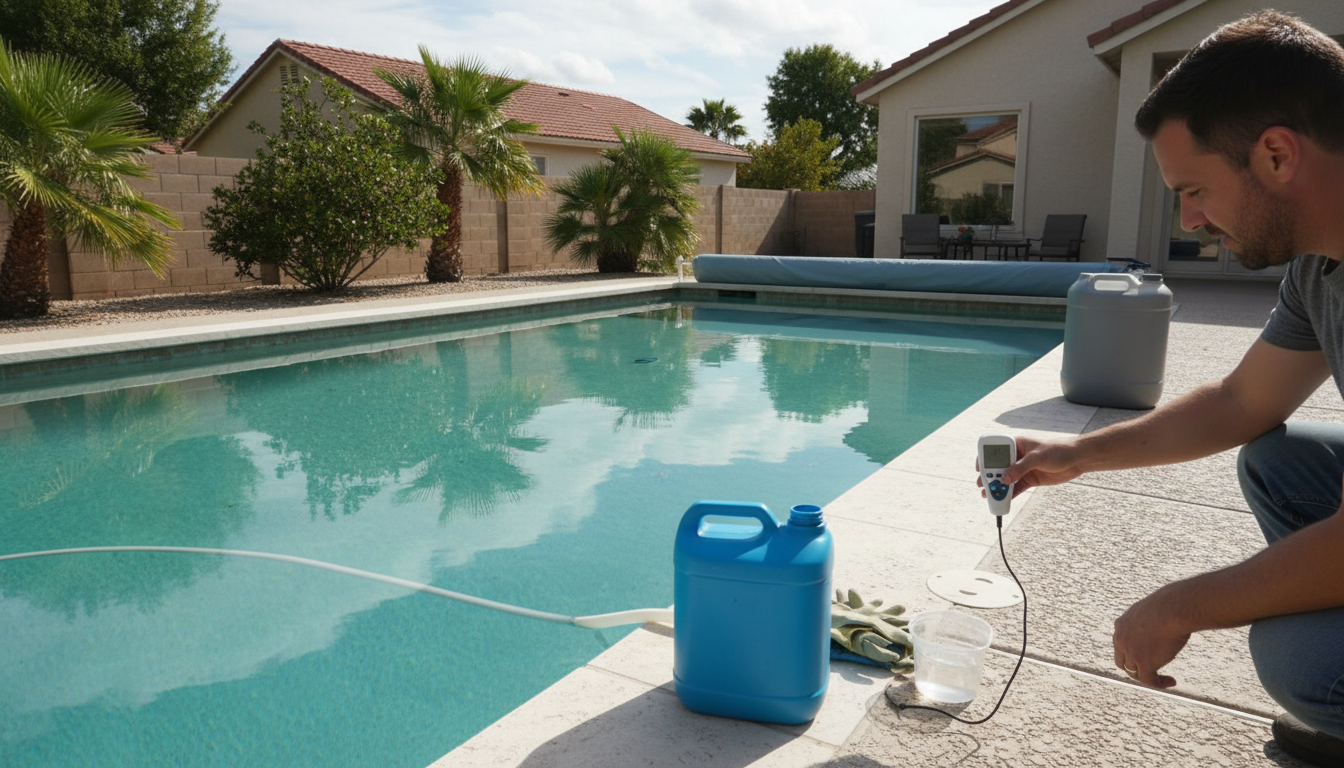
Closing day always has a way of piling up on you – the air compressor, the plugs, the antifreeze, the cover – and by the time you get to water chemistry, it can feel like an afterthought. But if you own a gunite pool, skipping a proper pH adjustment before the cover goes on is the kind of shortcut that shows up as pitting and scale next spring.
For a 10,000-gallon gunite pool, close with the pH sitting between 7.2 and 7.4. That range keeps the water slightly acidic enough to resist calcium scale deposits on the plaster but not so low that it etches the surface through the winter. The general starting dose is about 16 oz (1 pint) of standard 31.45% muriatic acid per 10,000 gallons to drop pH by roughly 0.2 units, but your actual dose depends on where your pH is right now and what your total alkalinity reads. This article walks through the full math, a table of doses by starting pH, and the step-by-step process to get it right on closing day.
Why Gunite Pools Need Tighter pH Control at Closing
Gunite and shotcrete shells are porous, calcium-based surfaces. When the water sits still under a cover for four to five months, any chemistry imbalance gets concentrated against that surface instead of being diluted by fresh water or corrected by your equipment. High pH – anything above 7.6 – encourages dissolved calcium to precipitate out and bond to the plaster as scale. Low pH – below 7.0 – causes the water to go after the calcium in the plaster itself, etching the surface and leaving a rough, chalky texture that worsens with each freeze-thaw cycle. Vinyl liner and fiberglass pools are more forgiving; gunite is not. You need to land in that 7.2 to 7.4 window, not just “somewhere in range.”
Total alkalinity matters here too, because it controls how hard it is to move pH with acid. If your alkalinity is high (above 120 ppm), the water resists pH change and you will need more acid than the base dose to hit your target. If alkalinity is low (below 80 ppm), pH swings easily and you risk overcorrecting. If your alkalinity is out of range, fix it before closing day and let it stabilize overnight, then dial in pH last. For a deeper look at how these two parameters interact, the post on total alkalinity vs pH explains why alkalinity always gets adjusted first.
Muriatic Acid Doses by Starting pH for a 10,000-Gallon Gunite Pool
The table below uses standard 31.45% muriatic acid (the full-strength version sold at most pool supply and hardware stores) and assumes total alkalinity in the normal range of 80 to 120 ppm. If your alkalinity runs high, add 20 to 25% more acid. Always add, circulate for at least 4 hours, and retest before adding another dose.
| Starting pH | Target pH | pH Drop Needed | Muriatic Acid Dose (31.45%) |
|---|---|---|---|
| 7.6 | 7.4 | 0.2 | 16 oz (1 pint) |
| 7.8 | 7.4 | 0.4 | 28 to 32 oz |
| 8.0 | 7.4 | 0.6 | 40 to 48 oz |
| 8.2 | 7.4 | 0.8 | 52 to 64 oz |
| 7.6 | 7.2 | 0.4 | 28 to 32 oz |
| 7.8 | 7.2 | 0.6 | 40 to 48 oz |
Why These Differences Matter
A 0.2-unit pH drop looks small on paper, but each step up from 7.6 toward 8.2 represents roughly a tenfold increase in hydroxide ion concentration, which means scale deposits build up exponentially faster. The dose jumps from 16 oz to over 48 oz as you move from a mild 7.6 to a problem-level 8.0 because the buffering capacity of the water fights the acid harder at higher pH. That is why the ranges widen toward the top of the table – you may land at 44 oz or at 48 oz depending on your specific water chemistry. Always use real test results, not guesses, before you commit to a dose. As Cristallo Pools notes, the actual amount of acid required varies pool to pool even at the same stated volume, so testing and adjusting in increments is the only reliable method.
Step-by-Step: Adding Muriatic Acid Before Closing
- Test the water thoroughly. Use a reliable liquid test kit or digital tester to get exact readings for pH, total alkalinity, and calcium hardness. Strips are not precise enough for closing chemistry.
- Adjust alkalinity first if needed. If total alkalinity is outside 80 to 120 ppm, correct it the day before and let the pool circulate overnight before touching pH.
- Calculate your dose from the table above. Use your starting pH and pick the dose for normal alkalinity, then bump it up 20 to 25% if your alkalinity is above 120 ppm.
- Dilute the acid before adding it. Pour the measured amount of muriatic acid into a bucket of pool water first, never add acid directly to undiluted pool water near the plaster. This protects the surface from a concentrated acid slug.
- Add slowly near a return jet. With the pump running on full speed, pour the diluted acid slowly around the deep end near a return jet. Avoid pouring near the walls or directly over the floor drain.
- Circulate for at least 4 hours. Do not retest until the pump has run the full 4 hours and the acid is evenly distributed throughout the water.
- Retest and fine-tune. If pH is still above 7.4, add a second smaller dose (usually 8 to 12 oz) and circulate another 2 hours before testing again.
- Add your winter chemicals, then cover. Once pH is confirmed in the 7.2 to 7.4 range, add your winterizing algaecide and shock dose per your normal closing routine, then install the cover.
One common mistake: adding the full calculated dose all at once when the starting pH is very high (8.0 or above). Gunite surfaces can suffer localized etching if a concentrated acid slug settles near the floor before it disperses. Split a large dose into two additions separated by 2 hours of circulation, and you will get an even result without risking surface damage. For a more detailed look at safe handling and common mistakes, Benchmark Pool Supply’s muriatic acid guide covers dilution ratios and safety gear clearly.
A Worked Example: pH 7.8, Alkalinity at 110 ppm
Say your 10,000-gallon gunite pool tests at pH 7.8 and total alkalinity is 110 ppm – right in the normal range. You want to land at pH 7.4 before covering. That is a 0.4-unit drop. From the table, the dose is 28 to 32 oz of 31.45% muriatic acid. Start with 28 oz, diluted in a bucket of pool water, added near the deep-end return with the pump running. Circulate for 4 hours. Retest. If pH is at 7.5, add another 8 oz and circulate 2 more hours. Final test confirms 7.4. Cover goes on. Total acid used: about 36 oz – right between the table range and the high end, exactly as expected given where you started and the slight buffering from 110 ppm alkalinity.
AquaDoc makes a liquid muriatic acid formulated specifically for pools, and some pool owners use it for closing precisely because it comes pre-measured in pint increments that match common dose targets for 10,000-gallon pools – no fumbling with a full gallon jug on a cold October morning.
Calcium Hardness: The Closing Variable Most Gunite Owners Miss
pH gets all the attention at closing, but calcium hardness plays a supporting role with gunite surfaces. If calcium hardness is below 200 ppm, the water is aggressive and will leach calcium from the plaster even at a properly adjusted pH, especially when temperatures drop and water chemistry becomes less stable. Close with calcium hardness between 200 and 400 ppm. If it is low, add a calcium hardness increaser a day before closing and circulate overnight – the same session you use to stabilize alkalinity. Pools in colder climates with dramatic temperature swings are especially vulnerable to low-calcium damage over a long winter. The same size-and-chemistry logic that applies here also applies to larger pools: if you are ever unsure how volume affects your dose calculations, the post on cloudy pool water causes and fixes is a useful reference for how out-of-balance chemistry cascades into visible problems.
Safety When Handling Muriatic Acid
Muriatic acid is corrosive and releases fumes that irritate your lungs and eyes. Always wear chemical-resistant gloves, splash-proof safety glasses, and old clothes you do not mind ruining. Work outdoors or in a well-ventilated area. Never pour water into acid – always add acid to water (in your dilution bucket). Keep a garden hose nearby in case of skin contact and flush immediately with large amounts of water. Store unused acid in its original container in a cool, dry place away from chlorine products – muriatic acid and chlorine stored together can produce toxic chlorine gas. EZ Pools’ full muriatic acid overview has a solid safety checklist worth reading before your first closing-day use.
Frequently Asked Questions
How much muriatic acid do I add to a 10,000-gallon pool to lower pH?
For a 10,000-gallon pool, the starting dose is about 16 oz (1 pint) of standard 31.45% muriatic acid to drop pH by approximately 0.2 units. Larger drops (0.4 to 0.8 units) require 28 to 64 oz depending on starting pH and alkalinity. Always add in increments: dose, circulate 4 hours, retest, and repeat as needed rather than adding the full calculated amount at once.
What pH should a gunite pool be at before closing for winter?
Close a gunite pool with pH between 7.2 and 7.4. High pH over winter (above 7.6) causes calcium scale to bond to the plaster, while low pH (below 7.0) etches the surface and causes pitting that compounds with every freeze-thaw cycle. The 7.2 to 7.4 range protects both the plaster and your plumbing through the off-season.
How much muriatic acid to lower pH from 7.8 to 7.4 in a 10,000-gallon pool?
Expect to use approximately 28 to 32 oz of 31.45% muriatic acid to drop pH from 7.8 to 7.4 in a 10,000-gallon pool when total alkalinity is in the normal 80 to 120 ppm range. If alkalinity is above 120 ppm, budget up to 40 oz. Add in two rounds if needed, circulating fully between doses.
Should I lower alkalinity before closing a gunite pool?
Yes, adjust total alkalinity to 80 to 120 ppm before closing if it is out of range, because high alkalinity makes pH nearly impossible to move with acid and low alkalinity causes pH to swing unpredictably over a long winter. Correct alkalinity the day before closing, circulate overnight, then fine-tune pH on closing day. The interaction between these two parameters is covered in detail in the total alkalinity vs pH guide on this site.
Can I add muriatic acid right before putting the winter cover on?
Add muriatic acid at least 4 hours before covering, with the pump running the entire time to distribute it evenly. Adding acid and immediately covering traps acidic pockets near the plaster, which can cause localized etching on the floor or walls. Confirm with a final pH test after full circulation before the cover goes on.
The Bottom Line
For a 10,000-gallon gunite pool, close with pH at 7.2 to 7.4, using roughly 16 oz of 31.45% muriatic acid per 0.2-unit drop as your baseline, adjusted up for high alkalinity and split into incremental doses for large corrections. Get that number right before the cover goes on and your plaster will thank you in April.