Trichlor Shock in a 15,000-Gallon Pool When CYA Is Already at 70 ppm
When your CYA is already at 70 ppm, using trichlor shock can push stabilizer into a range where chlorine barely works. This post walks through the exact dose for a 15,000-gallon above-ground pool, why CYA level changes the math, and what product to reach for instead.

Trichlor Shock in a 15,000-Gallon Pool When CYA Is Already at 70 ppm
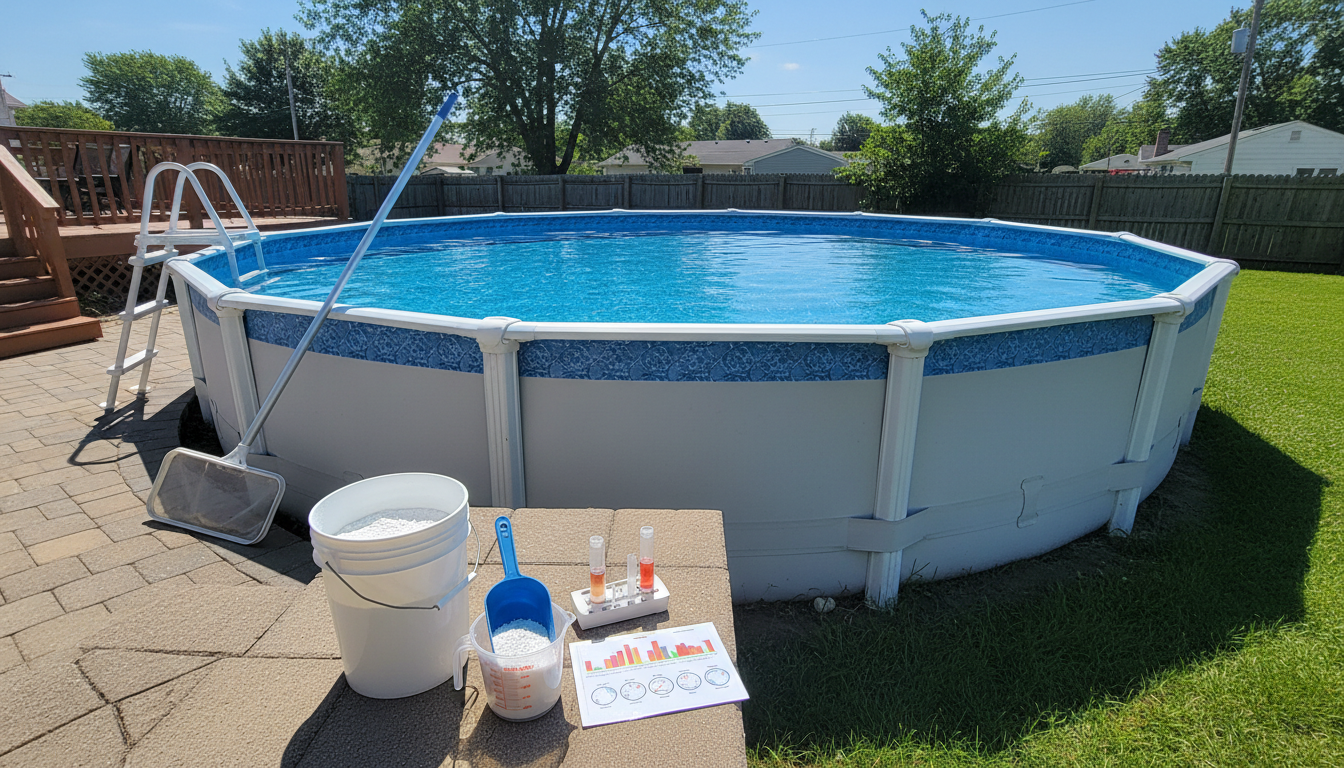
You did everything right: you tested the water, you kept up with the tablets all summer, and now your pool needs a shock. Then you notice your CYA reading sitting at 70 ppm and suddenly the question gets complicated. Do you reach for the trichlor shock sitting in your shed, or does that number on the test strip change what you should do?
Here is the short answer: you can add trichlor shock to a 15,000-gallon pool with CYA at 70 ppm, but the math argues against it. A proper shock dose of about 1.5 lbs of trichlor will bump your CYA from 70 ppm to roughly 79 ppm – right at the edge of where chlorine starts losing meaningful effectiveness. This article covers the exact dose if you decide to proceed, why that CYA number matters so much, and what most pool pros would actually reach for instead.
Why CYA Changes Everything About Shocking
Cyanuric acid (stabilizer) is a double-edged chemical. At 30-50 ppm it protects chlorine from UV degradation and extends the life of every tablet you add. But as Pool Troopers explains in their breakdown of trichlor and CYA, once that number climbs past 60-80 ppm the same stabilizer that was protecting your chlorine starts holding it hostage. Bound chlorine cannot sanitize. It reads as “free chlorine” on a standard DPD test kit, but it reacts so slowly with algae and bacteria that it might as well not be there.
The practical consequence: at 70 ppm CYA, you need a higher free chlorine level just to match the sanitizing power that 3 ppm would deliver at 40 ppm CYA. Industry guidelines from the Pool and Hot Tub Alliance suggest that your minimum free chlorine target should be at least 7.5% of your CYA level. At 70 ppm CYA, that means keeping free chlorine above 5.25 ppm all the time – not just after shocking. Most above-ground pool owners are not running that level day to day, which is exactly how algae sneaks in.
The Trichlor-CYA Loop: How You Got Here
If you have been using trichlor tablets as your primary sanitizer all season, that 70 ppm CYA reading is no surprise. Every pound of trichlor adds roughly 6 ppm of CYA to a 10,000-gallon pool, or about 4 ppm per pound in a 15,000-gallon pool. Run a puck floater from Memorial Day to Labor Day and you can easily add 30-50 ppm of stabilizer on top of whatever you started with. As this overview of trichlor, green pools, and CYA notes, many pool owners who rely on trichlor tablets alone are fighting an uphill battle against their own stabilizer by midsummer. Mixing in liquid chlorine or cal-hypo for shocking – products that add zero CYA – is the standard professional recommendation for breaking this cycle.
This is also why the question of what size pool you are working with matters so much. Pool volume is the foundation of every chemical dose calculation; if you are ever unsure about your pool’s actual gallonage, our post on how pool dimensions translate to real chemical doses walks through the math in detail.
Exact Trichlor Shock Dose for a 15,000-Gallon Pool
If you have weighed the options and trichlor shock is what you have on hand, here is the dose. The standard shock target is to raise free chlorine to at least 10 ppm – roughly double the normal upper end of 5 ppm. Most granular trichlor shock products are about 90% available chlorine.
- Starting free chlorine: Assume it has dropped to around 1-2 ppm, a common trigger for shocking.
- Target free chlorine: 10 ppm minimum for a maintenance shock; 20-30 ppm if you are fighting algae.
- Dose for maintenance shock: 1.5 lbs of trichlor shock raises free chlorine approximately 8-9 ppm in 15,000 gallons. Add that to your 1-2 ppm starting level and you land right at 10 ppm.
- CYA added by that dose: 1.5 lbs of trichlor adds roughly 6 ppm of CYA to a 15,000-gallon pool, pushing your level from 70 ppm to about 76 ppm.
Worked example: your pool holds 15,000 gallons, free chlorine reads 1 ppm, and you want to reach 10 ppm. You need to add 9 ppm of chlorine. At 15,000 gallons, 1 lb of 90% trichlor shock delivers roughly 6 ppm of available chlorine. Divide 9 by 6 and you get 1.5 lbs. That gets you to 10 ppm free chlorine. The side effect is approximately 6 additional ppm of CYA, landing you at 76 ppm. One more trichlor shock treatment – even weeks from now – could push you past 80 ppm, into territory where pool chemistry professionals almost universally recommend a partial drain.
Why Most Pros Would Skip the Trichlor Here
At 70 ppm CYA you are one routine shock away from a stabilizer problem that cannot be chemically fixed. Simplified Pools’ guide to high CYA confirms that the only reliable fix for CYA above 80-100 ppm is dilution: drain a portion of the pool and refill with fresh water. There is no chemical that meaningfully degrades cyanuric acid in an outdoor pool setting. That makes the CYA you are about to add a one-way door.
The practical alternative is cal-hypo (calcium hypochlorite) shock. Cal-hypo adds zero CYA. A 1 lb bag of 68% cal-hypo raises free chlorine about 7 ppm in 15,000 gallons, so two pounds gets you to roughly 14 ppm – a solid shock level – without touching your stabilizer number. The trade-off is that cal-hypo raises calcium hardness slightly (about 10-12 ppm per pound in 15,000 gallons), which matters more for vinyl liner pools than for hard-shell construction. For most above-ground pools with a calcium hardness reading below 200 ppm, that is a far better problem to have than CYA creeping toward 80 ppm. AquaDoc’s cal-hypo shock is one option pool owners use specifically for this situation, because it delivers a strong chlorine dose without any stabilizer added.
If you want to understand more about why your shock treatments may have been underperforming all season, our post on what goes wrong when pool shock stops working covers exactly this kind of CYA-related failure in detail.
How to Shock Correctly at This CYA Level
Whether you use trichlor or switch to cal-hypo, the process is the same. Do not skip any of these steps – the most common mistake is shocking at the wrong time or with the wrong pH, which wastes the dose entirely.
- Test pH first. Chlorine is most active at pH 7.2-7.4. If your pH is above 7.6, add muriatic acid and wait two hours before shocking. Shocking into high pH water is one of the most common and most wasteful mistakes pool owners make.
- Shock at dusk or night. UV will burn off unprotected chlorine (which includes your shock dose before the stabilizer has time to bind it) fast enough to cut effectiveness by half. Evening is always better.
- Pre-dissolve granular shock in a bucket of water before adding it to the pool, especially for vinyl liner pools. Pour the water into the bucket, then add the shock – never the reverse. Broadcast it around the perimeter with the pump running.
- Run the pump for at least 8 hours after shocking to circulate the chlorine evenly. Why 8 hours? That is roughly one full turnover for most above-ground pool setups, long enough to get the dose distributed to every corner.
- Retest after 24 hours. Free chlorine should still read above 3 ppm. If it has dropped below that in one day, you likely have an active algae problem demanding a heavier dose.
When to Drain Instead of Shock
If your CYA is at 70 ppm and you need to shock more than once this season, a partial drain now will save you a bigger headache in August. Draining and replacing 25% of your 15,000-gallon pool means removing 3,750 gallons and refilling with fresh water. That brings CYA from 70 ppm down to approximately 52-53 ppm – back inside the 30-50 ppm ideal range – and gives you room to resume trichlor tablets without hitting the ceiling again before the end of the season. For more context on how stabilizer levels shift with partial drains, this pool chlorine calculator guide includes a useful breakdown of how dilution affects chemical levels across different pool sizes.
It is also worth revisiting your routine sanitizing approach. If you are relying on trichlor tablets seven days a week all summer, CYA will keep climbing. Alternating with liquid chlorine between tablet cycles is the most common professional workaround, and it makes your shock treatments more effective every time.
For a deeper look at how stabilizer levels affect your whole chemistry strategy, our guide on pool stabilizer: when you need it and when it is already too high is worth reading before you make your next chemical purchase.
Frequently Asked Questions
How much trichlor shock should I add to a 15,000-gallon pool?
For a maintenance shock targeting 10 ppm free chlorine from a starting level of about 1-2 ppm, add 1.5 lbs of granular trichlor shock to a 15,000-gallon pool. If you are fighting visible algae, double that to 3 lbs and target 20-30 ppm free chlorine. Keep in mind that each pound of trichlor adds roughly 4 ppm of CYA at this pool volume, so if your stabilizer is already elevated, cal-hypo is a smarter choice.
Can I use trichlor shock if my CYA is at 70 ppm?
You can, but it is not recommended. Adding 1.5 lbs of trichlor to a 15,000-gallon pool pushes CYA from 70 ppm to about 76 ppm, and any follow-up shock treatment this season could cross the 80-100 ppm threshold where chlorine becomes largely ineffective. Cal-hypo or liquid chlorine delivers the same sanitizing punch with zero CYA added.
What happens if CYA is too high when I shock my pool?
When CYA exceeds 80-100 ppm, it binds enough of your added chlorine that the water tests as “sanitized” but is not effectively protected. You can read 5 ppm free chlorine on your kit and still develop an algae bloom within days. The only fix at that point is dilution: a partial drain and refill to bring CYA back into range.
What is the safe CYA range for an above-ground pool?
The ideal range is 30-50 ppm for a standard outdoor chlorinated pool. At 60-80 ppm you need to maintain a higher free chlorine level to compensate (minimum free chlorine should be at least 7.5% of CYA level). Above 100 ppm, most pool professionals recommend draining 30-50% of the water and refilling before adding any more chlorine.
How do I lower CYA in a 15,000-gallon above-ground pool?
Partial drain and refill is the only reliable method. Replacing 25% of your water (3,750 gallons) drops CYA proportionally, bringing 70 ppm down to about 52-53 ppm. Replacing 50% (7,500 gallons) gets you to around 35 ppm. No chemical additive reliably degrades cyanuric acid in pool water, despite some products making that claim.
The bottom line: with CYA at 70 ppm, limit yourself to 1.5 lbs of trichlor shock for a maintenance dose in your 15,000-gallon pool, and seriously consider switching to cal-hypo or liquid chlorine for the rest of the season so you do not shock yourself into a dilution problem.