
How Much DE Powder to Add to a 48 Sq Ft Filter After Backwashing
After backwashing a 48 square foot DE filter, you need to add approximately 4.8 pounds of fresh DE powder - roughly six scoops with a standard 1-cup scoop. This article walks through exactly how to measure, add, and verify the dose, plus the common mistakes that send DE straight through to your pool.

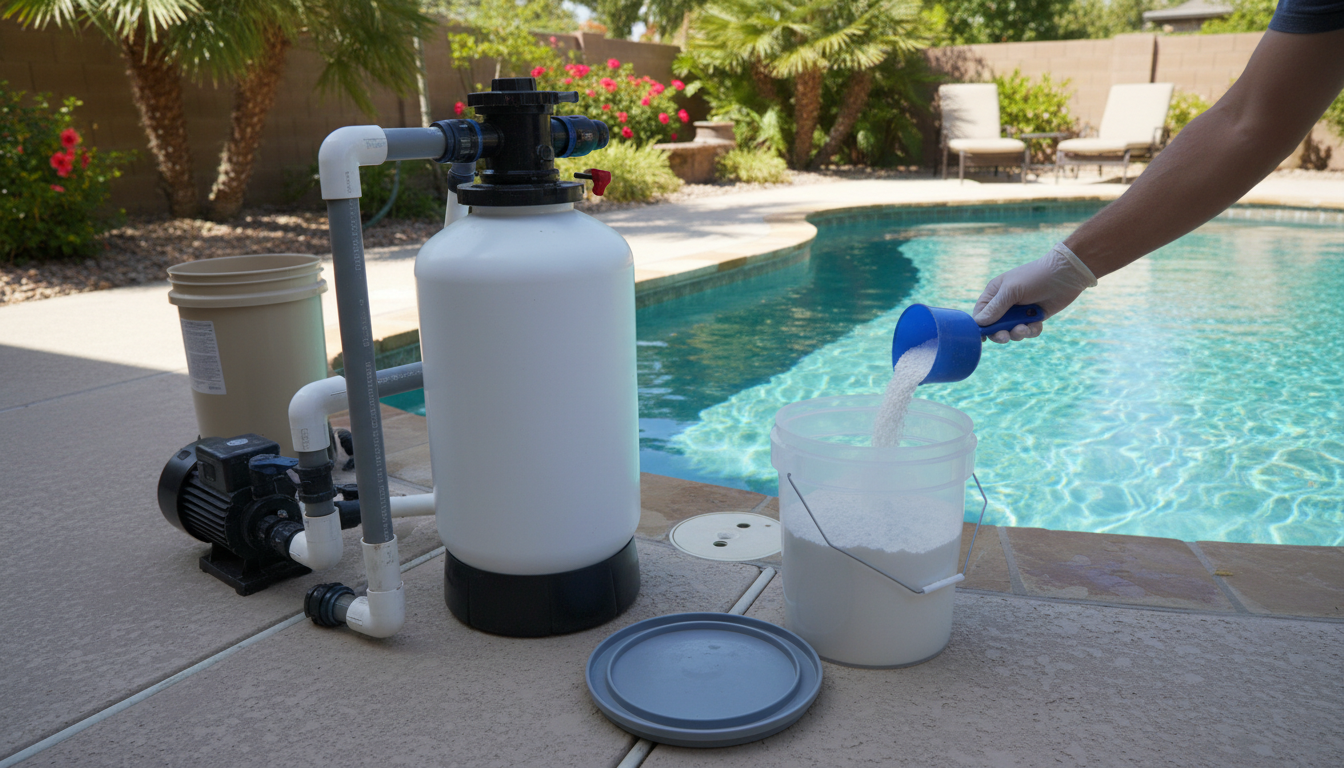
How Much DE Powder to Add to a 48 Sq Ft Filter After Backwashing
You flip the backwash valve, run the pump until the sight glass clears, and then stare at the DE bag wondering exactly how much goes back in. It should be a simple step, but the bag says nothing about a 48 square foot filter, and guessing too high or too low both cause real problems.
The answer is 4.8 pounds of DE powder for a 48 square foot filter after a full backwash – which works out to roughly 6 scoops with a standard 1-cup scoop. That number comes straight from the industry standard of 0.1 pounds of DE per square foot of filter area. The rest of this article walks through how to measure it accurately, how to add it without clouding your pool, and the mistakes that trip up even experienced pool owners.
Why the 0.1 Pound Per Square Foot Rule Works
DE filters trap particles by coating a set of fabric-covered grids with diatomaceous earth powder. Each square foot of grid surface needs 0.1 pounds of DE to build an effective, even coating. A 48 sq ft filter has 48 square feet of grid area, so the math is direct: 48 x 0.1 = 4.8 lbs. This is not a rough estimate – it is the manufacturer-recommended charge rate used across brands including Pentair, Hayward, and Jandy. Ask the Pool Guy’s breakdown of Pentair DE filter sizing confirms this same formula applies regardless of which brand of filter you own.
The coating has to be thin enough to let water flow through at normal pressure, but complete enough to catch particles down to 2 to 5 microns. Too little DE and the grids are partially bare, letting fine debris slip through. Too much DE and you pack the grids so tightly that pressure spikes and DE can push back into the pool. 4.8 pounds is the sweet spot for a 48 sq ft unit.
Converting Pounds to Scoops: The Real-World Measure
Almost nobody weighs DE on a kitchen scale at the pool pad. You use a scoop – but scoop sizes vary, and that is where the confusion starts. Here is how the math shakes out by common scoop size:
- 1-cup scoop (approx. 0.8 lbs per scoop): Use 6 scoops to hit 4.8 lbs. This is the most common scoop size sold with DE powder.
- 2-cup scoop (approx. 1.6 lbs per scoop): Use 3 scoops.
- Coffee-can method: A standard 1-lb coffee can holds roughly 1 lb of DE. Use just under 5 cans.
Engineer Fix’s guide to scooping DE for a 48 sq ft filter walks through the density variation across brands and explains why the listed scoop count on the bag sometimes differs from what the math suggests – it depends on whether the manufacturer is using a heaped or level scoop. When in doubt, weigh it once and mark your scoop with a marker line so you never have to guess again.
Step-by-Step: How to Add DE After Backwashing
Adding DE correctly means it coats the grids evenly instead of clumping or blowing straight through. Follow these steps every time after a backwash:
- Return the multiport valve to the Filter position and restart the pump. Do this before adding DE – the pump needs to be running to pull the powder in through the skimmer.
- Measure your DE. For a 48 sq ft filter, measure out 4.8 lbs (6 standard scoops).
- Pre-mix in a bucket. Add the DE powder to a 5-gallon bucket half-filled with pool water. Stir it into a thin slurry. This step prevents DE from clumping at the skimmer throat and distributing unevenly across the grids.
- Pour the slurry slowly into the skimmer. Use the skimmer closest to the pump. Pour steadily over about 30 seconds – do not dump it all at once.
- Note your clean baseline pressure. Check the pressure gauge 5 minutes after adding DE and write down that number on a piece of tape stuck to the filter tank. That is your new starting pressure. You will backwash again when it climbs 8 to 10 PSI above that reading.
For a detailed walkthrough of the backwash process itself before you get to the recharge step, Gohlke Pools’ guide to backwashing a DE filter is a solid reference, and Central Jersey Pools covers the same process with notes on what the sight glass should look like at different stages.
What Happens If You Get the Amount Wrong
Both over-dosing and under-dosing create visible, frustrating problems. Knowing what each one looks like helps you diagnose the cause fast.
- Too little DE: The grids are partially bare, so fine particles pass straight through. Your pool water goes cloudy, often within a few hours of running the pump. Pressure may also stay lower than your baseline because there is not enough powder creating proper flow resistance.
- Too much DE: Pressure climbs faster than it should, you end up backwashing more often, and excess powder can be forced back into the pool as a white dusty film or powder on the pool floor. If you see that film after adding DE, you over-dosed.
- DE added without the pump running: The powder settles at the bottom of the skimmer and pipes instead of coating the grids. You get clumped grids on one side, bare grids on the other, and the filter performs poorly. Always confirm the pump is running before you pour.
If cloudy water shows up despite what looks like a correct DE charge, it may be a separate issue with water chemistry rather than the filter. Our article on cloudy pool water causes and fixes walks through the non-filter reasons water can turn milky fast.
Partial Backwash vs. Full Backwash: Does the DE Amount Change?
Some pool owners do a quick 1-minute backwash to knock the pressure down a few PSI without fully dumping all the DE. In that case, you do not need a full 4.8 lb recharge. A quick rule of thumb: add 1 lb of DE for every 2 PSI of pressure relief you achieved. So if you ran a short backwash and dropped pressure by 4 PSI, add about 2 lbs of DE to replenish what was flushed out.
A full backwash – running until the sight glass clears completely, typically 2 to 3 minutes – removes nearly all the DE from the grids. That is when you go back to the full 4.8 lb charge. If you are unsure whether you did a partial or full backwash, play it safe and add the full amount. You can always backwash again in a few days if pressure climbs too fast, but you cannot easily add more filtration capacity to grids that are already caked.
When to Do a Full Filter Teardown Instead
Backwashing removes the DE and loose debris, but it does not remove oils, scale, and the fine debris baked into the grid fabric over a full season. Once a year – typically at opening or closing – you should do a full teardown: pull the grids, soak them in a grid cleaner solution, rinse them individually, inspect for tears, and reassemble before adding a fresh charge. A torn grid lets DE blow directly into the pool no matter how precisely you measure your dose.
AquaDoc makes a DE powder formulated for consistent particle size, which pool owners find helpful when fine filtration matters most – particularly after heavy algae treatments when you need the filter working at its best. Pair a clean set of grids with properly dosed DE and you will get the full 2 to 5 micron filtration a DE system is capable of. Also worth knowing: if your filter grids are more than 5 to 7 years old and tearing repeatedly, no amount of correct dosing will fix failing fabric. Replacement grids run $80 to $250 depending on the filter model.
While you have the filter open, it is also a good time to check surrounding equipment. If your filter sustained any physical damage from weather or debris impact, our guide to repairing pool equipment after a storm covers what to inspect and what typically needs a pro.
Frequently Asked Questions
How much DE do I add to a 48 sq ft filter after backwashing?
Add 4.8 pounds of DE powder after a full backwash of a 48 sq ft filter. Using a standard 1-cup (roughly 0.8 lb) DE scoop, that works out to about 6 scoops. Always pre-mix the powder in a bucket of water before pouring it through the skimmer to ensure the grids coat evenly.
How many scoops of DE for a 48 sq ft filter?
About 6 scoops using a standard 1-cup DE scoop, which holds roughly 0.8 pounds of powder. If your scoop is a 2-cup size, use 3 scoops. Check the label on your DE container for the exact weight per cup, since density can vary slightly, and consider marking your scoop at the correct fill line after weighing it once.
Can you add too much DE powder to a pool filter?
Yes, and it causes real problems. Overfilling packs the grids too tightly, raises filter pressure faster than normal, and can force excess DE back into the pool as a white dusty film on the floor. Stick to the manufacturer’s rated capacity – for a 48 sq ft filter, that is 4.8 lbs after a full backwash.
How often should you backwash a DE filter?
Backwash a DE filter when the pressure gauge reads 8 to 10 PSI above the clean baseline pressure you noted after the last DE recharge. For most pools, that happens every 4 to 6 weeks during swimming season, though heavy bather loads or algae blooms can shorten that interval to under two weeks. Pool Stop’s backwashing guide has a good visual walkthrough of the pressure-monitoring process.
Do you have to add DE every time you backwash?
Yes, every time. Backwashing flushes the spent DE out of the filter along with the trapped debris, leaving the grids bare. Without a fresh coat of DE powder, bare grids cannot filter properly and will let fine particles through, turning your pool water cloudy within hours of running the pump.
For a 48 square foot DE filter, 4.8 pounds – roughly 6 standard scoops – is the right charge every time you complete a full backwash. Measure it, slurry it, and pour it in while the pump is running, and your filter will be back to peak performance within minutes.