
Salt Chlorinator Monthly Running Cost by Pool Size
A saltwater chlorinator's monthly running cost depends on your pool size, your electricity rate, and how hard your cell is working. This breakdown covers real numbers for pools from 10,000 to 40,000 gallons so you know exactly what to expect on your electric bill.

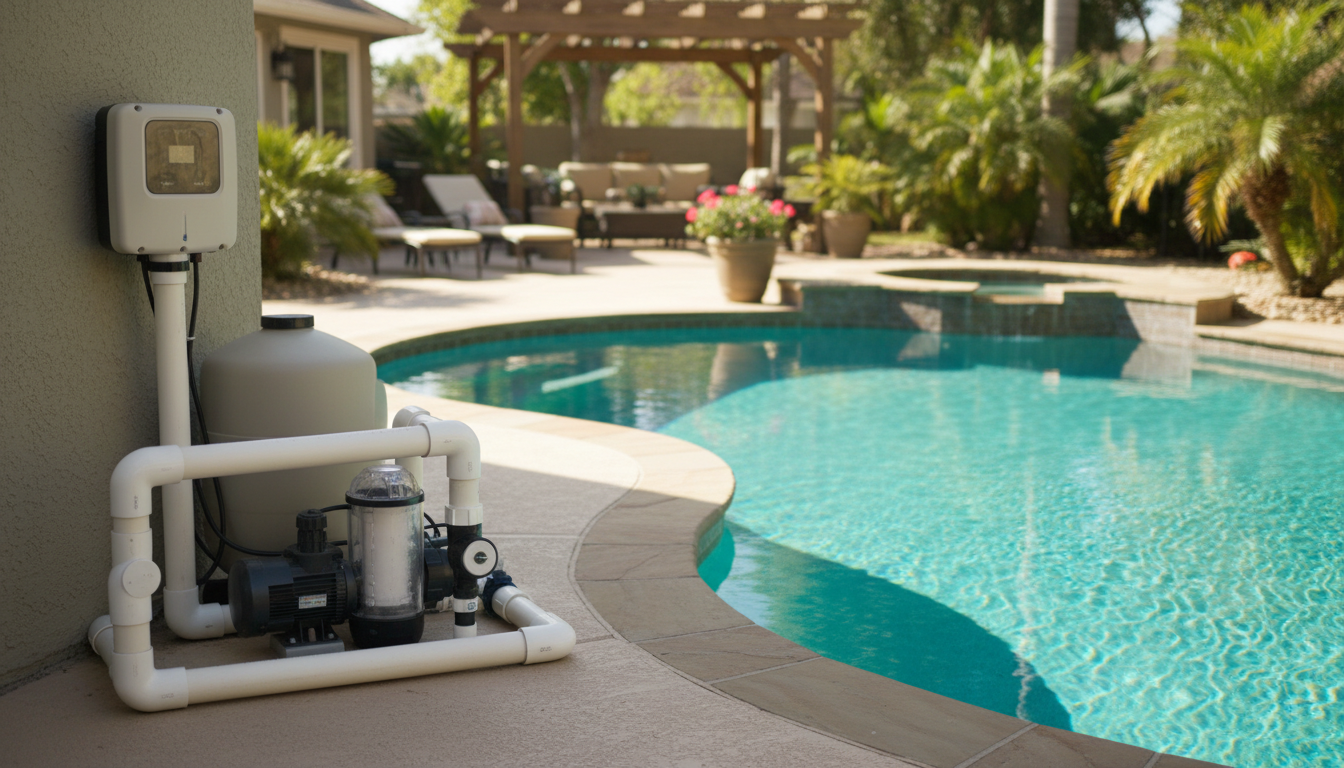
Salt Chlorinator Monthly Running Cost by Pool Size
You switched to a saltwater pool to simplify your life and cut chemical costs, but now your electricity bill looks a little higher and you’re wondering exactly how much of that is the chlorinator. It’s a fair question, and the answer is more specific than most people realize.
A residential saltwater chlorinator adds roughly $5 to $30 per month to your electric bill depending on pool size, cell wattage, daily run time, and your local electricity rate. That range is wide because a cell sized for a 10,000-gallon pool draws very differently than one built for a 40,000-gallon pool. This article walks through the real numbers for each common pool size, explains the variables that move the cost up or down, and shows you how to calculate your own monthly figure in about two minutes.
What a Salt Chlorinator Actually Draws
A salt chlorinator consists of two parts: the control box (the brains) and the cell (the electrolytic plates that generate chlorine from salt dissolved in the water). The control box draws very little power on its own, usually 5 to 20 watts. The cell is where the real draw happens, and it scales with the size of the unit. Small cells rated for pools up to 15,000 gallons typically draw 80 to 120 watts. Mid-range cells for 20,000 to 30,000-gallon pools draw 120 to 200 watts. Large cells for 35,000 to 40,000-gallon pools can draw 200 to 300 watts or more.
The cell only runs while your pump is running, since it needs water flowing through it to operate safely. That means your daily run time is set by your pump schedule, not by the chlorinator itself. Most pools run 8 to 12 hours a day in summer and 4 to 6 hours in off-peak months.
Monthly Cost by Pool Size: The Real Numbers
The table below uses a typical cell wattage for each pool size, an 8-hour daily run time at 70 percent output (a common real-world setting), and a rate of $0.17 per kWh, which is close to the 2024 U.S. residential average. Your rate may be higher (California averages $0.28) or lower (parts of the South run $0.12), so use the formula in the next section to adjust.
| Pool Size (gallons) | Typical Cell Size (rated) | Cell Wattage (approx.) | Monthly kWh (8 hrs/day) | Monthly Cost at $0.17/kWh |
|---|---|---|---|---|
| 10,000 | 15,000-gal cell | 90W | 21.6 kWh | ~$3.70 |
| 15,000 | 20,000-gal cell | 130W | 31.2 kWh | ~$5.30 |
| 20,000 | 25,000-gal cell | 160W | 38.4 kWh | ~$6.50 |
| 25,000 | 30,000-gal cell | 200W | 48.0 kWh | ~$8.15 |
| 30,000 | 35,000-gal cell | 240W | 57.6 kWh | ~$9.80 |
| 40,000 | 40,000-gal cell | 290W | 69.6 kWh | ~$11.85 |
Why These Numbers Matter for Your Decision
Notice that even for a 40,000-gallon pool, the chlorinator itself costs under $12 a month at the national average rate. That context matters because the pump running that same pool can easily cost $40 to $80 a month on a single-speed motor. The chlorinator is rarely your biggest electricity draw; if your bill jumped after going saltwater, the culprit is almost certainly a longer pump schedule your installer programmed rather than the cell itself.
Output percentage is another big lever. Running your cell at 50 percent output instead of 100 percent cuts electricity draw roughly in half, and for many pools with moderate bather loads and good chemistry, 50 to 70 percent is all you need during the swimming season. Only heavy swim weekends or a heat wave that pushes your pool above 84 degrees should push you toward 90 to 100 percent output.
How to Calculate Your Own Monthly Cost in Two Minutes
You don’t need a pool pump size calculator or a spreadsheet. Just three numbers: your cell’s wattage (check the label on the unit or the manual), your daily pump run time in hours, and your electricity rate in dollars per kWh (find it on your utility bill).
- Convert watts to kilowatts: Divide the cell wattage by 1,000. A 160-watt cell becomes 0.16 kW.
- Calculate daily kWh: Multiply 0.16 kW by your daily run hours. At 10 hours per day, that’s 1.6 kWh per day.
- Calculate monthly kWh: Multiply daily kWh by 30. So 1.6 x 30 = 48 kWh per month.
- Calculate the cost: Multiply monthly kWh by your rate. At $0.20/kWh, that’s 48 x $0.20 = $9.60 per month.
Say your pool holds 24,000 gallons and you’re running a 200-watt cell for 10 hours a day in summer. That’s 0.20 kW x 10 hours x 30 days = 60 kWh per month. At California’s $0.28 rate, you’re paying about $16.80 a month. At a Southern rate of $0.12, it’s $7.20. Same pool, same cell, more than double the cost depending on where you live.
The Hidden Costs Beyond Electricity
Monthly electricity is only part of the real cost of running a salt chlorinator. Salt itself needs occasional topping up, and while the amount a saltwater pool loses each month is smaller than most people expect, it adds up over a season. A 50-pound bag of pool salt costs $8 to $20 depending on your region, and most pools need one to three bags replenished per season after initial fill.
Cell replacement is the cost that sneaks up on owners. A quality replacement salt cell runs $200 to $700 and needs replacing every 5 to 7 years under normal conditions. Amortized monthly, that’s $3 to $10 per month stacked on top of electricity. Add those two together and the true monthly operating cost of a chlorinator sits at roughly $10 to $25 per month for most residential pools, which still undercuts the cost of buying bulk chlorine tablets or shock for a comparably sized traditional chlorine pool.
One thing that quietly extends cell life: keeping your chemistry dialed in. pH is the big one. When pH drifts above 7.8, calcium scales the cell plates faster, reducing efficiency and forcing you to run at higher output to hit your target chlorine level. Keep pH between 7.4 and 7.6, salinity between 3,000 and 3,500 ppm, and clean the cell with a mild acid solution every three months. AquaDoc’s salt cell cleaner is formulated specifically for this type of routine rinse – one of the small maintenance products pool owners use to stretch a $400 cell to its full 7-year lifespan instead of replacing it at year four.
Common Mistakes That Inflate Your Running Costs
- Undersizing the cell: If your pool holds 25,000 gallons and your cell is rated for 20,000, you’ll run it at 100 percent output constantly, burning more electricity and wearing out the plates in 3 to 4 years instead of 6 or 7.
- Running 12-hour pump cycles year-round: Summer demands it. Winter usually doesn’t. Drop to 4 to 6 hours in the off-season and you cut the chlorinator’s electricity draw proportionally.
- Ignoring pH drift: High pH forces you to run the cell harder to compensate for reduced chlorine effectiveness. Every tenth of a pH point above 7.6 is working against you.
- Skipping cell cleaning: A scaled cell draws the same wattage but produces less chlorine, so you compensate by cranking the output setting higher. You pay more in electricity and shorten the cell’s life at the same time.
If you’ve converted your pool from a traditional chlorine system recently, you might also be thinking about pool brushing routines, since salt water does affect certain surfaces differently. The best pool brushes for saltwater pools are worth reading before your next weekly brush-down to make sure you’re not inadvertently damaging your finish.
Frequently Asked Questions
How much does it cost to run a saltwater chlorinator per month?
For most residential pools, a salt chlorinator adds between $5 and $30 per month to your electric bill depending on pool size and local electricity rates. A cell sized for a 20,000-gallon pool typically draws 100 to 200 watts and runs 8 to 12 hours a day, putting the monthly electricity cost around $10 to $18 at the U.S. average rate of $0.17 per kWh. Actual chemical and cell amortization costs add another $5 to $15 on top of that.
What size salt chlorinator do I need for a 20,000-gallon pool?
A 20,000-gallon pool needs a chlorinator rated for at least 20,000 gallons, and sizing up 20 to 30 percent – to a 25,000-gallon-rated cell – is smart if your pool gets heavy use or sits in a hot climate. Running an undersized cell at 100 percent output shortens its lifespan significantly, often cutting it from 5 to 7 years down to 3. The higher wattage of the larger cell adds only $1 to $2 per month in electricity but buys years of additional cell life.
Does a saltwater chlorinator use a lot of electricity?
No. A salt cell is one of the lower-draw devices on your pool equipment pad. Most residential cells consume 100 to 300 watts, far less than a single-speed pump (750 to 1,500 watts) or an electric heater (5,000 to 10,000 watts). The biggest electricity cost at any pool is almost always the pump, not the chlorinator, so if your bill spiked after going saltwater, check your pump’s run schedule first.
How long does a salt cell last before it needs replacing?
A properly maintained salt cell lasts 5 to 7 years on average. Keeping salinity in the 3,000 to 3,500 ppm range, maintaining pH between 7.4 and 7.6, and cleaning the cell with a mild acid rinse every three months extends life toward the higher end of that range. Running a cell at 100 percent output continuously, or letting calcium scale build up unchecked, is the fastest way to shorten its life to 3 years or fewer.
What is the total monthly cost to own a saltwater pool vs a chlorine pool?
A saltwater pool typically costs $20 to $50 per month to maintain in chemicals and electricity combined, versus $50 to $100 per month for a traditional chlorine pool when you factor in chlorine tablet and shock purchases. The savings come from replacing bulk chlorine with the electricity cost of generating it on-site. The one periodic cost to plan for is salt cell replacement every 5 to 7 years at $200 to $700, which traditional chlorine pools don’t have.
The bottom line: for most pools between 10,000 and 40,000 gallons, the chlorinator itself costs less than $15 a month in electricity. Size your cell generously, keep your chemistry tight, and that number stays low for years.