
CYA Remaining After Draining 3 Inches a Week for 12 Weeks in a 20,000-Gallon Pool
Draining 3 inches a week for 12 weeks removes a surprising amount of water from a 20,000-gallon pool, and your CYA level drops with every inch. This post walks through the exact dilution math so you know what stabilizer you are actually closing with and whether you need to add more before winter.

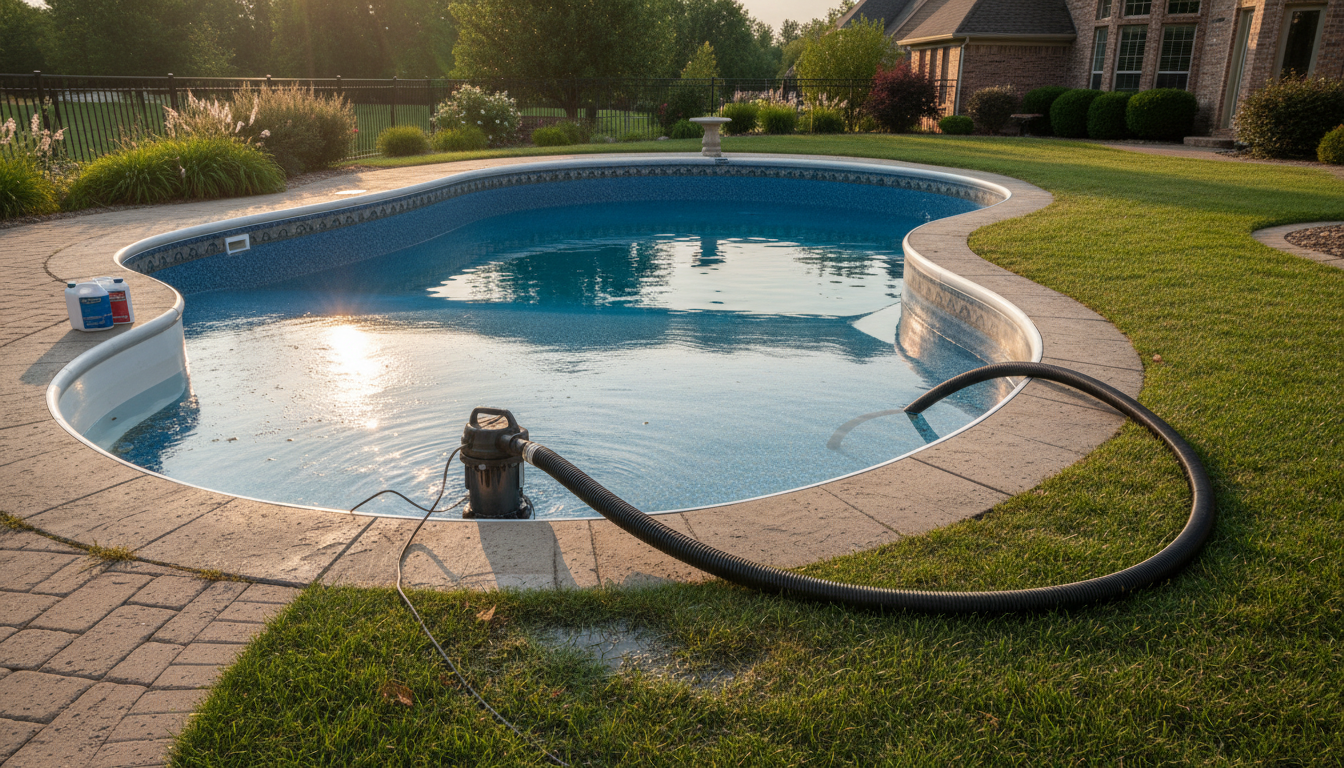
CYA Remaining After Draining 3 Inches a Week for 12 Weeks in a 20,000-Gallon Pool
A 20,000-gallon pool that loses 3 inches to drainage every week for 12 weeks and is refilled each time ends up with approximately 24 ppm of CYA remaining if it started at 50 ppm. That is roughly a 52 percent reduction from dilution alone, and it happens without adding a single chemical or forgetting a single dose. The math compounds week over week, so the losses in weeks 10 through 12 are smaller in absolute terms but the total is still significant.
If you have been topping off your pool all season to manage overflow, rain, or water chemistry, the stabilizer bleed is real and measurable. Understanding exactly how much is left before you close tells you whether you are walking into spring underprotected or right on target. This article walks through the full dilution calculation, a worked example with real numbers, and what to do if the result is too low for a solid close.
Why Weekly Drainage Bleeds Out Stabilizer
Cyanuric acid (CYA) does not break down in pool water the way chlorine does. It does not evaporate, it does not get consumed by sunlight, and it does not react away over winter. The only way it leaves the pool is with the water itself. When you drain 3 inches and refill with fresh tap water, you are removing a fixed percentage of the pool’s total volume, and the CYA concentration drops by that same percentage. Refill water from a city supply or well contains zero CYA, so every refill dilutes what is already there.
Three inches of water sounds modest, but on a 20,000-gallon pool with a typical surface area of roughly 500 square feet, 3 inches equals about 1,250 gallons per week. That is 6.25 percent of the pool’s volume leaving and being replaced each week. For a full picture of how water leaves a pool beyond intentional draining, understanding Pool Losing Water: Evaporation or a Leak? Here’s How to Know is worth reviewing before close.
The Dilution Math: Week by Week
Each week you replace 6.25 percent of the pool volume, which means 93.75 percent of the water (and CYA) stays behind. The retention factor per week is 0.9375. Applying that factor repeatedly for 12 weeks gives you the cumulative fraction of original CYA that remains:
Remaining fraction = 0.9375 raised to the power of 12 = 0.4723
That means roughly 47 percent of the original CYA is still in the pool after 12 weeks of this drain-and-refill cycle. The remaining 53 percent left with the drained water.
Worked Example: Starting at 50 ppm
Say your pool holds 20,000 gallons and your CYA was at 50 ppm when summer started in late May. You have drained 3 inches every week from mid-June through early September, 12 drain-and-refill cycles total. Here is what the numbers look like at key checkpoints:
| Week | Cumulative Retention Factor | CYA Remaining (ppm) from 50 ppm Start |
|---|---|---|
| 0 (start) | 1.000 | 50 ppm |
| 4 | 0.777 | 39 ppm |
| 8 | 0.603 | 30 ppm |
| 10 | 0.527 | 26 ppm |
| 12 | 0.472 | 24 ppm |
Why These Numbers Matter at Closing Time
By week 8 you are already at the low edge of the acceptable range (30 ppm), and by week 12 you are under it at 24 ppm. That matters because CYA does two things heading into fall. First, it shields any chlorine you add as part of your closing dose from UV degradation during those last warm days before the cover goes on. Second, in pools that see sun in early spring before the owner opens officially, residual CYA helps protect the chlorine level from crashing before anyone tests it. Closing with 24 ppm instead of 40 to 50 ppm leaves you more exposed on both fronts.
If you started the season at a different level, multiply your starting CYA by 0.472 to find where you land after 12 weeks of 3-inch weekly drainage. Starting at 70 ppm? You end up at about 33 ppm, which is acceptable but tight. Starting at 40 ppm? You land at 19 ppm, which is too low to close on without a top-up.
What to Do If Your CYA Is Below 30 ppm Before Closing
Test first, always. A drop-based test kit or a good reagent strip will confirm the actual number before you buy anything. If the level is below 30 ppm, raise it before you shut down. For a 20,000-gallon pool:
- To raise CYA by 10 ppm: Add 1.3 lbs of granular cyanuric acid. Dissolve it in a bucket of warm water first to speed dissolution, then pour it in front of a return jet with the pump running.
- To raise CYA by 20 ppm: Add 2.6 lbs using the same method. Run the pump for at least 24 hours before retesting.
- Target range at closing: 30 to 50 ppm. There is no UV load in winter, so you do not need 50 to 70 ppm the way you might in July. Closing at 30 to 40 ppm is enough to protect early-season chlorine if the cover comes off in a sunny week.
AquaDoc makes a granular stabilizer that dissolves cleanly without leaving residue at the bottom, which matters at this time of year when you do not want to disturb settled debris before the cover goes on. Add it at least two days before you close so the pump can fully distribute it.
For a broader look at where stabilizer fits in your overall pool chemistry strategy, the guide on Pool Stabilizer: When You Need It, When It’s Already Too High covers the full picture of CYA management from opening to close.
Common Mistakes With Pre-Close CYA
- Skipping the test: Assuming the level is fine because you added stabilizer in May leads to surprises. Twelve weeks of water loss changes the number more than most people expect.
- Adding stabilizer too late: Cyanuric acid takes 24 to 48 hours to fully dissolve and distribute. If you add it the same day you close, the pump is already off and the product sits undistributed at the return.
- Overcorrecting: There is no UV to fight in winter, so chasing 60 or 70 ppm before closing is unnecessary. It just means you open in spring with a level that is already climbing toward the range where chlorine efficiency starts to drop.
- Forgetting that refill source matters: Well water with high iron or calcium can affect pool chemistry beyond just CYA dilution. If your top-off water is from a well, test it separately before the close.
Frequently Asked Questions
How much CYA is left in a 20,000-gallon pool after draining 3 inches a week for 12 weeks?
Starting at 50 ppm, roughly 24 ppm of CYA remains after 12 weeks of 3-inch weekly draining and refilling on a 20,000-gallon pool. The cumulative retention factor is 0.472, so you keep about 47 percent of whatever you started with. Test before closing and add stabilizer if the level has dropped below 30 ppm.
Does draining and refilling a pool lower CYA?
Yes, every time you drain water and refill with fresh water you dilute the cyanuric acid already in the pool. Fresh tap water or well water contains no CYA, so each drain-and-refill cycle lowers the concentration by the fraction of total volume replaced. Over 12 weeks this compounds into a substantial reduction.
What CYA level should I have when closing a pool for winter?
Aim for 30 to 50 ppm at closing. CYA below 30 ppm can let UV degrade any chlorine present during the last warm days before the cover goes on and during early spring before you officially open. CYA above 70 ppm at closing can limit chlorine effectiveness when you open in spring and start dosing again.
How much stabilizer do I need to add to a 20,000-gallon pool to raise CYA by 10 ppm?
Add approximately 1.3 lbs of granular cyanuric acid to raise CYA by 10 ppm in a 20,000-gallon pool. Dissolve it in a bucket of warm water first, then pour it in front of a return jet with the pump running. Retest after 24 to 48 hours to confirm the level before closing.
Does a pool lose more stabilizer from backwashing or from weekly draining?
Weekly draining removes far more water and therefore more CYA than a typical backwash cycle. A single backwash sends roughly 200 to 300 gallons out of the system, while 3 inches of drainage from a 20,000-gallon pool represents about 1,250 gallons per week. Over a full season, weekly drain-and-refill cycles are the dominant source of CYA loss.
If your 20,000-gallon pool started the season at 50 ppm and you drained 3 inches every week for 12 weeks, you are closing with roughly 24 ppm. Test before you close, top up to 30 to 50 ppm if needed, and give the pump at least two days to distribute the stabilizer before you shut everything down.