
Muriatic Acid for a 20,000-Gallon Saltwater Pool When pH Hits 8.2
When a saltwater pool's pH climbs to 8.2 mid-season, the fix is usually 1 to 1.5 quarts of muriatic acid for a 20,000-gallon pool, but the exact dose depends on your total alkalinity too. This guide walks through the full dosing calculation, how to add acid safely, and why saltwater systems push pH high in the first place.

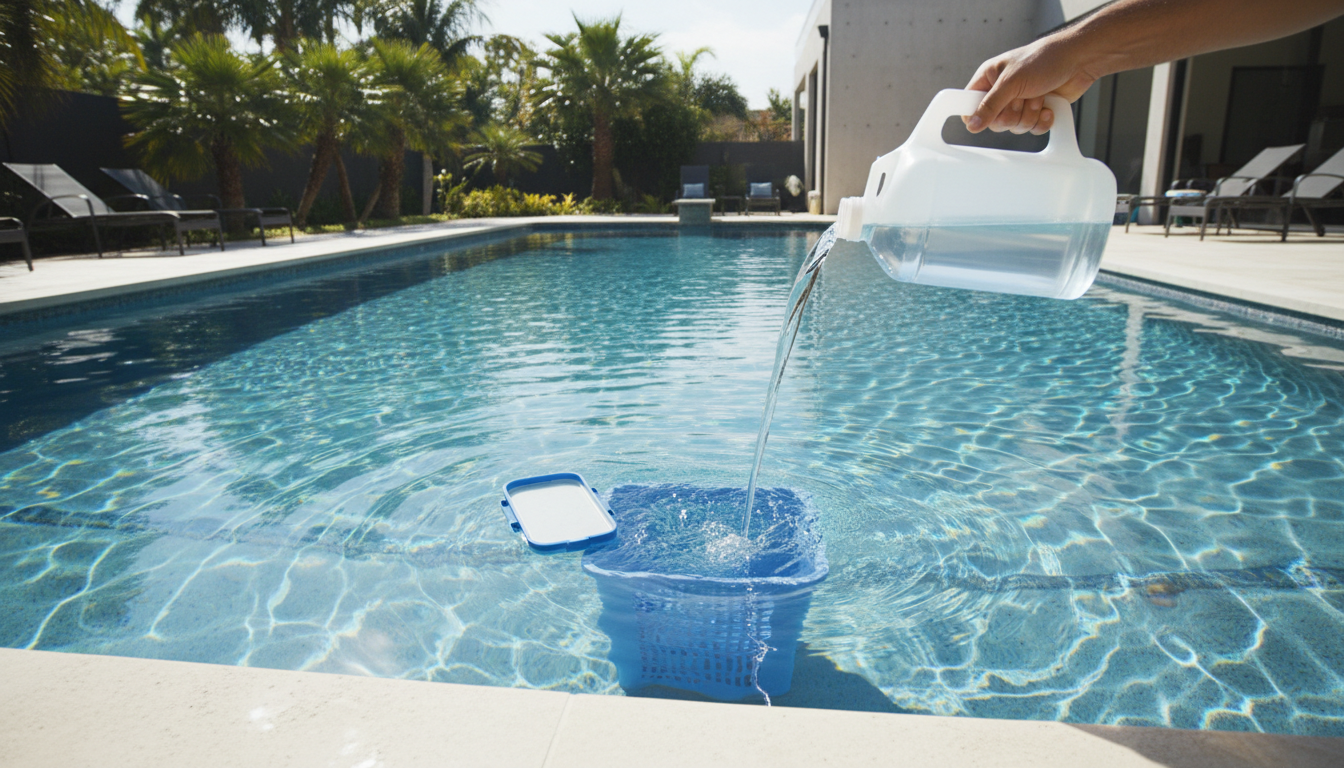
Muriatic Acid for a 20,000-Gallon Saltwater Pool When pH Hits 8.2
To lower pH from 8.2 to the target range of 7.4 to 7.6 in a 20,000-gallon saltwater pool, add 1.25 to 1.5 quarts of 31.45% muriatic acid. That range covers most real-world scenarios, but your total alkalinity reading will shift the number up or down, so read through the dosing math before you grab the jug.
If you’ve watched your saltwater pool’s pH creep up faster than your chlorine tabs ever let it, you’re not imagining things. Salt chlorine generators are inherently pH-raising machines, and mid-season heat only makes it worse. By the time pH hits 8.2, your chlorine is already running at reduced effectiveness, since chlorine loses roughly half its sanitizing power above 8.0. Getting it corrected quickly matters, and getting the dose right the first time means you won’t overshoot and spend the next day chasing it back up.
Why Saltwater Pools Are Prone to High pH
A salt cell works by running electricity through saltwater to produce chlorine as sodium hypochlorite. That process also off-gasses carbon dioxide from the water, and when CO2 leaves, pH rises. The more your cell runs (which is a lot in mid-season), the more pH climbs. Add in warm water temperatures, splashing returns, and any waterfalls or spillovers, and you have a system that naturally pushes pH toward 8.0 and above on a weekly basis.
Conventional chlorine pools deal with this too, but salt pools tend to drift higher, faster. A pH of 8.2 is not a crisis, but it means your free chlorine is operating at roughly 20% of its rated effectiveness. For a pool that may already be leaning on the cell to keep up with summer bather loads, that gap matters.
The Dosing Calculation: How to Get the Right Amount
Standard pool chemistry guidance gives you a useful baseline: 1 quart of 31.45% muriatic acid lowers pH by approximately 0.2 points in a 10,000-gallon pool when alkalinity is in the normal range of 80 to 120 ppm. Scale that to 20,000 gallons and you need roughly 1 quart per 0.1-point drop. To go from 8.2 to 7.4 (a drop of 0.8 points), that works out to about 1.5 to 1.6 quarts total.
In practice, most pool owners target 7.4 to 7.6 rather than exactly 7.4, so you can round down to 1.25 quarts as your starting dose, retest after the acid circulates, and add a second small slug if needed. Here is a worked example using real numbers:
- Pool volume: 20,000 gallons
- Starting pH: 8.2
- Target pH: 7.4 to 7.6
- Total alkalinity: 100 ppm (normal range)
- Acid concentration: 31.45% (standard pool-grade muriatic acid)
- First dose: 1.25 quarts, let circulate 30 minutes, then retest
- Second dose if needed: 0.25 to 0.5 quarts to finish the correction
If your total alkalinity is running high (say, 140 to 160 ppm), that buffer fights every pH drop you try to make, and you will likely need closer to 2 quarts across two or three doses to reach your target. High TA is worth correcting on its own. Understanding pool volume and how it scales chemical doses is a core skill; if you’re ever unsure whether your pool is actually 20,000 gallons, the breakdown in How Many Gallons Is an 18×36 Inground Pool and What It Means for Chemicals shows exactly how to verify your volume by dimensions.
How to Add Muriatic Acid Safely
Muriatic acid burns skin and eyes on contact and releases fumes that irritate your lungs. Respect it and you’ll be fine. Rush it and you’ll regret it.
- Gear up first: Wear chemical-resistant gloves, safety glasses, and old clothes. Have the garden hose nearby before you open the jug.
- Turn off the salt cell: Set it to 0% output or switch it to standby. Running chlorine through a fresh acid dose adds unnecessary wear on the titanium plates.
- Keep the pump running: You need water circulating so the acid disperses evenly rather than pooling on the floor.
- Pre-dilute when possible: Pour the measured acid slowly into a bucket of water first (always acid into water, never water into acid). Then pour the diluted mixture in front of a return jet.
- Add at the return jet: Walk the solution around the perimeter if the pool is large. Avoid pouring directly over a vinyl liner or near a main drain.
- Wait 30 minutes, then retest: Use a reliable test kit to check pH and also recheck alkalinity before deciding whether to add a second dose.
- Turn the cell back on: Once pH is in the 7.4 to 7.6 range, resume normal cell output.
What Total Alkalinity Does to Your Dose
Total alkalinity (TA) is the most overlooked variable in pH correction. Think of it as the pool water’s resistance to pH change. Higher TA means you need more acid to move the needle, and it also means pH will bounce back upward faster after you correct it. The sweet spot for a saltwater pool is 80 to 100 ppm, which is slightly lower than the 100 to 120 ppm often cited for conventional pools. Running TA at the lower end of that range gives your salt cell’s natural pH-raising tendency less buffer to fight through.
If your TA is above 120 ppm when pH also hits 8.2, consider doing a dedicated alkalinity reduction first. Add acid in several small doses over 24 hours, brush the pool floor to outgas CO2, and let TA settle before you do a final pH correction. This two-stage approach uses less acid overall and gives you a more stable result. AquaDoc’s pH Minus is a dry acid option some pool owners prefer for this staged approach because it’s easier to dose incrementally without handling a liquid jug repeatedly.
How Often Will You Need to Do This Mid-Season?
In most climates, a mid-season saltwater pool running its cell at 50 to 70% output will need pH correction every seven to fourteen days. If yours is drifting to 8.2 in less than a week, check a few things:
- Cell output setting: Oversized output for your bather load means more CO2 off-gassing and faster pH rise. Dial it back if chlorine levels are routinely high.
- Aeration sources: Waterfalls, spillovers, and therapy jets all off-gas CO2. If yours run constantly, pH will climb faster.
- Alkalinity creep: If you’re regularly adding baking soda to maintain TA, you’re feeding the pH rise cycle. Keep TA at 80 to 100 ppm and resist the urge to push it higher.
- Water temperature: Warm water holds less CO2, so pH rises faster in summer. This is normal, not a sign something is broken.
Persistent cloudiness after a pH swing can be a secondary problem. If your water looks hazy after you’ve corrected chemistry, the article on cloudy pool water: what’s causing it and how to fix it fast covers the most common culprits and fixes.
Common Mistakes to Avoid
- Adding too much at once: Pouring more than 1 quart at a time into a 20,000-gallon pool can create localized low-pH zones that etch plaster or bleach vinyl. Split larger doses and always retest between them.
- Testing too soon: pH needs at least 30 minutes to fully equilibrate after acid addition. Testing at 10 minutes will give you a falsely low reading and tempt you to stop too early.
- Ignoring alkalinity: Correcting pH without checking TA first is guesswork. A $15 drop-based test kit or a good digital meter takes two minutes and removes all the uncertainty.
- Adding acid with the cell running: The chlorine gas produced at the cell reacts poorly with freshly added acid near the return lines. Give the system at least 30 minutes of acid-only circulation before restarting the cell.
- Using diluted or aged acid: Pool-grade muriatic acid at 31.45% is the standard. Some hardware-store jugs are 20% or 15.7% (also labeled as “safer” or “low-fume” formulas). If you use a lower concentration, increase the volume proportionally or you’ll underdose.
Frequently Asked Questions
How much muriatic acid do I need to lower pH from 8.2 to 7.4 in a 20,000-gallon pool?
For a 20,000-gallon pool with pH at 8.2 and total alkalinity in the normal range of 80 to 120 ppm, plan on 1.25 to 1.5 quarts of 31.45% muriatic acid to reach 7.4. Add 1.25 quarts first, circulate for 30 minutes, retest, and add the remainder only if needed. If your TA is above 120 ppm, you may need closer to 2 quarts across multiple doses.
Why does my saltwater pool pH keep rising?
Salt chlorine generators produce chlorine through electrolysis, a process that off-gasses carbon dioxide and naturally raises pH. Warm water, aeration from jets and waterfalls, and high cell output settings all accelerate the drift. Most active saltwater pools need pH correction every one to two weeks in summer, and that’s normal operation, not a sign of a problem.
Should I lower alkalinity before pH in a saltwater pool?
Yes, if your total alkalinity is above 120 ppm. High alkalinity resists pH correction, so fixing TA first (targeting 80 to 100 ppm for saltwater pools) means your pH acid dose will work faster and hold longer. If TA is already in range, you can go straight to pH correction without the extra step.
What happens if I add too much muriatic acid to a saltwater pool?
Dropping pH below 7.2 corrodes your salt cell’s titanium plates over time, irritates swimmers’ skin and eyes, and can etch plaster finishes. If you overshoot, add baking soda in small increments (about 1.5 lbs per 10,000 gallons raises alkalinity roughly 10 ppm) and let the pool circulate before retesting. Avoid the temptation to then over-correct back down.
Can I run my salt cell while adding muriatic acid to a 20,000-gallon pool?
Turn the cell off or set it to minimum output before adding acid. Wait at least 30 minutes after the acid has fully circulated before switching the cell back on. Running the cell through an acid dose creates unnecessary stress on the electrode plates and can cause brief localized chemistry swings near the return where the cell feeds in.
At pH 8.2, a 20,000-gallon saltwater pool needs 1.25 to 1.5 quarts of 31.45% muriatic acid to get back to the 7.4 to 7.6 target range. Add it in a single measured dose at the return jet with the pump running, wait 30 minutes, retest, and top off as needed rather than dumping it all in at once.