
Muriatic Acid Before Blowing Out Lines on a 20,000-Gallon Gunite Pool With High pH
Before you blow out the lines on a gunite pool with high pH, you need to bring pH down to the 7.2 to 7.4 range first. This post gives you the exact muriatic acid dose for a 20,000-gallon pool and walks through the right sequence so your plumbing and plaster stay protected all winter.

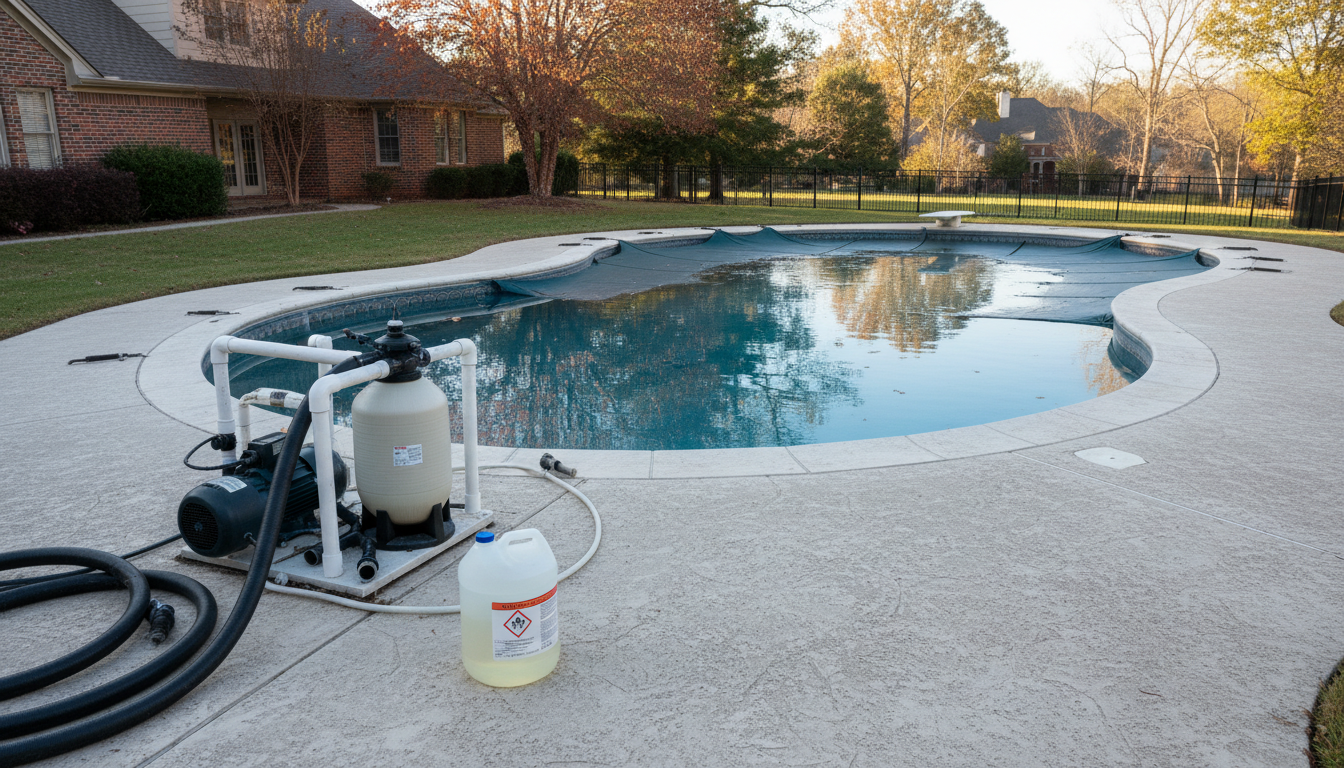
Muriatic Acid Before Blowing Out Lines on a 20,000-Gallon Gunite Pool With High pH
To lower pH from the 8.0 to 8.2 range down to 7.2 to 7.4 in a 20,000-gallon gunite pool before blowing out lines, plan on 2 to 3 quarts of 31.45% muriatic acid, added in 1-quart doses with 30 minutes of circulation between each one. If pH is pushing 8.4 or higher, budget 3 to 4 quarts. Total alkalinity plays a big role here: the higher your TA, the more acid you will burn through before pH actually moves.
If you have ever watched your pH test come back deep purple right before you planned to winterize, you know the sinking feeling. You still have to blow out the lines, but now you need to make time for a chemistry fix first. Getting that pH down is not optional on a gunite pool. High pH water sitting against plaster all winter is a reliable recipe for calcium scale, and scale in tight plumbing is a problem you do not want to find in spring.
Why pH Matters More on Gunite Before Closing
Gunite and plaster pools are porous. When the pump shuts down for the last time before winter, the water chemistry you leave behind is essentially what your plaster soaks in for the next four to six months. High pH water (anything above 7.6) is scale-forming, meaning dissolved calcium carbonate wants to precipitate out and deposit on surfaces and inside plumbing. At pH 8.0 and above, that tendency accelerates sharply.
Closing at pH 7.2 to 7.4 keeps the water slightly on the aggressive side of the Langelier Saturation Index. Slightly aggressive water dissolves light scale rather than depositing it. That is exactly what you want sitting in dormant plumbing and against a plaster surface for months at a time.
Check Total Alkalinity Before You Touch the Acid
Total alkalinity is the buffer that controls how hard pH is to move. If your TA is 150 ppm or above, you can pour acid into the pool and watch pH barely budge. You are essentially neutralizing alkalinity before the acid even starts working on pH. If your TA is in that elevated range, you need to bring it down to 80 to 120 ppm first, and then tackle pH. The article on total alkalinity vs pH and why you fix TA first explains the buffering relationship in detail and is worth reading before you open that acid jug.
Once TA is in the 80 to 120 ppm range, acid doses become much more predictable. At that alkalinity level, 1 quart of 31.45% muriatic acid in 20,000 gallons drops pH by roughly 0.3 to 0.4 units. That is the working number to keep in your head.
Worked Example: pH 8.1, TA 100 ppm, 20,000-Gallon Gunite Pool
Say your pool is 20,000 gallons, pH is 8.1, and total alkalinity is sitting at 100 ppm. You want to reach a closing pH of 7.2 to 7.4. That is a drop of about 0.7 to 0.9 pH units.
- Dose 1: Add 1 quart of muriatic acid. Run the pump for 30 minutes. Retest. Expect pH around 7.7 to 7.8.
- Dose 2: Add another 1 quart. Run the pump for 30 minutes. Retest. Expect pH around 7.4 to 7.5.
- Dose 3 (if needed): Add half a quart. Run for 30 minutes. Retest. You should land at or just below 7.4.
Total acid used: approximately 2 to 2.5 quarts. That tracks with the general rule that a 20,000-gallon pool needs about 1 quart per 0.3 to 0.4 pH units of drop when TA is in the normal range. If you overshoot below 7.0, add small amounts of baking soda to nudge pH back up before you close.
Step-by-Step Closing Sequence for Acid Addition
- Step 1: Test your water. Confirm pH, total alkalinity, and calcium hardness before touching any chemicals. You need the full picture.
- Step 2: Adjust alkalinity first. If TA is above 120 ppm, add muriatic acid in the deep end with the pump off, then brush, then run the pump. Retest after 4 hours. Repeat until TA hits 80 to 120 ppm.
- Step 3: Add acid for pH in increments. With the pump running, pour 1 quart near a return jet or in the deep end (never near the skimmer). Never add acid directly to the skimmer. Wait 30 minutes, then retest.
- Step 4: Confirm target pH of 7.2 to 7.4. Test at least twice, 15 minutes apart, to make sure pH has stabilized and is not still drifting.
- Step 5: Wait the full circulation window. Give yourself at least 4 to 6 hours of pump run time after the final acid dose before shutting down and blowing out lines. This ensures the treated water has moved through the entire plumbing loop.
- Step 6: Add winterizing chemicals, then blow out lines. Add your closing shock and algaecide, run the pump for another hour, then proceed with blowing out and plugging.
Common Mistakes That Waste Acid or Damage the Pool
- Adding too much at once: Dumping a full gallon in one shot will spike the localized pH drop and can bleach or etch plaster near the point of entry. One quart at a time is the ceiling per dose.
- Skipping the TA test: If TA is 180 ppm and you go straight for pH, you can burn through a full gallon of acid and still be at pH 7.9. Test alkalinity first, every time.
- Testing too soon: pH needs time to equalize throughout a 20,000-gallon body of water. Testing five minutes after adding acid gives you a local reading, not a pool-wide reading. Wait the full 30 minutes.
- Ignoring calcium hardness: Gunite pools need calcium hardness at 200 to 400 ppm. If CH is low, even a correct pH can produce aggressive water that etches plaster over winter. Test CH and add calcium chloride if needed before closing.
- Closing at pH below 7.0: Going too acidic is as damaging as going too basic. Below 7.0 the water will actively etch plaster. Your target window is 7.2 to 7.4, not “as low as possible.”
A Note on Muriatic Acid Concentration
The doses in this article assume 31.45% muriatic acid, which is the full-strength product sold at most pool and hardware stores. If you are using a diluted version sold as “safer” acid (typically 15 to 20% concentration), you need to roughly double the volume to get the same effect. Check the label for concentration before you calculate. AquaDoc muriatic acid is formulated at full 31.45% strength, which is what most pool owners prefer because the dosing math stays simple and consistent. Volume calculations that work for a 20,000-gallon pool, including how pool volume itself affects every chemical dose, are covered well in the post on how many gallons an 18×36 inground pool holds and what that means for chemicals.
What pH to Target When Closing a Gunite Pool
The sweet spot for closing a gunite pool is pH 7.2 to 7.4. Some experienced pool techs close at the lower end of that range, specifically pH 7.2, because they know pH tends to drift upward over winter as carbon dioxide escapes and the plaster off-gasses slightly. If you close at 7.4, you may open in spring at 7.8 or higher. If you close at 7.2, you are more likely to open in a manageable 7.4 to 7.6 range.
Do not close below 7.0 regardless of what anyone tells you about “lowering it extra” to give yourself a buffer. The etching risk to plaster below 7.0 is real and can show up as rough texture, pitting, and accelerated plaster wear that shortens the life of your finish significantly.
Frequently Asked Questions
How much muriatic acid should I add to a 20,000-gallon pool before blowing out lines?
For a 20,000-gallon gunite pool with pH around 8.0 to 8.2 and normal total alkalinity (80 to 120 ppm), plan on 2 to 3 quarts of 31.45% muriatic acid to reach a closing pH of 7.2 to 7.4. Add it in 1-quart increments, run the pump 30 minutes between doses, and retest before adding more. If total alkalinity is elevated above 120 ppm, resolve that first or the acid use will be significantly higher.
Should I lower pH or alkalinity first before closing a pool?
Lower total alkalinity first if it is above 120 ppm. High alkalinity buffers pH and makes it resistant to acid, so you end up wasting chemical if you try to move pH when TA is elevated. Get TA into the 80 to 120 ppm window, then address pH. This sequence saves acid and gives you more predictable results.
Why does pH need to be low before winterizing a gunite pool?
High pH water sitting against plaster over a dormant winter encourages calcium carbonate to precipitate out as scale on plaster surfaces and inside plumbing. Closing at pH 7.2 to 7.4 keeps the water chemistry slightly on the dissolving side of the Langelier Saturation Index, which resists scale buildup rather than promoting it.
Can I add muriatic acid the same day I blow out the lines?
Yes, as long as you allow at least 4 to 6 hours of pump circulation after the final acid dose before shutting down. This ensures the treated water has cycled through all the plumbing you are about to winterize. Confirm the pH has stabilized at 7.2 to 7.4 before you shut the pump off for the season.
What if pH is 8.4 or higher in my 20,000-gallon pool before closing?
At pH 8.4 with normal alkalinity, budget 3 to 4 quarts of 31.45% muriatic acid for a 20,000-gallon pool, still added in 1-quart doses. If total alkalinity is also above 150 ppm, you may need a full gallon spread across two dosing sessions on separate days before pH will hold at 7.2 to 7.4. Never add more than 1 quart per dose, and always retest before the next addition.
The bottom line: a 20,000-gallon gunite pool with high pH needs 2 to 3 quarts of full-strength muriatic acid to close at 7.2 to 7.4, added in stages with the pump running. Fix alkalinity first if it is elevated, confirm your target pH twice before shutting the pump off, and your plaster and plumbing will come through winter in good shape.