
CYA Lost Draining 4 Inches a Week for 8 Weeks From a 20,000-Gallon Pool
Draining 4 inches of water a week for 8 weeks removes more cyanuric acid than most pool owners realize. This post walks through the exact math for a 20,000-gallon pool and tells you how much stabilizer you will need to add back once the draining stops.

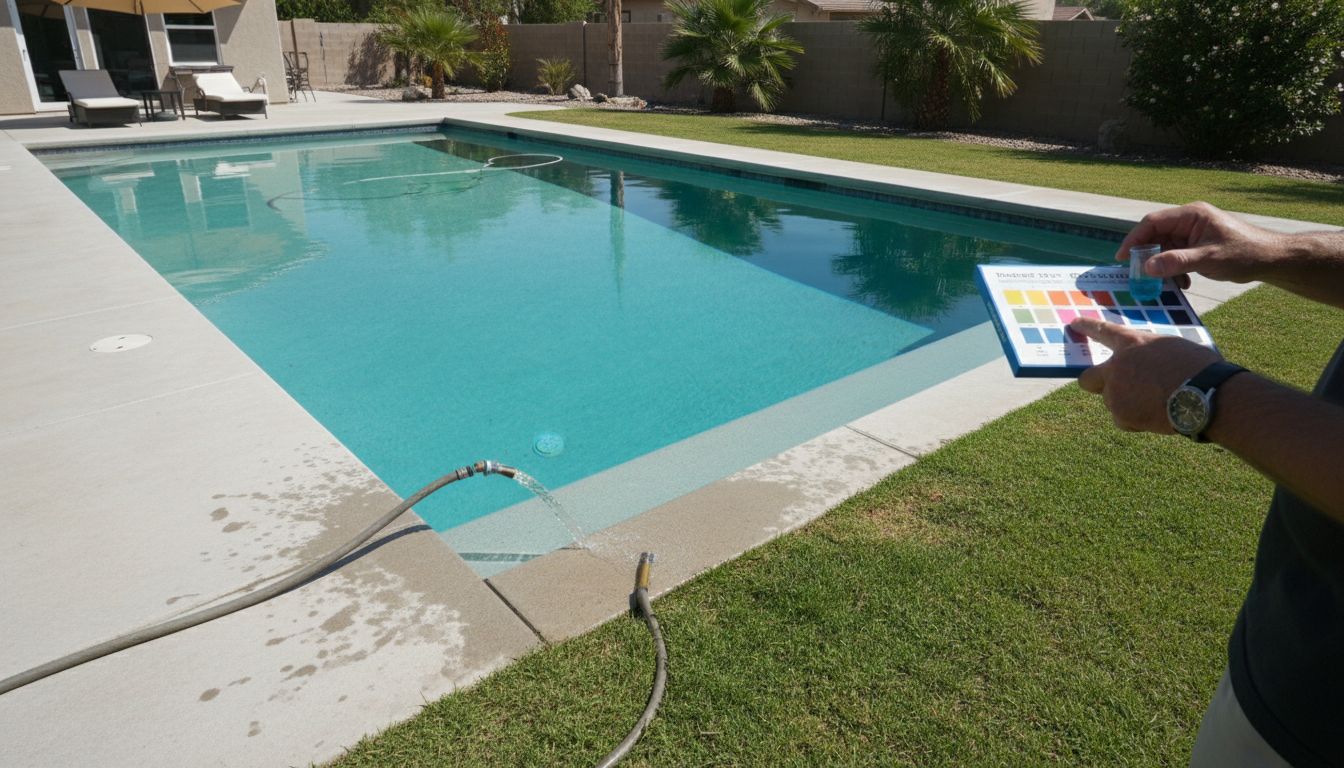
CYA Lost Draining 4 Inches a Week for 8 Weeks From a 20,000-Gallon Pool
You have been watching your pool water level drop four inches every week, topping it back off with fresh water, and quietly wondering what all that dilution is doing to your chemistry. After eight weeks it stops feeling like maintenance and starts feeling like a slow drain on every chemical you have ever added.
Here is the direct answer: a 20,000-gallon pool that loses 4 inches of water per week for 8 weeks and is refilled with fresh water each time will shed roughly 30 to 32 ppm of cyanuric acid, assuming it started at 50 ppm. By the end of the eighth week you are looking at a CYA level closer to 18 to 20 ppm, which is below the recommended floor of 30 ppm and means your chlorine is now burning off faster in sunlight than it should. This article walks through the exact math, explains why it matters, and tells you how much stabilizer to add back once the draining stops.
How Much Water Actually Leaves the Pool Each Week
Before calculating CYA loss, you need to know how many gallons a 4-inch drain actually removes. Pool volume per inch of depth varies with pool shape, but a standard rectangular pool in the 16×32 range holds roughly 320 gallons per inch of depth at the shallow end average. Four inches of drainage removes approximately 1,280 gallons per week.
Over 8 weeks that adds up to 10,240 gallons removed and replaced with fresh water. On a 20,000-gallon pool, you are swapping out roughly 51 percent of the original water volume. That is not a small dilution. That is basically draining half the pool one slow inch at a time. If you have ever been unsure whether water loss is coming from drainage or something else, the pool evaporation vs. leak guide on this site can help you rule out a slow structural leak before you start adding chemicals back.
The CYA Loss Math: Week by Week
CYA loss from draining is not linear in the way you might expect. Each time you drain and refill, you dilute whatever CYA remains, so the absolute amount lost per week shrinks as the season goes on. The formula for each cycle is straightforward: multiply the current CYA reading by the fraction of pool water removed that week.
Starting CYA: 50 ppm. Pool volume: 20,000 gallons. Weekly drain: 1,280 gallons, which is 6.4 percent of 20,000.
- Week 1: 50 ppm minus 6.4% = 46.8 ppm remaining
- Week 2: 46.8 minus 6.4% = 43.8 ppm
- Week 3: 43.8 minus 6.4% = 41.0 ppm
- Week 4: 41.0 minus 6.4% = 38.4 ppm
- Week 5: 38.4 minus 6.4% = 35.9 ppm
- Week 6: 35.9 minus 6.4% = 33.6 ppm
- Week 7: 33.6 minus 6.4% = 31.5 ppm
- Week 8: 31.5 minus 6.4% = 29.5 ppm
After 8 weeks you land at approximately 29 to 30 ppm. If your starting CYA was closer to 60 ppm (common mid-summer with regular trichlor use), the same 8-week dilution schedule leaves you around 35 to 36 ppm, still inside range but trending toward the lower boundary. Start at 70 ppm and you end up near 42 ppm, which is actually ideal. The math punishes low starting levels far more than high ones.
Why Losing CYA Below 30 ppm Is a Real Problem
Cyanuric acid shields chlorine from ultraviolet degradation. Without enough CYA, free chlorine in direct sunlight degrades up to 90 percent in about two hours. The recommended range for outdoor chlorine pools is 30 to 50 ppm, and for saltwater pools some pros push that to 60 to 80 ppm because the salt cell runs continuously. Drop below 30 ppm and you will burn through chlorine noticeably faster, especially in peak summer heat.
On the flip side, too much CYA causes its own headache. Above 80 to 100 ppm, the stabilizer actually binds chlorine so tightly that it cannot sanitize effectively, a situation known as chlorine lock from high cyanuric acid. This is the exact reason that controlled partial draining is a legitimate pool management strategy and not just something you do when the water looks bad. The goal is to keep CYA in the 30 to 50 ppm window, which this 8-week drain schedule can threaten from the low end if you started below 50 ppm.
Comparison: Starting CYA vs. Where You End Up
| Starting CYA (ppm) | CYA After 8 Weeks (ppm) | Total Loss (ppm) | In Range at Week 8? |
|---|---|---|---|
| 30 | 17.7 | 12.3 | No, needs a boost |
| 50 | 29.5 | 20.5 | Borderline, watch it |
| 70 | 41.3 | 28.7 | Yes, ideal |
| 100 | 59.0 | 41.0 | Yes, and now corrected |
Why These Numbers Matter for Your Decision
If your CYA was already elevated before you started draining (say, 80 to 100 ppm from months of trichlor tablet use), this drain schedule is actually doing you a favor. You will land in a healthy range without any intervention. But if you were already at 40 to 50 ppm when you started the weekly draining, you need to plan on adding stabilizer back once the cycle ends. Starting at exactly 30 ppm is genuinely risky: after 8 weeks you are under 18 ppm, which is low enough to measurably increase chlorine consumption and your weekly chemical costs. You can read more about when and how to manage CYA without a full drain if you are trying to fine-tune from the other direction.
How Much Stabilizer to Add Back
The standard dose for granular cyanuric acid is roughly 13 oz (just under 1 lb) per 10,000 gallons to raise CYA by 10 ppm. For a 20,000-gallon pool, that translates to 26 oz (1.6 lbs) per 10 ppm of increase.
Say you started at 50 ppm and finished 8 weeks at 29.5 ppm. You want to return to 40 ppm, so you need a 10.5 ppm boost. That means adding roughly 1.7 lbs of granular stabilizer. Dissolve it in a bucket of warm water first, pour it slowly in front of a return jet with the pump running, and retest after 24 hours. Do not add the full amount all at once if you are trying to hit a specific target: add 80 percent, wait a day, test, then top off. CYA does not fully register on a test strip for 12 to 24 hours after addition. AquaDoc makes a granular stabilizer that dissolves cleanly without clouding the water, which is worth keeping on the shelf if this is a recurring mid-season adjustment for you.
One thing to check before adding anything back: confirm that the draining has actually stopped and the pool is holding its level. If water is still leaving through a slow leak or ongoing backwash cycles, you are adding stabilizer to a moving target. Understanding what to check before fall closing can save you from chasing chemistry that keeps shifting.
Does the Reason for Draining Change the Math?
Whether the water is leaving through a skimmer drain, a backwash cycle, or an intentional partial drain to lower CYA or total dissolved solids, the dilution math is identical. What changes is your awareness of it. Intentional drains mean you planned for this. Accidental loss from a slow leak means you may not have noticed the CYA dropping until something felt off with your chlorine. How often you actually need to drain pool water depends on your TDS, CYA, and calcium hardness levels rather than a fixed schedule, so testing before and after any significant water change is the only way to stay ahead of it.
Evaporation is a common source of confusion here. When water evaporates, only the water molecules leave. Every dissolved chemical, including CYA, stays behind and actually concentrates. Topping off an evaporated pool with fresh water does not lower CYA. Only physically removing water from the pool takes CYA with it.
Frequently Asked Questions
How much CYA does a 20,000-gallon pool lose draining 4 inches a week for 8 weeks?
Starting from 50 ppm, a 20,000-gallon pool loses roughly 20 to 21 ppm of cyanuric acid over 8 weeks of 4-inch weekly drains, landing near 29 to 30 ppm. The loss is smaller in absolute terms if you start at a lower level, but proportionally more damaging because you end up further below the 30 ppm floor.
How much water does a 20,000-gallon pool lose draining 4 inches per week?
A 4-inch drain removes approximately 1,280 gallons per week from a pool in the 16×32 size range. After 8 weeks that totals roughly 10,240 gallons, or about 51 percent of the original water volume replaced with fresh, CYA-free water.
What CYA level is too high and when should you start draining?
The target range for a chlorine pool is 30 to 50 ppm. Most pool professionals recommend a partial drain once CYA exceeds 80 ppm, and consider it urgent above 100 ppm because chlorine efficiency drops sharply. Above 100 ppm, algae can bloom even when free chlorine reads normal on a test strip.
How do I bring CYA back up after draining and refilling a pool?
Add granular cyanuric acid at 13 oz per 10,000 gallons for every 10 ppm increase you need. For a 20,000-gallon pool requiring a 20 ppm boost, that is approximately 3.2 lbs. Dissolve it in a bucket of warm water first, add it near a return jet with the pump running, and retest after 24 hours before adding more.
Does evaporation lower CYA the same way draining does?
No. Evaporation removes only water molecules and leaves all dissolved chemicals behind, so CYA actually increases as evaporation drops the water level. Only physically draining, backwashing, or splashout carries CYA out of the pool. Topping off an evaporated pool with fresh water does not dilute CYA at all.
Eight weeks of 4-inch weekly drains from a 20,000-gallon pool removes roughly 51 percent of your original water and pulls your CYA down by 20 ppm or more depending on where you started, so test your stabilizer level before and after any extended drain cycle and have granular CYA on hand to bring it back into the 30 to 50 ppm range.