
DE Filter Closing Dose for a 24,000-Gallon Pool With a 60 Sq Ft Filter
Closing a 24,000-gallon pool with a 60 sq ft DE filter means getting the DE charge right before you button everything up for winter. Add too little and your filter grids sit unprotected; add too much and you risk a clogged laterals headache in spring. This guide gives you the exact dose, the math behind it, and the step-by-step process so nothing gets skipped.

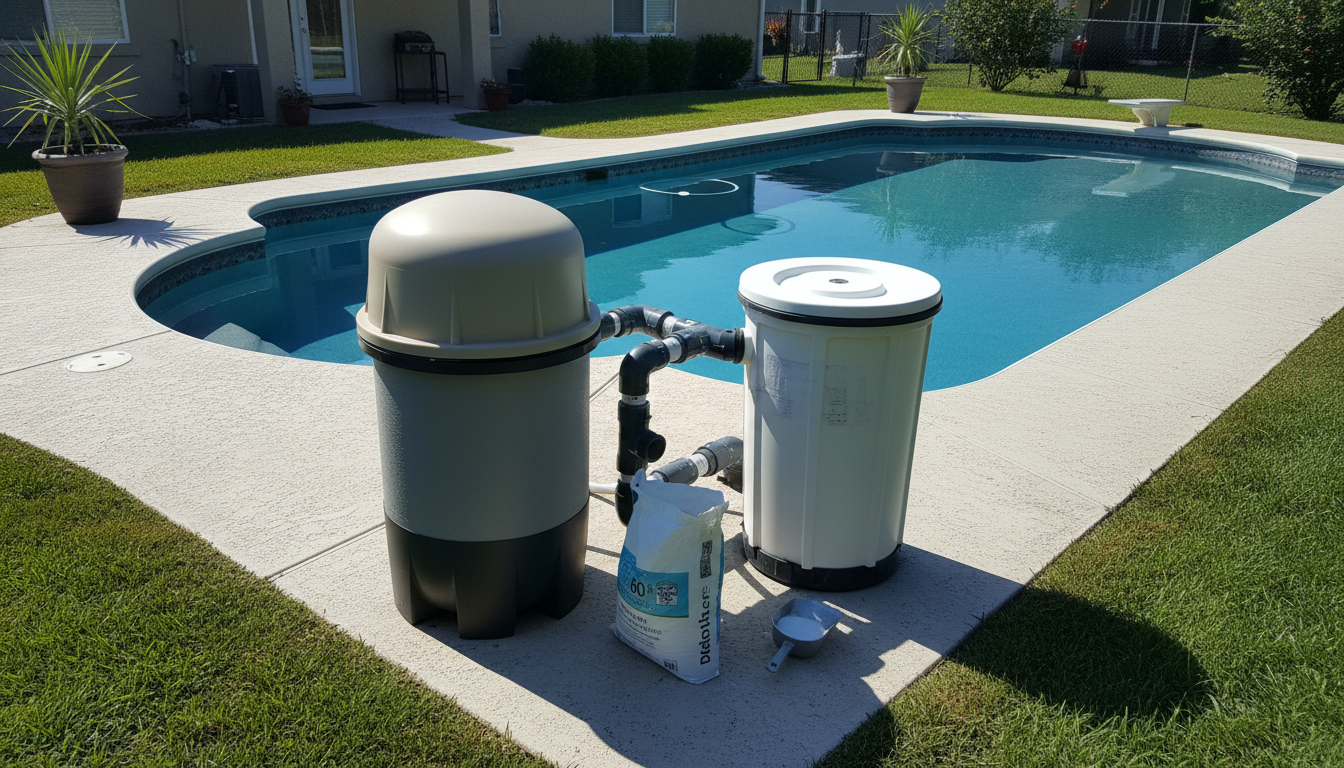
DE Filter Closing Dose for a 24,000-Gallon Pool With a 60 Sq Ft Filter
If you have ever stared at a 50-pound bag of DE powder while your filter is already drained and the cover is half-folded in the driveway, you know closing season has a way of throwing small but annoying questions at the worst possible moment. The DE dose is one of those questions that feels like it should be obvious but never quite is.
For a 60 sq ft DE filter, the standard full charge is 6 pounds of DE powder, using the industry rule of 1 pound per 10 square feet of filter area. When closing a 24,000-gallon pool, you do not need a full charge since the filter will sit dormant all winter. A closing charge of 4 to 5 pounds is enough to coat and protect the grids through one final run cycle before shutdown. This article walks through the math, the step-by-step closing process, and the most common mistakes pool owners make when winterizing a DE filter.
The Math: Where the 6-Pound Number Comes From
DE filter manufacturers rate their units in square feet of filter area, and the universal rule is 1 pound of DE per 10 square feet. Your 60 sq ft filter therefore takes a 6-pound full charge. That math holds whether you own a Hayward, Pentair, or Sta-Rite unit.
Pool volume does not factor into the DE dose at all. Your 24,000-gallon pool could have a 36 sq ft filter or an 84 sq ft filter and the dose would change completely based on the filter, not the water. Where pool volume matters is in choosing the right filter size in the first place, but once you have a 60 sq ft unit installed, the charge is always based on filter area.
At closing specifically, you are not running the filter through a full dirt load, so a slightly reduced charge of 4 to 5 pounds protects the grids without overloading them for a 15-to-20-minute final run. If you want to keep it simple, 5 pounds is a perfectly clean number for a 60 sq ft filter at winterization.
Step-by-Step: Closing a 24,000-Gallon Pool With a DE Filter
- Step 1: Balance the water. Test and adjust pH to 7.2 to 7.6, alkalinity to 80 to 120 ppm, and calcium hardness to 200 to 400 ppm. Low calcium is especially hard on plaster and grids over a long winter.
- Step 2: Shock the pool. Add a closing shock dose (typically 2 lbs of calcium hypochlorite per 10,000 gallons, so about 5 lbs for a 24,000-gallon pool). Run the pump overnight to distribute it fully before moving on.
- Step 3: Add a winter algaecide. A winter-formula algaecide dosed at the label rate for 24,000 gallons gives you a chemical backstop while the pool sits under a cover for months.
- Step 4: Backwash the DE filter completely. Run a full backwash cycle until the sight glass runs clear, then bump the filter if yours has a bump handle. You want to flush out a full season of spent DE and trapped debris before everything freezes in place.
- Step 5: Add a fresh closing DE charge. Return the multiport valve to the filter position, then slowly add 4 to 5 pounds of DE through the skimmer with the pump running. Do this gradually over 60 to 90 seconds so the powder distributes evenly across all the grids.
- Step 6: Run the filter for 15 to 20 minutes. This seats the fresh DE coat on the grids and circulates the treated water one final time.
- Step 7: Shut down and drain. Turn off the pump, drain the filter tank, remove the drain plug, and open the air relief valve. In freezing climates, water left in the tank will crack the housing and ruin the grids.
- Step 8: Blow out the lines and cover. Blow out the skimmer, main drain, and return lines, plug the returns, and lower the water level to the appropriate winter depth before installing the cover.
Full Charge vs. Closing Charge: What Is the Difference?
| Situation | DE Dose (60 sq ft filter) | Reason |
|---|---|---|
| Normal season restart after full backwash | 6 lbs | Full charge needed for active filtration |
| Mid-season partial backwash (bump) | 2 to 3 lbs | Replenish only what was lost |
| Closing charge before winter shutdown | 4 to 5 lbs | Protect grids through one final run, then drain |
| Spring opening after full drain and clean | 6 lbs | Grids are bare after acid wash or rinse |
Why These Differences Matter
A full 6-pound charge makes sense when the filter will run continuously and process real dirt load. At closing, the filter runs for only 15 to 20 minutes before you drain and store it, so a full 6-pound charge is not harmful but is slightly wasteful. The 4-to-5-pound range is the practical sweet spot: enough DE to coat every grid evenly, not so much that excess powder blows back into the pool during that short final run. If you find white powder in the water during that run, you have likely overcharged the filter or added the DE too fast through the skimmer.
Common Mistakes When Closing a DE Filter
- Skipping the backwash: Closing without backwashing first traps spent DE (which is essentially a cake of dirt and dead algae) inside the tank all winter. Come spring, that compacted mass is far harder to break up and flush out.
- Adding DE too fast: Dumping the full dose into the skimmer at once causes clumping. A clump of DE lands on one section of a grid instead of spreading across all surfaces, leaving bare spots that let fine particles through. Slow it down to a steady pour over at least 60 seconds.
- Leaving water in the tank: This is the most expensive mistake. Any standing water in a DE filter tank will freeze and expand, cracking the housing or snapping the internal manifold. Always drain the tank, pull the drain plug, and open the air relief before the first hard freeze. If you are concerned about whether your filter internals look right before buttoning up for winter, it is worth noting that signs of filter media wear show up in similar ways across cartridge and DE units, so give the grids a quick visual inspection while the tank is open.
- Not testing water before shocking: Shocking a pool with pH above 7.8 wastes most of the chlorine. Bring pH into range first, then shock, then circulate before touching the filter.
- Assuming cloudy water is fine under a cover: If the water is hazy before you close, it will be greener when you open. Cloudy water going into winter almost always signals an incomplete shock or a chemistry imbalance that compounds over months of sitting under a cover.
A Note on DE Powder Quality
Not all DE powder performs the same. Pool-grade DE is mined and milled to a specific particle size that coats filter grids evenly and traps particles down to 3 to 5 microns. Garden-grade or food-grade DE has a different particle structure and can reduce filtration efficiency. Use pool-grade DE specifically. AquaDoc makes a pool-grade DE powder that pool owners use for both regular recharges and closing doses because it flows evenly through the skimmer without clumping. Whatever brand you choose, check the label to confirm it is rated for pool filtration use.
Frequently Asked Questions
How much DE do you add to a 60 sq ft filter?
A 60 sq ft DE filter requires 6 pounds of DE powder for a full charge after backwashing. At pool closing, when you will only run the filter for 15 to 20 minutes before draining, a 4-to-5-pound charge is sufficient to coat and protect the grids without overloading the system.
Do you need to add DE when closing a pool for winter?
Yes, add a light DE charge before closing if you plan to run the filter at all during winterization. Without DE on the grids, the fabric runs unprotected and fine debris can embed directly into the weave. A partial charge of 4 to 5 pounds in a 60 sq ft filter is enough for the final run cycle before you drain and store the filter.
How much DE do you add to a 24,000-gallon pool filter after backwashing?
The DE dose depends entirely on your filter’s square footage, not your pool’s volume. For a 60 sq ft filter serving a 24,000-gallon pool, add 6 pounds of DE after a full backwash. For a mid-season partial backwash, add roughly 3 pounds to replenish what was flushed out.
What happens if you put too much DE in a pool filter?
Overcharging a DE filter pushes excess powder back through the return jets, creating a white cloudy haze in the water. It can also compact the filter cake, restrict flow, and spike your filter pressure faster than normal. Stick to 1 pound per 10 sq ft of filter area and add it slowly through the skimmer to avoid both problems.
Should you backwash a DE filter before closing the pool?
Yes, always backwash before closing so you flush out a full season of spent DE and trapped debris before the filter sits dormant all winter. After backwashing, add a fresh 4-to-5-pound closing charge for a 60 sq ft filter, run the pump for 15 to 20 minutes, then shut down, drain the tank completely, and remove the drain plug before your first freeze.
The bottom line: for a 60 sq ft DE filter at closing, add 4 to 5 pounds of pool-grade DE through the skimmer after your final backwash, run the pump for 15 to 20 minutes, then drain the tank completely before any hard freeze. Your filter grids will thank you in spring.