Trichlor Shock Dose for a 10,000-Gallon Indoor Pool With No Sun Exposure
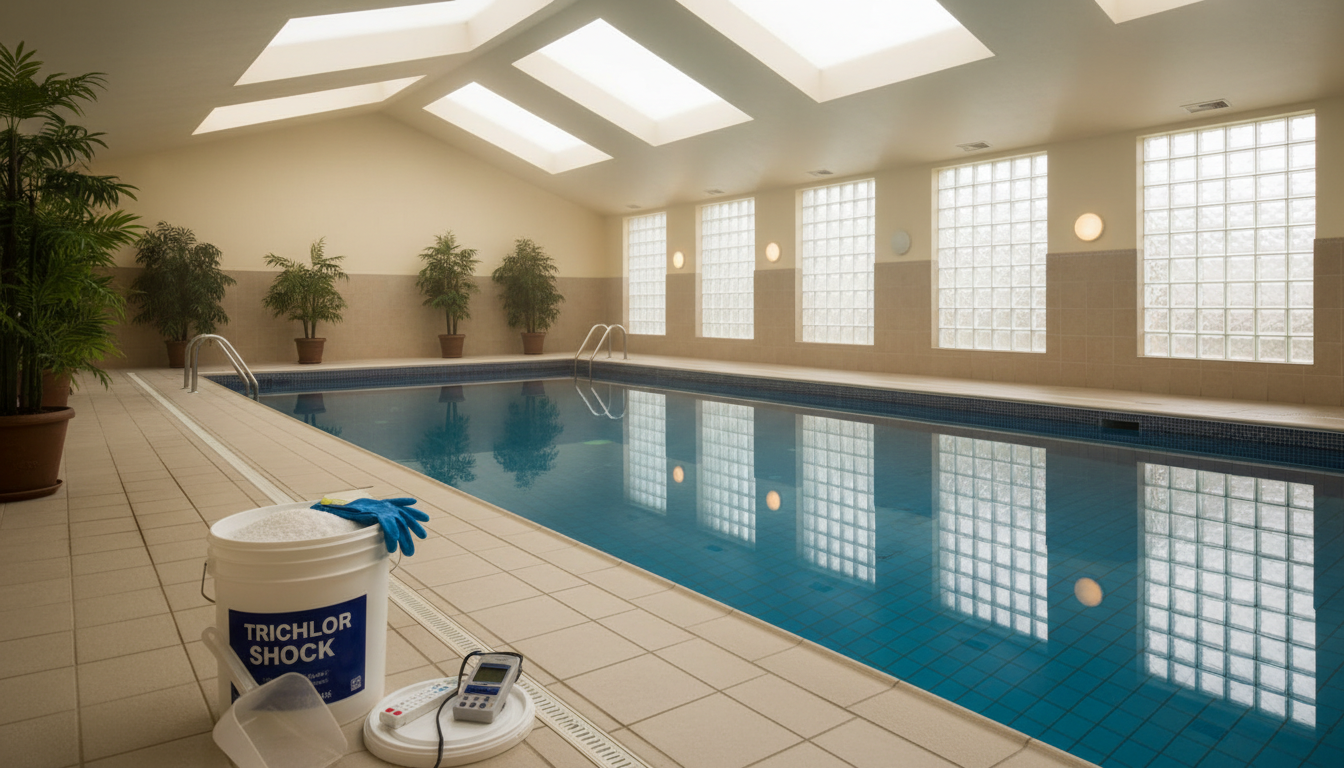
Indoor pools skip the sun, but that changes your trichlor shock math in ways most owners don't expect. CYA accumulates faster with no UV burn-off, and your target dose shifts accordingly. This post walks through the exact numbers for a 10,000-gallon indoor pool.

Trichlor Shock Dose for a 10,000-Gallon Indoor Pool With No Sun Exposure
You bought or built an indoor pool, you love not worrying about sunscreen and weather, and then someone told you to just shock it the same way you would an outdoor pool. If that advice has left you with water that smells like a locker room or a CYA reading that climbed to 80 ppm seemingly out of nowhere, you already know something is off.
The short answer: for a 10,000-gallon indoor pool with no sun exposure, a routine shock dose of trichlor (65-70% available chlorine) is 1.5 lbs to raise free chlorine to approximately 5 ppm. But the dose is only half the story. Indoor pools accumulate cyanuric acid much faster than outdoor pools because there is no UV light to degrade it, which means your shock strategy has to account for CYA creep from the very first treatment. This article walks through the exact math, the CYA problem unique to indoor pools, when to switch shock types, and how to keep your chemistry stable long-term.
Why Indoor Pools Play by Different Rules
Sunlight does two things in an outdoor pool: it destroys free chlorine (which is why outdoor pools need stabilizer) and it very slowly breaks down cyanuric acid over a full season. An indoor pool with no sun exposure gets neither of those effects. Your chlorine lasts longer between doses, which sounds great, but every trichlor product you add still deposits stabilizer into the water. With no UV to chip away at the CYA, the only thing removing it is dilution, meaning draining and refilling. That changes your shock math, your dosing frequency, and which chlorine product makes the most sense over time.
There is also the chloramine problem. Outdoors, UV light oxidizes some combined chlorine (chloramines) passively. Indoors, those chloramines linger and build up faster. Chloramines are what cause the sharp, eye-stinging “chlorine smell” that is actually a sign of too little active chlorine, not too much. Shocking breaks chloramines apart, which is why indoor pools often need to be shocked on a tighter schedule than their outdoor equivalents.
The Math: Exact Trichlor Dose for 10,000 Gallons
Trichlor shock products typically run 65-70% available chlorine. At 65% available chlorine, 1 lb of trichlor delivers roughly 0.78 lbs of actual chlorine, which raises free chlorine in 10,000 gallons by about 9 ppm in a vacuum (before demand). In real water with existing chlorine demand from bathers, organics, and off-gassing, the usable lift is lower. Here is how to work the numbers for the most common scenarios:
- Routine weekly shock (target: 5 ppm FC): Add 1.5 lbs of 65% trichlor shock to 10,000 gallons. This accounts for chlorine demand and brings you to a clean 5 ppm starting point.
- Algae outbreak or heavy bather load (target: 10 ppm FC): Add 3 lbs of 65% trichlor shock. Test after 4 hours and re-dose if you have not held above 5 ppm.
- Breakpoint chlorination to eliminate chloramines (target: 10x combined chlorine reading): If your combined chlorine (CC) reads 0.5 ppm, you need to push free chlorine to at least 5 ppm. If CC is at 1.0 ppm, target 10 ppm FC. Use the 3 lb dose as your starting point and test on the way up.
Say your 10,000-gallon indoor pool currently reads 1.0 ppm FC and 0.8 ppm CC. That combined chlorine level means your water smells and is not sanitizing efficiently. To hit breakpoint, you need FC at 8 ppm minimum. Starting from 1.0 ppm, you need to raise FC by 7 ppm, which takes roughly 2.2 lbs of 65% trichlor shock. Round to 2.5 lbs, run the pump for 2 hours, then retest before anyone swims.
The CYA Problem: Why It Matters More Indoors
Every pound of trichlor shock you add to a 10,000-gallon pool also adds approximately 6 ppm of cyanuric acid. Outdoors in full sun, some CYA degrades over a swim season. Indoors, it does not. If you shock 1.5 lbs per week for 10 weeks, you have added 90 ppm of CYA to that pool. At 80 ppm and above, cyanuric acid over-stabilizes your chlorine, meaning the chlorine is technically present but largely inactive. You end up shocking more to get the same effect, which adds more CYA, and the cycle gets away from you fast.
For an indoor pool, keep CYA between 20 and 50 ppm. There is no UV chlorine destruction to protect against, so you do not need 50-80 ppm the way an outdoor pool might. Test CYA every 4-6 weeks. If it climbs past 50 ppm, the only fix is a partial drain and refill. Draining 25% of a 10,000-gallon pool (2,500 gallons) and refilling with fresh water will typically drop CYA by about 25%, enough to bring a 60 ppm reading back to 45 ppm. If you find yourself draining constantly, that is a signal to switch to a CYA-free shock form for most of your treatments. The article on why pool shock fails covers several of these chemistry traps in detail.
Trichlor vs. Other Shock Options for Indoor Pools
Trichlor is not automatically the best choice for an indoor pool. Here is how the common shock types compare:
| Shock Type | Available Chlorine | Adds CYA? | Adds Calcium? | Best For Indoor Pool Use? |
|---|---|---|---|---|
| Trichlor (65-70%) | 65-70% | Yes (~6 ppm per lb per 10k gal) | No | Occasional use only; watch CYA |
| Cal-Hypo (65-73%) | 65-73% | No | Yes (~7 ppm per lb per 10k gal) | Good for shocking; monitor calcium |
| Sodium Dichlor (56-62%) | 56-62% | Yes (~9 ppm per lb per 10k gal) | No | Worse CYA impact than trichlor |
| Liquid Chlorine (10-12%) | 10-12% | No | No | Best for routine indoor shocking |
Why These Differences Matter
For a 10,000-gallon indoor pool you shock every week, the CYA column is the one that should drive your decision. Trichlor adds 6 ppm of CYA per pound per 10,000 gallons. Use it for 20 weeks straight and you have added 180 ppm of CYA from shock alone, which is unmanageable. If you want to keep trichlor in your rotation, use it no more than once or twice a month and fill the other weeks with liquid chlorine or cal-hypo. AquaDoc’s cal-hypo shock is one product indoor pool owners use for this reason: it delivers a strong, clean hit of chlorine without stacking stabilizer into water that has nowhere to burn it off.
Cal-hypo raises calcium hardness by about 7 ppm per pound per 10,000 gallons, so keep an eye on calcium levels (target 200-400 ppm for a plaster pool, 175-225 ppm for vinyl or fiberglass). That is a manageable trade-off for most indoor pools. Liquid chlorine adds neither CYA nor calcium and is the cleanest option, though it is bulkier to store and has a shorter shelf life.
Step-by-Step: How to Shock an Indoor 10,000-Gallon Pool Correctly
- Test first. Check FC, CC, pH, and CYA before adding anything. You cannot calculate how much shock you need without knowing where you are starting.
- Adjust pH to 7.2-7.4. Chlorine is far more active at lower pH. At pH 8.0, roughly 20% of your chlorine is in the active hypochlorous acid form. At pH 7.2, it is closer to 65%. Do not skip this step.
- Calculate your dose. Use 1.5 lbs of 65% trichlor shock to raise FC by approximately 4-5 ppm in 10,000 gallons, accounting for typical demand. Add 0.5 lbs for every additional ppm you need.
- Pre-dissolve in a bucket. Fill a 5-gallon bucket with pool water, add the trichlor shock granules, stir until fully dissolved, then pour slowly around the perimeter of the pool. Never add granules directly to the skimmer.
- Run the pump for at least 2 hours. Circulate before testing. Trichlor dissolves and mixes more slowly than liquid chlorine.
- Retest before anyone swims. Free chlorine should be below 5 ppm before swimmers enter. Indoor pools with limited air circulation can concentrate chlorine gas near the surface, so do not rush re-entry.
- Log your CYA after every shock. Even one shock treatment adds 9 ppm of CYA to a 10,000-gallon pool. Keep a running total so you know when you are approaching 50 ppm.
Understanding how pool volume connects to chemical dosing is one of those foundational things that makes every other decision easier. If you ever size up or change pool shapes, the post on how many gallons an 18×36 inground pool holds and what that means for chemicals walks through the volume-to-dose relationship clearly.
Common Mistakes Indoor Pool Owners Make When Shocking
- Assuming outdoor doses apply directly: Outdoor shock guidance often accounts for heavy UV chlorine loss. Indoor pools hold chlorine longer, so you may need less frequent shocking, but when CYA climbs, you need more per dose. The two effects work against each other.
- Never testing CYA: Many indoor pool owners test FC and pH religiously but ignore CYA for months. By the time they test, CYA is at 90 ppm and the only fix is a significant drain-and-refill.
- Shocking with the pump off: Granular trichlor will settle on the floor and bleach vinyl liners or etch plaster. Always run the pump during and after shocking.
- Skipping breakpoint math: Adding a token half-pound of shock when CC is elevated does not reach breakpoint chlorination. You need 10 times the CC reading in FC to break chloramines apart. Underdosing gives you chloramines plus wasted chemical.
- Not accounting for air circulation: Indoor pools with poor ventilation can accumulate chlorine gas above the water surface. If your pool room smells sharp after shocking, improve air circulation before adding more chemical – the issue may be chloramines in the air, not low chlorine in the water.
Frequently Asked Questions
How much trichlor shock should I add to a 10,000-gallon indoor pool?
For a routine shock to reach 5 ppm free chlorine, add roughly 1.5 lbs of trichlor shock (65-70% available chlorine) to a 10,000-gallon indoor pool. Because there is no UV to burn off chlorine or stabilizer, your chlorine holds longer but CYA climbs steadily, so test both before each shock treatment and adjust if CYA is already above 50 ppm.
What free chlorine level should I target when shocking an indoor pool?
Target 5 ppm free chlorine for a routine shock in an indoor pool. If you are dealing with algae or a heavy bather load, push to 10 ppm. Indoor pools do not lose chlorine to sunlight the way outdoor pools do, so you rarely need to exceed 10 ppm, and you should wait for FC to drop below 5 ppm before allowing swimmers back in.
Does CYA build up faster in an indoor pool using trichlor?
Yes, significantly faster. Every pound of trichlor adds roughly 6 ppm of cyanuric acid per 10,000 gallons, and without UV exposure there is no natural degradation to offset it. Test CYA monthly in an indoor pool and plan a partial drain when it exceeds 50 ppm. At that point, dilution is the only reliable fix.
Can I use trichlor shock in an indoor pool, or should I switch to cal-hypo?
You can use trichlor, but because CYA accumulates with no UV degradation, many indoor pool operators use cal-hypo or liquid chlorine for most shock treatments and reserve trichlor for occasional use. Those forms add no stabilizer, keeping CYA from creeping past the 50 ppm threshold where it starts to cripple chlorine effectiveness.
How often should I shock a 10,000-gallon indoor pool?
Shock an indoor 10,000-gallon pool every 1-2 weeks under normal use, or immediately after heavy swimmer traffic or any visible cloudiness. Indoor pools produce chloramines faster because there is no UV oxidation to assist, and keeping combined chlorine below 0.5 ppm is especially important in an enclosed space where those compounds accumulate in the air above the water as well.
The bottom line: use 1.5 lbs of trichlor shock per 10,000 gallons for a routine indoor pool shock, but track your CYA every month, keep it under 50 ppm, and rotate in cal-hypo or liquid chlorine regularly so stabilizer does not build to levels that make your chlorine largely useless.