How to Raise Calcium Hardness in a Vinyl Liner Pool Without Clouding the Water
Low calcium hardness in a vinyl liner pool can wrinkle the liner and corrode metal fittings, but adding calcium chloride the wrong way turns the water milky white. This guide walks through the right dose, the right method, and how to raise hardness gradually without clouding the water.

How to Raise Calcium Hardness in a Vinyl Liner Pool Without Clouding the Water
You test your water, see that calcium hardness is reading 80 ppm, and think “I’ll just dump some calcium chloride in and fix it.” Twenty minutes later the pool looks like someone filled it with skim milk. If that sounds familiar, you are not alone – clouding after adding calcium increaser is one of the most common chemistry mistakes pool owners make.
The fix is straightforward in principle: raise calcium hardness in a vinyl liner pool by pre-dissolving calcium chloride in a bucket, adding it slowly with the pump running, and limiting each dose to a 25 to 30 ppm increase before retesting. The target range for a vinyl liner pool is 175 to 225 ppm – lower than the 200 to 400 ppm range you need for plaster, because vinyl does not leach calcium the way plaster does. This article walks through the correct dose calculation, the pre-dissolving method that prevents cloudiness, how to space out multiple doses, and what to check before you add anything.
Why Calcium Hardness Matters More Than You Might Think
Soft water – anything below about 150 ppm – is chemically hungry. It will pull dissolved minerals from any surface it contacts: metal fittings, ladder rails, pump impellers, and even the vinyl liner itself. As the team at Richmond Pool and Spas explains, low calcium over time causes vinyl liners to absorb water unevenly, which leads to wrinkling, stretching, and premature aging. On the equipment side, corroded fittings and etched metal show up faster than most owners expect.
Going too high is also a problem. Above 300 ppm in a vinyl pool, calcium starts scaling on the liner surface and on your salt cell if you have one. The 175 to 225 ppm sweet spot is where the water is satisfied and leaves everything alone. For more background on what these numbers mean across different pool types, the guide on calcium hardness in pools and how to adjust it covers the full picture.
What Causes the Cloudy Water in the First Place
Calcium chloride dissolves in water in an exothermic reaction – it generates real heat. When you pour it directly into the pool in a large undiluted mass, two things happen at once: the immediate area gets very hot, and the calcium concentration spikes locally to hundreds of ppm before the pump can distribute it. If your pH and alkalinity are already on the high side, the calcium hits carbonate ions and crashes out as calcium carbonate particles. Those particles are what you see as cloudiness, and they can take days to clear.
The Deep Blue Pool and Spa team puts it well: adding calcium chloride to warm water at high pH is practically a recipe for a white cloud. The solution is not a different product – it is a different method.
Check These Numbers Before You Add Anything
Adding calcium into water that is already out of balance amplifies every problem. Before you open the bag of calcium increaser, test and confirm the following:
- pH: Keep it between 7.4 and 7.6. High pH (above 7.8) dramatically increases the chance of calcium carbonate precipitation and cloudiness.
- Total Alkalinity: Should be 80 to 120 ppm. High alkalinity means more carbonate available to react with calcium – more cloudiness risk.
- Water Temperature: Cooler water (below 70°F) dissolves calcium more slowly. Work in smaller increments on cold days.
- Current Calcium Hardness: You need an accurate baseline to calculate your dose. A reagent-based test kit gives a more reliable reading than a strip. If you are not sure how to run this test, the article on how to test pool water for calcium levels walks through the process step by step.
Step-by-Step: How to Add Calcium Chloride Without Clouding the Pool
- Calculate your dose. The standard rule: 1.25 lbs of calcium chloride dihydrate (the common 77-78% product) raises calcium hardness by about 10 ppm in 10,000 gallons. Limit each single treatment to a 25 to 30 ppm increase – that means no more than 3 to 4 lbs per 10,000 gallons per dose.
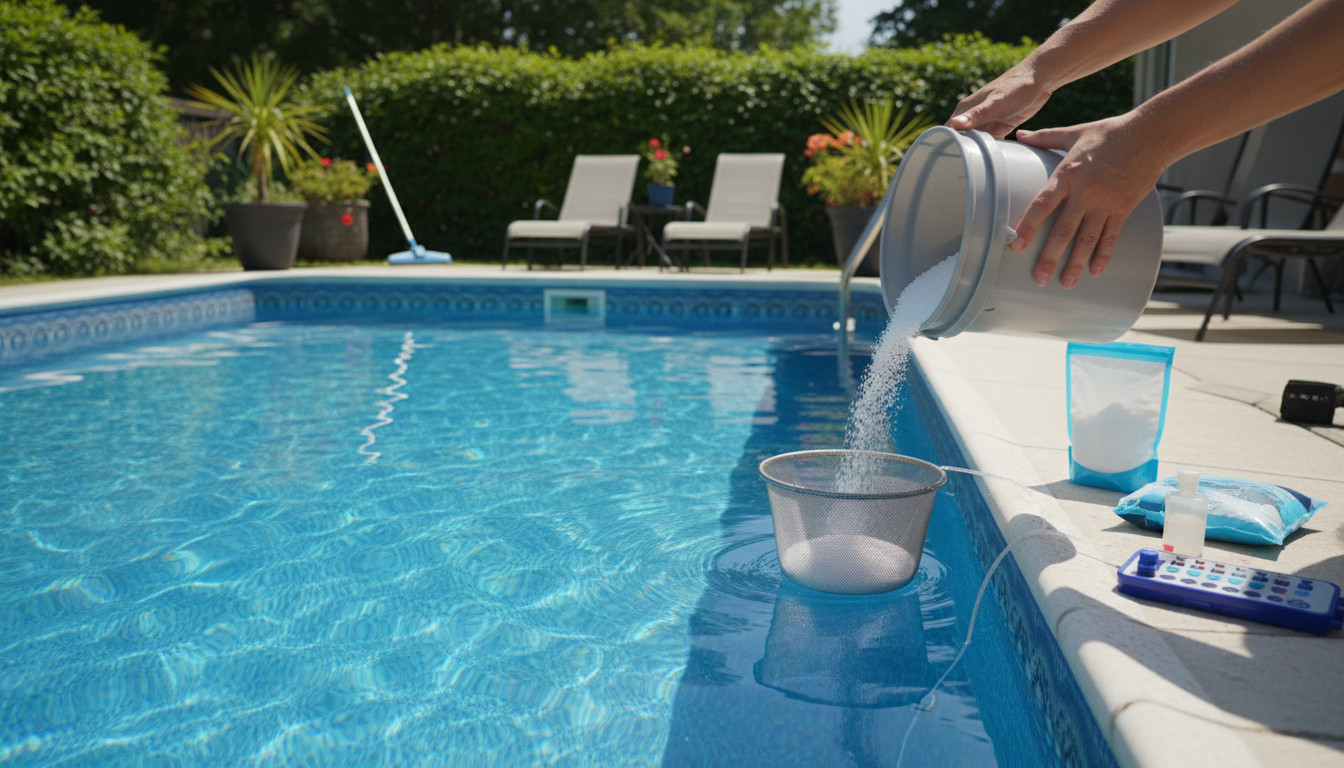
- Pre-dissolve in a bucket. Fill a 5-gallon bucket two-thirds full with pool water. Slowly pour the measured calcium chloride into the bucket – never the reverse, which can cause a violent heat reaction. Stir until fully dissolved. The water will get noticeably warm; that is normal.
- Run the pump. Your circulation pump should be running and has been running for at least 30 minutes before you add anything. Full circulation is what distributes the calcium evenly instead of letting it pool in one spot.
- Pour slowly around the perimeter. Walk the bucket around the pool edge and pour the dissolved solution in a slow, steady stream. Keep moving; do not dump it all in one corner.
- Wait 4 to 6 hours before retesting. Let the pump circulate fully before you test again. Then retest and decide if a second dose is needed.
- Repeat in increments. If you need to raise hardness by more than 30 ppm, do it over multiple days. One dose per day is a safe pace.
A Worked Example: 20,000-Gallon Pool at 100 ppm Hardness
Say you have a 20,000-gallon vinyl liner pool and your test shows calcium hardness at 100 ppm. Your target is 200 ppm, so you need to raise it by 100 ppm total. At 1.25 lbs per 10 ppm per 10,000 gallons, raising 10 ppm in 20,000 gallons takes 2.5 lbs. To raise 100 ppm total, you need 25 lbs – but you are not adding that all at once.
Day 1: Dissolve 7.5 lbs (raises hardness roughly 30 ppm, landing around 130 ppm). Retest that evening. Day 2: Another 7.5 lbs, landing around 160 ppm. Day 3: Another 7.5 lbs, landing around 190 ppm. Day 4: A smaller 2.5 lb dose to nudge it to 200 ppm and confirm with a test. Four days, zero cloudy water. AquaDoc’s calcium hardness increaser is formulated to dissolve cleanly and is one option pool owners use for this kind of multi-day correction.
What to Do If the Water Clouds Anyway
If you see cloudiness after adding calcium, run the pump continuously for 24 hours and backwash or clean the filter after that cycle. Most calcium carbonate haze clears on its own within 24 to 48 hours once the dose is distributed and the filter captures the fine particles. If cloudiness persists past 48 hours, test pH – it may have crept above 7.8 during the process. Lower it with muriatic acid, then let the filter do its work. Do not add clarifier immediately, as it can bind calcium particles in a way that clogs cartridge filters aggressively.
As Cincinnati Pool and Patio notes, patience is the real tool here – rushing the process is what creates the problem, and giving the water time to stabilize is what fixes it. Caring for a vinyl liner pool well also means staying on top of the full range of chemistry checks; for a broader look at liner-specific maintenance, Prestige Pools outlines the key practices worth building into your routine.
Frequently Asked Questions
What is the ideal calcium hardness level for a vinyl liner pool?
The target range for a vinyl liner pool is 175 to 225 ppm. Concrete and plaster pools need higher levels (200 to 400 ppm) because plaster leaches calcium, but vinyl does not, so you can stay on the lower end of the spectrum without any risk to the surface.
How much calcium chloride do I need to raise hardness by 50 ppm in a 15,000-gallon pool?
To raise calcium hardness by 50 ppm in a 15,000-gallon pool, you need approximately 18.75 lbs of calcium chloride dihydrate (the common 77-78% product). Do not add it all at once – split it into two doses across two days, pre-dissolving each dose in a bucket before adding it to the pool.
Why does my pool water turn cloudy after adding calcium chloride?
Clouding almost always happens because calcium chloride was poured in too quickly, in too large a dose, or into water where pH and alkalinity were already elevated. The calcium reacts with dissolved carbonates and precipitates out as fine calcium carbonate particles, turning the water milky. Pre-dissolving in a bucket and raising hardness in increments of 25 to 30 ppm per dose prevents this reaction.
Can low calcium hardness damage a vinyl liner?
Yes. Water below 150 ppm is aggressive and will pull minerals from metal fittings, pump components, and ladder rails. Over time it also causes the liner to absorb water unevenly, leading to wrinkling and premature aging. Keeping hardness at 175 ppm or above protects both the liner and the equipment.
How do I raise calcium hardness in a vinyl liner pool without a cloudy mess?
Pre-dissolve calcium chloride in a bucket of pool water, raise hardness no more than 25 to 30 ppm per dose, wait 4 to 6 hours between doses, and confirm that pH is between 7.4 and 7.6 and alkalinity is in the 80 to 120 ppm range before you start. Run the pump continuously the entire time so the solution distributes evenly rather than sitting in one spot.
The short version: pre-dissolve, go slow, and fix pH first. Those three steps are almost always the difference between clear water and a milky pool after a calcium correction.